
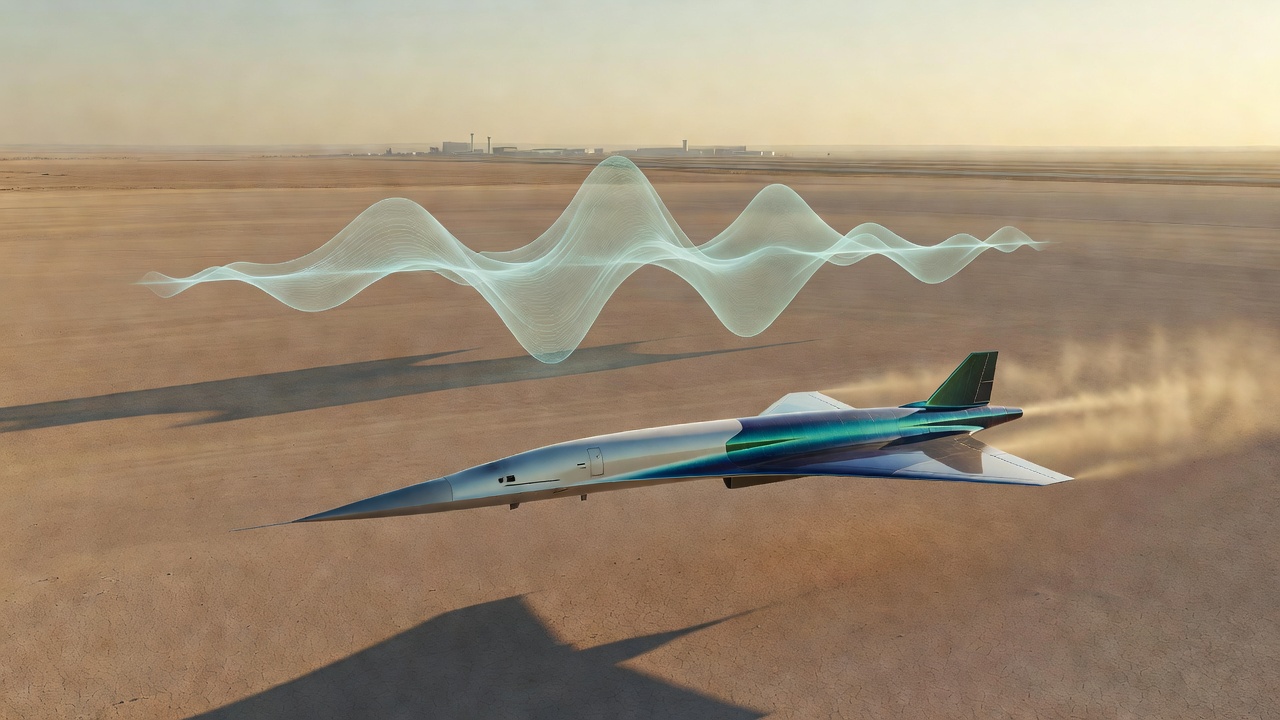
The Federal Aviation Administration has proposed new rules that would permit supersonic passenger jets to operate over the United States, provided the aircraft produce sonic booms quiet enough to avoid disturbing people on the ground. This marks a significant policy shift after decades of strict prohibition on civilian supersonic flight over land, a restriction rooted in the noisy and often destructive sonic booms generated by aircraft like the Concorde. According to reporting from Ars Technica, the agency’s notice of proposed rulemaking outlines specific noise thresholds and certification processes that manufacturers must meet before gaining approval for overland routes.
Supersonic travel has long captured public imagination. The ability to cross the Atlantic in under four hours instead of seven or eight offers clear advantages for business travelers, diplomats, and anyone who values time. Yet practical barriers have persisted. When the Concorde entered service in 1976, its sonic boom proved so disruptive that most nations banned it from flying supersonically over their territory. The aircraft was largely confined to transatlantic routes between London or Paris and New York or Washington. Even on those paths, the boom could be heard as a sharp double crack that rattled windows and startled residents. By the time the fleet retired in 2003, only a handful of routes remained viable, and the plane’s high operating costs, combined with limited seating, made it a niche luxury rather than a broadly accessible mode of transport.
Modern developers believe technology has advanced enough to change that equation. Companies such as Boom Supersonic, Spike Aerospace, and Aerion Supersonic have spent years designing aircraft intended to create far gentler pressure waves. Rather than the abrupt N-wave signature of older supersonic jets, these new designs aim for a smoother, more rounded pressure profile that translates into a soft thump or distant rumble rather than a startling explosion. NASA’s X-59 QueSST experimental aircraft, currently undergoing flight tests, serves as a key proof-of-concept for this quieter approach. The plane’s elongated nose and carefully shaped airframe are engineered to reshape the shock waves so they dissipate before reaching the surface with significant intensity.
The FAA’s proposal sets out measurable standards. Under the new framework, supersonic aircraft would need to generate sonic booms no louder than 75 PLdB at ground level during cruise. For context, that figure sits roughly between the sound of a car door closing and moderate thunder. The agency also proposes allowing limited operations over certain sparsely populated areas at higher noise levels during initial testing phases, provided operators collect data on community response. This data would feed into future refinements of the regulation. Manufacturers would submit their aircraft for type certification that includes both traditional airworthiness requirements and new acoustic performance demonstrations using ground microphone arrays and atmospheric modeling.
Supporters argue the move could revive American leadership in commercial aviation. The United States once dominated the field with the development of the Boeing 747 and other widebody jets that defined long-haul travel. Supersonic capability slipped away after the government canceled the national supersonic transport program in 1971. Today, several startups headquartered in the US are racing to build the next generation of high-speed airliners. Boom Supersonic, based in Colorado, has raised substantial funding and signed letters of intent with airlines including United and American. Its Overture aircraft is designed to carry 64 to 80 passengers at Mach 1.7, burning sustainable aviation fuel to address environmental concerns. If the FAA’s rule is finalized, these companies could pursue certification pathways that were previously closed.
Critics, however, raise multiple concerns. Environmental groups worry about increased carbon emissions from flying at supersonic speeds, which require more thrust and therefore more fuel per passenger mile than subsonic jets. Even with sustainable fuels, scaling production remains challenging. Noise advocates point out that 75 PLdB may still prove annoying when heard repeatedly throughout the day. A single event might be tolerable, but regular overflights could affect sleep, wildlife behavior, and quality of life in communities beneath flight corridors. The proposal acknowledges these issues by requiring operators to publish route information and establish community engagement programs, though details on enforcement remain vague.
The regulatory process itself reflects lessons learned from earlier efforts. In the 1960s and 1970s, sonic boom research relied on limited test flights and anecdotal reports. Modern measurement techniques, computer simulation, and extensive community surveys allow regulators to set standards grounded in better science. The FAA plans to incorporate data from NASA’s X-59 flights, which will generate thousands of sonic booms over select US cities and rural areas. Residents in those test corridors will be asked to report their reactions through structured surveys. This empirical approach aims to replace the blanket prohibition with a performance-based standard that rewards quieter designs.
Economic implications could prove substantial. Supersonic flight might open new city pairs that are currently too distant for comfortable same-day business travel. A flight from New York to London in three and a half hours would allow executives to attend morning meetings in Europe and return home for dinner. Transpacific routes could similarly shrink, bringing Los Angeles and Tokyo within comfortable reach for day trips. Cargo operators have also expressed interest in supersonic transport for time-sensitive goods such as medical supplies, high-value electronics, and fresh seafood. Smaller business jets capable of supersonic speeds could serve the private aviation market first, providing early revenue while larger airliners complete certification.
Challenges remain formidable. Developing an engine that operates efficiently across subsonic, transonic, and supersonic regimes demands sophisticated variable-cycle designs. Materials must withstand extreme aerodynamic heating at sustained high Mach numbers. Interior cabin pressure, temperature control, and window design all require fresh engineering solutions. Certification under both FAA and European Union Aviation Safety Agency rules will demand years of testing. Supply chains for exotic materials and specialized components are still immature. Despite these hurdles, recent progress in computational fluid dynamics, advanced composites, and additive manufacturing has shortened development timelines compared with previous generations.
Public perception will play a decisive role. Many Americans associate sonic booms with military training flights and may view civilian versions with suspicion. Effective outreach programs that explain the reduced noise levels and demonstrate the aircraft’s environmental safeguards could help build acceptance. Transparent flight tracking, similar to current commercial aircraft monitoring, would allow citizens to understand when and where supersonic operations occur. The FAA proposal includes provisions for noise monitoring networks that could provide real-time data to both regulators and the public.
International coordination adds another layer of complexity. While the United States can set domestic rules, overwater supersonic flight still requires agreement from destination countries. The International Civil Aviation Organization has been updating its sonic boom standards, but adoption by individual nations will take time. Bilateral negotiations may be necessary to establish acceptable corridors and noise limits for arrivals and departures. Japan, for example, has shown interest in supersonic technology and may welcome quiet designs, while some European nations remain cautious about environmental impact.
The proposal represents more than a technical adjustment; it signals renewed institutional confidence that engineering solutions can overcome the historical drawbacks of supersonic passenger travel. If successful, the regulations could pave the way for regular scheduled supersonic service within the next decade. Airlines would need to balance premium pricing against the value of time saved. Early adopters might include corporate travel departments and high-net-worth individuals, with broader market penetration depending on ticket prices and proven reliability.
Safety considerations receive prominent attention in the rulemaking. Supersonic aircraft must demonstrate handling qualities during the critical transonic acceleration phase, where shock waves form and move across the airframe. Engine-out performance at high speed, structural integrity under sustained aerodynamic heating, and emergency descent procedures all require validation. The FAA intends to adapt existing certification methods where possible while creating new test protocols for boom-related phenomena.
Looking ahead, the interaction between regulatory approval and market forces will determine the pace of adoption. Should early flights demonstrate both quiet operation and acceptable environmental performance, additional investment could accelerate. Conversely, any high-profile incidents or community backlash might slow momentum. The coming years of flight testing, certification campaigns, and public trials will provide the data necessary to refine both the aircraft and the rules that govern them.
The FAA’s proposal opens a carefully regulated door to supersonic flight over American cities and countryside. By tying permission to measurable noise performance rather than outright prohibition, the agency seeks to balance innovation with protection of the public and environment. Whether the industry can deliver on the promise of acceptably quiet, efficient, and safe supersonic airliners remains to be seen, but the regulatory foundation is now being laid. Manufacturers, airlines, researchers, and communities will all play roles in shaping how, or if, this technology becomes part of everyday air travel. The outcome could influence not only how Americans fly but how the world approaches high-speed commercial aviation for decades to come.


 WebProNews is an iEntry Publication