
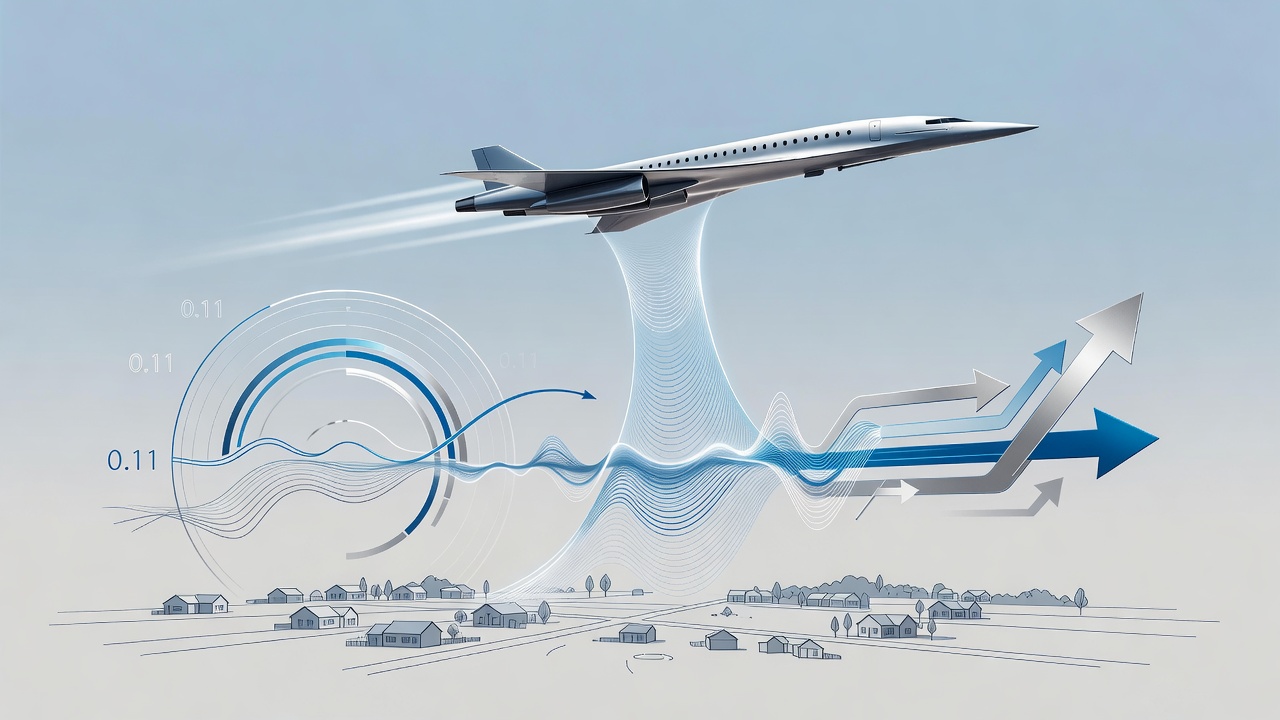
The Federal Aviation Administration just took a concrete step toward bringing routine supersonic travel back to American skies. On June 30, 2026, the agency released a notice of proposed rulemaking that would repeal the 1973 prohibition on civil aircraft flying faster than Mach 1 over land. In its place sits a performance-based standard. Sonic boom overpressure at the surface must stay at or below 0.11 pounds per square foot.
That threshold draws from real flight data. The NPRM itself points to Boom Supersonic’s February 2025 demonstration of “boomless cruise” with its XB-1 test aircraft. The plane hit Mach 1.18. Shock waves refracted upward. Ground observers registered nothing above background noise. NASA’s X-59 Quiet Supersonic Technology demonstrator supplied additional validation through its own test flights.
Transportation Secretary Sean P. Duffy framed the move in straightforward terms. “Thanks to massive innovations in supersonic technology, it will be possible to safely operate these innovative aircraft without a sonic boom,” he said in the FAA announcement. The proposal aligns with a June 2025 executive order from President Trump directing the agency to clear outdated barriers.
But don’t expect New York to Los Angeles flights in under three hours next year. The rule sets an interim en-route noise limit only. A separate proposal covering landing and takeoff noise standards is slated for later this year. Both aim for finalization by mid-2027. That pace reflects congressional pressure. The House passed the Supersonic Aviation Modernization Act in March 2026. It required the FAA to update rules within a year so long as no sonic boom reaches the ground.
The current regulation, codified at 14 CFR § 91.817, dates to the Concorde era. It banned overland supersonic flight outright after public complaints about window-rattling booms. Military aircraft received exemptions. Civil operators did not. Fifty-three years later the FAA calls that blanket prohibition outdated. Technological progress now allows operators to manage shock waves so they never strike the surface with damaging force.
Here’s how the new standard would work. Operators must demonstrate compliance through measurement, computer modeling or a combination the FAA approves. They also need to show they possess the means to maintain that performance in day-to-day operations. Altitude, speed, atmospheric conditions—all factor in. The agency would issue a formal finding once satisfied. Limitations could attach to the approval. Think weather restrictions or specific corridors.
Secondary booms get attention too. These refracted or reflected waves sometimes reach the ground far from the flight path. The proposal defines primary and secondary sonic booms explicitly in 14 CFR Part 1 and applies the same 0.11 psf limit to both. It draws on 1980s research from the National Transportation Safety Committee as well as recent NASA work on evanescent waves that fade before hitting the earth.
Aviation Week examined the implications days after release. The interim rule would let manufacturers like Boom Supersonic test and eventually operate their aircraft beyond isolated military ranges. Boom’s Overture airliner, designed for 64 to 80 passengers at Mach 1.7, now has a clearer regulatory path toward 2030 service entry. Yet the publication notes that real certification still requires the landing and takeoff rule. Without it, airlines cannot gain full type certification. Aviation Week reported on June 30, 2026.
AIN Online offered additional context. The piece highlighted how the 0.11 psf figure stems from NASA’s Flight Acoustic Integration and Noise Testbed studies. Those tests confirmed Mach cutoff operations keep primary booms from forming audible signatures on the ground. The article also noted four companies already hold special flight authorizations for supersonic testing: Boom, Hermeus, Scaled Composites and one Gulfstream program. The new framework could reduce reliance on those case-by-case approvals for routine operations. AIN Online detailed the announcement on June 30, 2026.
Forbes captured the broader excitement. The publication tied the proposal directly to Trump administration policy and quoted FAA Administrator Bryan Bedford saying technological advances “will eliminate the old sonic boom.” Travel times could drop dramatically. A transcontinental flight that now takes five and a half hours might shrink to three. Cargo movement would speed up too. Still, Forbes cautioned that public acceptance hinges on proving the noise floor stays low enough. Forbes covered the development on June 30, 2026.
Industry insiders see both promise and practical hurdles. Boom Supersonic has invested heavily in quiet supersonic design. Its XB-1 demonstrator already proved key techniques under existing special flight authorization rules. Yet scaling to a commercial airliner introduces variables. Fleet operations, route planning, air traffic control integration—none of those challenges disappear with the new noise standard.
The NPRM estimates modest paperwork costs. Five potential operators might each spend roughly 200 engineering hours preparing compliance demonstrations. Total industry burden sits near $96,000. FAA review costs add another $32,000. These figures reflect the performance-based approach. The agency avoided prescribing exact test methods. Flexibility, officials argue, encourages innovation.
Comments on the proposal remain open for 45 days. Stakeholders from manufacturers, airlines, environmental groups and local communities will weigh in. Some will push for a stricter limit than 0.11 psf. Others may argue the threshold lacks sufficient real-world validation across varied climates and population densities.
And the international angle matters. The FAA aims to stay compatible with future ICAO standards expected after 2031. European regulators have watched NASA and Boom tests closely. A successful U.S. framework could set the global tone for supersonic revival.
So the proposal marks progress. It replaces a rigid, half-century-old speed limit with a measurable acoustic criterion. It acknowledges that engineering has advanced since Concorde first rattled windows over Europe and the eastern seaboard. Yet it stops short of promising immediate commercial service. That waits on the second rule, on final certification, on aircraft that actually fly passengers while meeting every requirement.
Still, the direction feels clear. Regulators, lawmakers and industry now share the same stated goal. Make safe, quiet supersonic flight over land possible. Reduce travel times. Strengthen American leadership in aviation technology. The details—how low the noise must stay, how operators prove it, how communities respond—will fill in over the next twelve months of public debate and engineering validation.
The 1973 ban ends not with a thunderclap but with a precisely calibrated whisper. If the final rules hold to the proposed path, Americans may one day watch an Overture or its successor streak overhead at supersonic speed. They’ll hear nothing more than the distant hum of engines already miles behind the plane. That quiet arrival would close one chapter of aviation regulation and open another.


 WebProNews is an iEntry Publication