
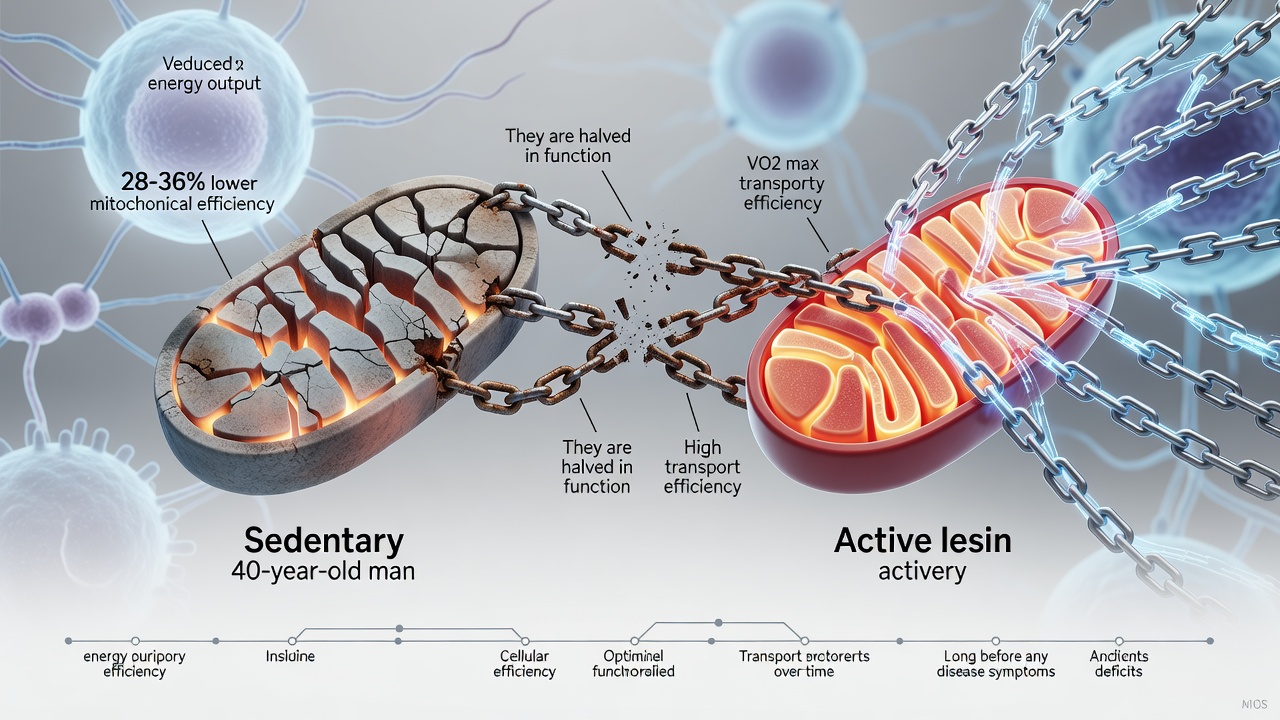
Healthy men in their early 40s who rarely exercise already exhibit striking deficits in the power plants of their muscle cells. Mitochondria in these individuals burn sugar and fat less efficiently. They harbor far less of a critical transport protein. And the consequences show up quickly during physical effort.
The findings come from researchers at the University of Colorado Anschutz Medical Campus. Their work, published in Clinical Bioenergetics, compared nine sedentary but otherwise healthy men with 10 who exercised regularly. Both groups averaged about 42 years old. The differences proved stark. And they appeared well before typical signs of disease.
“Mitochondrial function is the center of metabolic health,” said Iñigo San Millan, the study’s senior author and an adjoint assistant professor in the Division of Endocrinology, Metabolism and Diabetes at CU Anschutz. “If you are 40, healthy and sedentary, it is likely that you already have something going on inside your cells that will likely come back to haunt you in 10 or 15 years.”
San Millan knows mitochondria. He has spent years optimizing energy systems for elite athletes, including Tour de France champion Tadej Pogačar. His lab’s latest effort shifts focus to the other end of the activity spectrum. The results suggest that “healthy sedentary” may be an illusion. Cells don’t wait for a diagnosis to falter.
Muscle biopsies told the clearest story. In sedentary participants, mitochondrial efficiency fell between 28 and 36 percent across several measures. The protein MPC1, which shuttles pyruvate into mitochondria for conversion into usable energy, was 49 percent lower. CPT1, the enzyme that moves fat into the same organelles, showed roughly half the activity. These changes directly impair the cell’s ability to generate ATP from the body’s two primary fuels.
Exercise tests reinforced the cellular data. Sedentary men recorded VO2 max values 38 percent lower than their active counterparts. Blood lactate levels ran 60 percent higher during exertion, signaling that their bodies labored harder to meet energy demands. The active group, by contrast, displayed greater metabolic flexibility. Their mitochondria switched between fat and carbohydrate oxidation with ease.
The CU Anschutz team didn’t stop at observation. They framed these deficits as an early erosion of cellular identity. Sedentary muscle appears to lose its capacity for efficient fuel processing long before weight gain or blood markers turn abnormal. That loss, San Millan argues, sets the stage for insulin resistance, type 2 diabetes, and other chronic conditions. “Being sedentary will progressively erode metabolic health. When you stop moving, you lose that cellular identity of being healthy, and your body begins moving toward disease,” he said.
These observations echo and extend earlier work. A 2024 preprint by the same group, later refined for peer-reviewed publication, documented similar patterns at rest and during activity. Resting mitochondrial respiration dropped markedly in the sedentary cohort. Complex I activity fell 36 percent. Complex II declined 28 percent. Total electron transport system capacity decreased 34 percent. The preprint appeared on bioRxiv in August 2024.
Broader research supports the pattern. A June 2026 study from the Leibniz Institute on Aging linked declining phosphatidylcholine levels to reduced mitochondrial flexibility and accelerated cellular aging. That paper, published in Nature Communications, showed the change is malleable. Interventions that restore membrane lipids can slow the decline. The timing matters. Changes begin earlier than many assume.
Yet the CU Anschutz results stand out for their focus on truly healthy but inactive adults. Participants reported no diagnosed conditions. They simply sat too much. Less than 150 minutes of moderate activity per week. The threshold aligns with public health guidelines. Few meet it. The consequences accumulate quietly.
San Millan sees opportunity in early detection. Cardiopulmonary exercise testing and lactate profiling can flag these cellular shifts without invasive procedures. Targeted training programs could then restore mitochondrial capacity. His team plans larger trials that include women and test whether specific exercise or pharmacological approaches can reverse the MPC1 and CPT1 deficits.
The implications stretch beyond individual health. Societies that engineer physical inactivity into daily life, through desk work, screen time, and urban design, may be programming metabolic vulnerability at scale. Public health messaging has long emphasized weight and cardiovascular risk. This research points upstream. To the organelles that determine whether cells thrive or merely cope.
Other recent analyses reinforce the urgency. A 2025 review in Nutrition, Metabolism and Cardiovascular Diseases tied sedentary behavior to frailty, inflammation, and mitochondrial decline in both healthy adults and those with existing conditions. The authors noted that physical inactivity accelerates the transition from pre-frailty to frailty through pathways that include reduced oxidative capacity and heightened oxidative stress.
Even light activity appears protective. Studies dating back more than a decade show that breaking up sitting time with standing or slow walking helps maintain lipoprotein lipase activity and improves glucose uptake. The CU Anschutz data suggest these benefits operate at the mitochondrial level from the outset.
San Millan’s message is direct. Movement preserves cellular identity. Inactivity dismantles it, one inefficient electron transport chain at a time. The men in the sedentary group weren’t sick. They just weren’t moving. Their mitochondria already knew the difference.
Future work will test whether restoring mitochondrial transport proteins can prevent the diseases that currently define late middle age. For now, the evidence is clear. The cellular cost of a sedentary life arrives sooner than expected. And it registers first in the powerhouses that keep every tissue alive.


 WebProNews is an iEntry Publication