
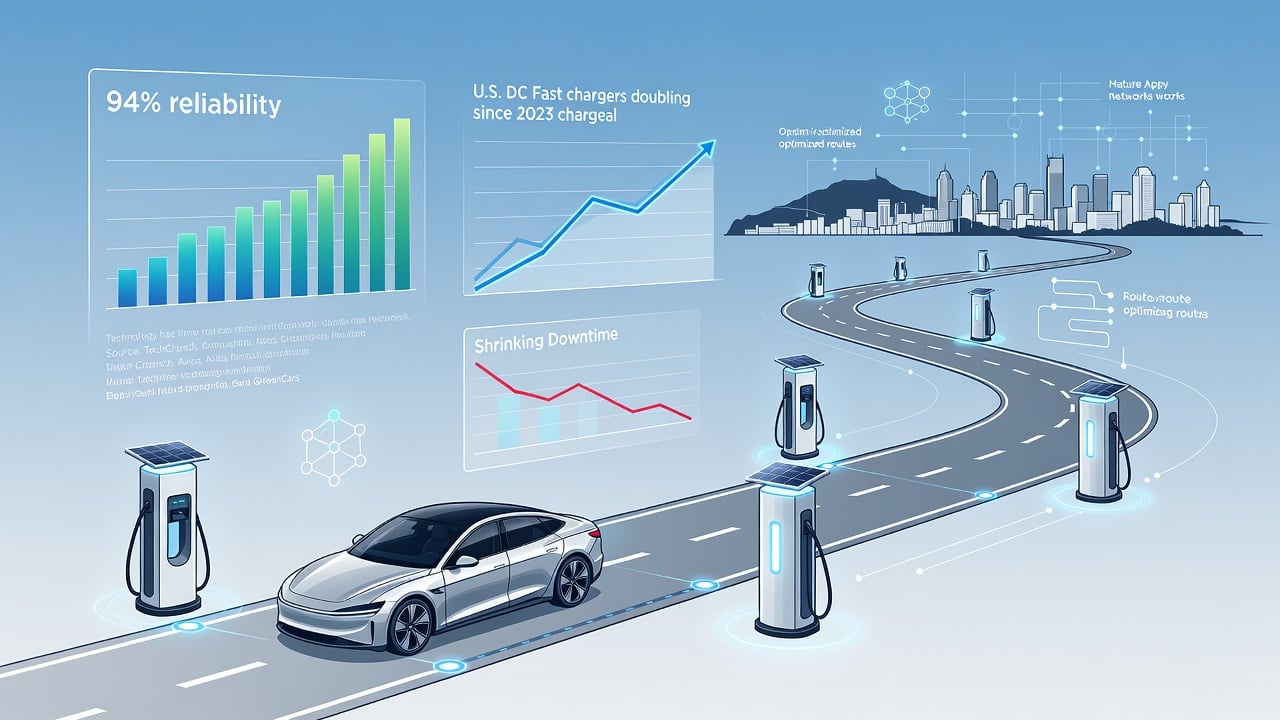
Tim De Chant set out this summer on a 600-mile drive to Montreal and back. He expected the usual headaches with public chargers. What he got instead felt almost routine. Sessions wrapped up in about 20 minutes. No lines formed. Apps worked on the first try. One small glitch aside, the whole experience went off without a hitch.
De Chant, a senior climate reporter at TechCrunch, documented the trip in detail. He drove an Audi e-tron with roughly 220 miles of range. The vehicle performed fine despite falling short of newer models. He relied on A Better Route Planner to map stops. The app factored in weather, traffic and battery health. It steered him to a Rivian station near Lebanon, New Hampshire. Six 300-kilowatt chargers stood ready. All functioned. Payment cleared with a credit card. Power flowed at more than 140 kilowatts. Lunch options surrounded the site. The return leg mirrored the outbound success.
Contrast that with his 2023 trek. Same car. Shorter distance to Maine and back, about 350 miles total. The drive turned into a comedy of errors. One charger failed minutes after connection. A second refused to start until he called support. Apps showed working plugs that sat dead. Three customer-service calls later, he reached his destination exhausted. “Imagine if gas stations worked like this,” he wrote then.
But fast-forward three years. The difference jumps out. De Chant noted in TechCrunch that his recent outing “appears to be the norm, not the exception.” Data backs him up. The U.S. counted roughly 32,000 DC fast chargers in July 2023, per the Joint Office of Energy and Transportation. Many remained Tesla-only at the time. Tesla began opening its network that year, yet broad access took more than 12 months. Today the total exceeds 64,000. Competition among networks has sharpened service across the board.
Reliability scores reflect the gains. Paren, an analytics firm tracking charger performance, pegged the national index at 85 last year. By the second quarter of 2026 it climbed into the mid-90s. The metric weighs successful sessions against downtime and other failures. Tesla still leads. Other providers close the gap fast. Broken units get fixed quicker now. New stations come online each month. Gaps persist in rural corridors. Yet the trend line points higher. “It’s not perfect, but I’m genuinely surprised by how much better fast charging has become,” De Chant concluded. “Someone should tell the holdouts what they’re missing.”
Recent coverage echoes the shift. Just days before De Chant’s piece, Axios published an account of a 1,900-mile EV journey from Michigan to New Hampshire and back. Reporter Joann Muller drove a Toyota bZ4X. She found the drive itself delightful. Charging, however, still lagged behind the simplicity of filling a gas tank. “My 1,900-mile road trip last week in an electric vehicle proved it’s easily doable, but the charging experience is still not as convenient as pumping gas,” she wrote in the Axios article dated July 8. Range anxiety lingers for some buyers. Sales data cited in the story show U.S. EV adoption remains uneven. Infrastructure progress has yet to erase every doubt.
GreenCars took a broader view in March. Kevin Jennings argued that 2026 marks a pivot from raw charger counts to real-world usability. Faster sessions, wider payment options and fewer broken stalls define the new era. A 30-minute stop trimmed to 20 minutes changes the math for long drives. Incremental gains compound. “Even incremental improvements make a difference,” Jennings observed in GreenCars. Road-trippers notice.
European trends offer another data point. Forbes examined seven EV-friendly routes across the continent in early July. Author Emese Maczko highlighted Luxembourg’s dense network of 3,000 public points, including 500 fast chargers. GridX’s 2026 Charging Report, referenced in the story, shows Europe now hosts more than 1.2 million charging points across 32 countries. That figure is nearly five times the 2020 total. Fast chargers grew 38.5 percent in the latest period. Ultra-fast units rose to 11.8 percent of the mix. The Forbes piece suggests North American networks can draw lessons from that density.
Industry forecasts paint an optimistic picture. Juniper Research projected that 35 million households worldwide will charge EVs at home in 2026. The firm expects one billion charging sessions globally. More than half of those households will rely on wallboxes. The infographic accompanying the analysis, available via Juniper Research, underscores how residential charging reduces pressure on public networks during peak travel seasons.
Yet anecdotes from drivers on X reveal mixed emotions. One recent post praised ABRP for shaving total charge time on multi-state trips. Another highlighted real-time stall availability now appearing in Google Maps for non-Tesla vehicles at certain stations. A Michigan-based user with a Chevrolet Blazer EV noted that convenient locations still trump price in trip planning. Rural stretches continue to test patience. “What’s the biggest challenge you face when planning a long EV road trip?” asked one account in mid-July. Replies cited sparse coverage in certain states more than raw speed.
Policy moves add momentum. In India, the central government cleared funding for EV charging stations as part of a larger Delhi infrastructure package. Business Standard reported the approval of ₹1,647 crore for 28 projects including metro lines and road upgrades. The story, published July 14 on Business Standard, signals how public investment can accelerate deployment in high-density zones.
Back on American highways the picture sharpens. Uniz Solar’s June analysis forecast fast chargers capturing 51.7 percent of the global market by year-end, up sharply from prior years. The shift toward ultra-fast units redefines what counts as a “quick stop.” Drivers on 2026 road trips can expect 10-to-80-percent replenishment in 20 minutes for many models. That pace aligns with De Chant’s experience in the Audi. He never waited on the vehicle. Charging stops doubled as meal or coffee breaks. Total added time roughly matched the wait at the U.S.-Canada border.
Planners and analysts agree on one point. Preparation still matters. Apps such as ABRP, now under Rivian ownership, deliver accurate predictions even without an OBD dongle. Hotels and resorts increasingly offer overnight Level 2 plugs. One X user described a Bangalore-to-Coorg hill run where pre-booked resort charging eliminated the need for public stops entirely. Similar stories surface from U.S. travelers who call ahead.
The collective evidence suggests a threshold has been crossed. Concerns that once dominated buyer surveys from AAA no longer tell the full story. Public charging has moved from experimental to practical for many routes. Reliability sits in the low-to-mid-90s. Session times have fallen. Networks expand and repair faster. Holdouts may cling to old assumptions. Data from the road, however, tells a different tale. EV travel has shed much of its former risk. The numbers and the drives both confirm it.


 WebProNews is an iEntry Publication