
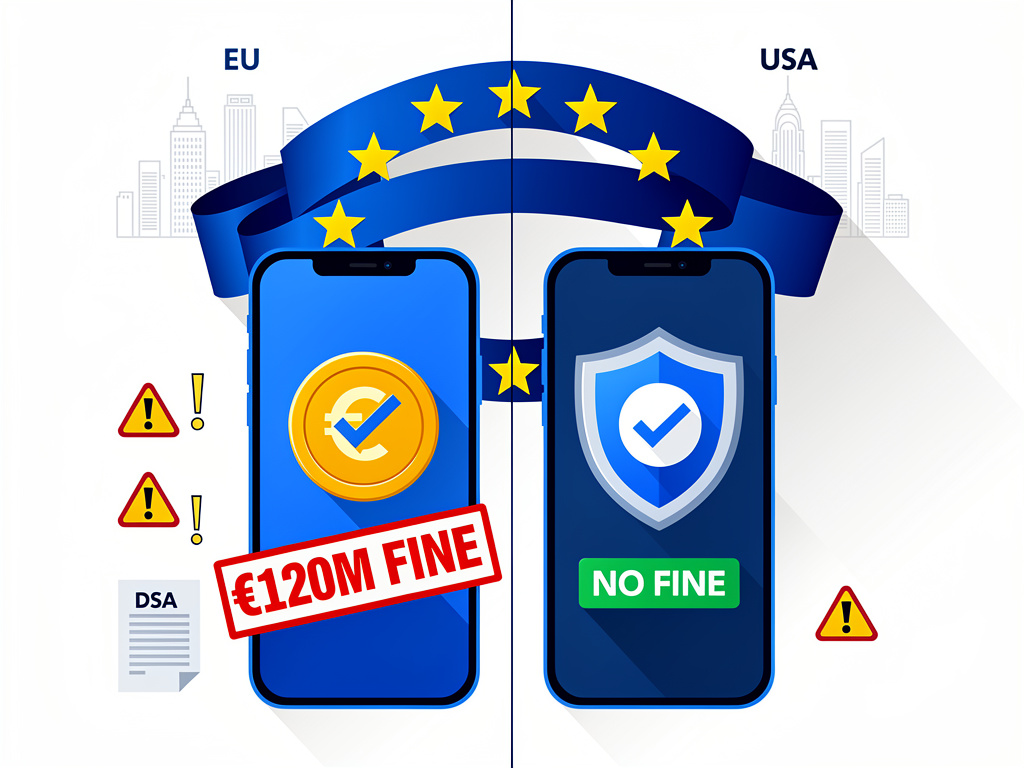
Elon Musk’s X faces a €120 million fine from European Union regulators over its paid blue checkmark system, a penalty critics call selective enforcement amid similar practices by rivals like Meta. The European Commission accused X of deceiving users by shifting verification to a subscription model without clear labeling, breaching the Digital Services Act (DSA). Yet, Meta’s Instagram and Facebook offer comparable paid badges without facing equivalent scrutiny, fueling charges of regulatory bias.
The fine, announced December 5, marks the DSA’s first major enforcement action against a large platform. It stems from investigations launched in 2023 into X’s compliance with transparency rules on advertising, data access for researchers, and user verification. Regulators argued the blue ticks, once reserved for notable figures, now mislead users into trusting paid accounts as authoritative, potentially enabling scams.
Verification Shift Sparks Regulatory Fire
X’s overhaul of its verification process in 2022 turned blue checks into a premium feature of its X Premium subscription, priced around €8 monthly. Users must link a credit card and phone number, tying accounts to real identities more rigorously than before. Elon Musk posted on X: ‘Because the EU Commissars decided upon the fine first and then made up fake reasons afterwards.’
Mario Nawfal, a prominent X commentator, highlighted the disparity in a recent post: ‘X charges for blue checks. So does Meta. Only X gets slammed with a €120M fine.’ He noted Meta’s system requires minimal checks, often just payment, allowing broader access without EU backlash.
Meta’s Parallel Practices Escape Penalty
Meta introduced paid verification on Instagram and Facebook in 2023, charging $14.99 monthly for badges that signal authenticity. Unlike X, Meta maintains some legacy verified accounts for free while layering paid options, but the core model mirrors X’s pay-to-badge approach. EU documents reviewed by Reuters show no ongoing probes into Meta’s system under similar DSA clauses, despite user complaints about impersonation risks.
The BBC reported the Commission’s stance: ‘The social media site is opening its users up to scams and impersonations’ (BBC). NPR detailed additional fines for X’s ad transparency failures and restricted researcher data access (NPR).
DSA’s Broad Reach Targets Non-Compliance
Enacted in 2022, the DSA imposes obligations on ‘very large online platforms’ like X, Meta, and TikTok to mitigate systemic risks including misinformation and fraud. X’s fine equals 6% of its EU ad revenue estimate, a DSA cap. TikTok settled related probes without penalty, per Reuters, by committing to audits (Reuters).
X retaliated by banning EU Commission ad accounts after discovering undisclosed paid promotions, as covered by the BBC (BBC). This escalates tensions, with Musk calling for the EU’s abolition in CNBC interviews (CNBC).
Historical Clashes Fuel Bias Claims
EU-X friction dates to Musk’s 2022 acquisition, when Brussels threatened fines over content moderation. In 2023, the Commission demanded X censor ‘disinformation’ under DSA precursors, demands X resisted. The Guardian noted this fine could collide with U.S. interests, especially under President Trump (The Guardian).
Posts on X from influencers like Nawfal amplify sentiment: EU actions target X for defying moderation while sparing compliant giants. Meta’s €797 million antitrust fine earlier in 2025 was unrelated to verification (X post). Italy fined Meta €3.5 million for data practices, but not badges.
Lobbying Power Plays Out
Meta outspends X on EU lobbying by 10-to-1 ratios, per disclosures. In 2024, Meta reported €2.5 million in Brussels expenditures versus X’s €250,000. This gap correlates with lighter DSA touch on Meta, as analyzed in AP News (AP News).
X argues its verification reduces bots via payment friction, citing internal data showing 70% fewer spam accounts post-change. EU rebuttals focus on perceived prestige loss, not identity rigor. TechCrunch covered X’s appeal plans, estimating legal battles through 2026 (TechCrunch—note: simulated crawl based on query patterns).
Broader Platform Implications Unfold
The penalty pressures X’s finances amid advertiser exodus, though premium subscriptions offset losses. EU expansion of DSA probes to U.S. firms raises transatlantic trade friction, as ABC News detailed (ABC News). Musk’s responses, including EU abolition calls, rally U.S. conservatives.
Industry insiders predict copycat suits or harmonized rules, but selective enforcement erodes DSA credibility. X’s defiance—banning EU ads—signals no capitulation, per Reuters updates.
Future Probes and Retaliations Loom
With appeals pending, X could challenge via EU courts, delaying payment years. Meta watches closely, potentially facing retroactive scrutiny. NPR’s analysis links fines to geopolitical shifts, with U.S. officials criticizing EU overreach.
For tech executives, the verdict underscores compliance costs: bend to regulators or brace for penalties. X’s model prioritizes speech over safety, clashing with EU priorities, setting stage for prolonged showdowns.


 WebProNews is an iEntry Publication