
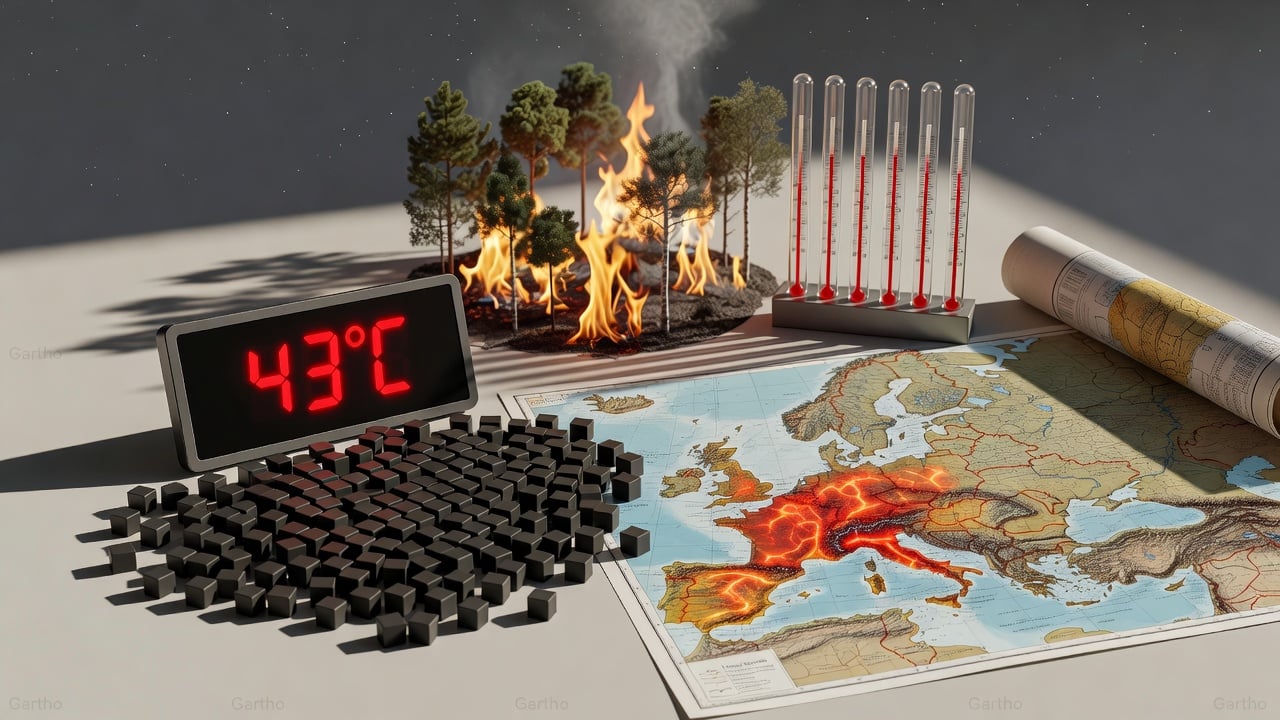
BERLIN — France tallied around 1,000 excess deaths last week as a ferocious heat wave smashed temperature records across Western Europe. Public Health France delivered the stark tally on Sunday. The agency pointed to three days of extreme heat when daily deaths jumped from a typical 900 to 1,000 in April and May to more than 1,200 on Wednesday and over 1,400 on each of the next two days.
But those numbers tell only part of the story. Eighty-five percent of the additional fatalities involved people aged 65 and older. “Since June 24, approximately 1,000 additional deaths (unconsolidated figures) have been recorded compared to the deaths recorded in previous months,” the French national health agency said in a statement. It warned the preliminary count underestimates the total. Data from deaths at home and elsewhere still trickles in.
The heat didn’t stop at borders. Germany shattered its all-time high with 41.5 degrees Celsius in the eastern town of Moeckern-Drewitz. Nighttime lows stayed brutally high too. One reading hit 29.4 degrees Celsius. Wildfires erupted in forests, some complicated by buried World War II munitions that raised contamination fears during firefighting. Berlin police turned water cannons on crowds seeking relief near landmarks like the Brandenburg Gate. Roads buckled. Train tracks warped.
And the World Health Organization sounded a broader alarm. Director-General Tedros Adhanom Ghebreyesus noted more than 1,300 excess deaths linked to the heat across Europe since June 21. He called Europe the fastest-warming continent on the planet. Its temperatures rise at about twice the global average. Heat stress acts as a silent killer, he said. Countries must build better protections. Fast.
Scientists tie this event directly to human-caused climate change. A World Weather Attribution study found the heat wave 200 times more likely today than two decades ago. It would have been virtually impossible 50 years back without the influence of greenhouse gases. France saw its hottest June day on record. Paris approached 41 degrees Celsius. Some spots elsewhere in the country topped 43.8 degrees. Red alerts blanketed 58 departments. Drought worsened wildfire risks. Rivers ran low and warm, forcing nuclear plants to throttle output to avoid overheating waterways.
Drownings added to the toll. At least 40 people died in water-related incidents in France since mid-June. Many involved unsupervised swimming as residents sought any escape from the oppressive air. Prime Minister Sébastien Lecornu called the pattern a tragic scourge, especially among younger people. Two children died after being left in a hot car. Elderly residents in Bordeaux succumbed to heat-aggravated conditions.
Yet the impacts stretched beyond immediate loss of life. Highways cracked under the strain in Germany. Power demand surged while supply wobbled. Hospitals faced extra pressure. Farmers watched crops bake in fields already parched from earlier dry spells. The early timing of the heat — arriving in force during June rather than the usual July or August peak — caught many systems off guard.
Similar patterns played out in neighboring countries. The Czech Republic logged 41.1 degrees Celsius. Poland, Slovakia and others braced for their own records as the high-pressure system drifted east. In the U.K., new June highs compounded worries. Across the continent, experts see a clear trend. Extreme heat events grow more frequent, more intense and arrive earlier in the calendar.
Public Health France stressed the excess mortality appeared across all age groups, even if older adults bore the heaviest burden. “The increases [in deaths] are seen across all age groups, underscoring the fact that the effects of heat waves can affect the entire population,” the agency noted. Still, 85 percent of the recorded excess involved those 65 and up. The agency also highlighted sharper rises in regions under the highest alerts.
This episode follows years of deadly summers. Europe suffered more than 62,000 heat-related deaths in 2024, according to earlier studies. The 2003 heat wave killed tens of thousands. Lessons from those tragedies led to better warning systems, cooling centers and urban planning adjustments in some cities. But gaps remain. Many older people live alone. Air conditioning stays rare in much of Europe compared with the United States. Behavioral changes during early heat waves prove slower to take hold.
Officials in France issued top-level warnings for days. Schools closed in some areas. Outdoor work faced restrictions. Yet the speed and scale still overwhelmed parts of the response. In Germany, authorities battled fires while managing heat-stressed infrastructure. One lightning strike at a park in Sweden injured several people amid the unstable weather tied to the broader pattern.
Tedros urged immediate action. Countries need heat action plans that cover early warnings, urban greening, support for vulnerable groups and long-term adaptation. Without them, he said, the human and economic costs will mount. The Pope even referenced the heat during his Angelus prayer, drawing attention at the Vatican as fountains offered small public relief.
The numbers, however, hide individual stories. Families mourning grandparents. Parents losing children in preventable accidents. Workers collapsing on the job. Each excess death represents a failure of preparation or a limit of human endurance under conditions once considered rare.
Researchers continue to refine attribution science. They run climate models with and without human emissions to quantify how much worse events become. In this case, the signal looks unmistakable. What once might have been a one-in-a-thousand-year event now carries far higher odds. And as global temperatures climb further, those odds shorten dramatically.
France’s preliminary figures come from its national public health monitoring. They compare observed deaths against expected baselines adjusted for season and recent trends. The agency cautions that full data could push the excess count higher. Similar surveillance systems operate across Europe, feeding into broader WHO assessments.
Meanwhile, the heat dome has begun shifting. Eastern Europe now faces its brunt. Yet meteorologists warn this won’t be the last such outbreak this summer. Models suggest above-average temperatures persist. Drought conditions linger. Fire danger stays elevated.
For policymakers, the episode delivers fresh evidence. Adaptation measures that worked for past heat waves may fall short as extremes intensify. Investment in resilient infrastructure, better social safety nets for the elderly and improved forecasting all demand attention. So does the larger task of cutting emissions to limit how much worse future summers become.
Europe stands at a crossroads. The continent that pioneered much of the industrial revolution now confronts its environmental bill. Record heat in June. Thousands of excess deaths. Fires and failing roads. The signs accumulate. How governments and societies respond in the months ahead will shape the human cost of the next inevitable wave.
Fortune first highlighted the French death toll alongside German wildfires. The Washington Post reported parallel details on the European records and Berlin’s crowd-control measures. Politico published the exact agency statements on timing and demographics. The Associated Press, via multiple outlets, supplied core temperature and mortality data. Recent coverage from Xinhua added context on drowned victims and record German highs. WHO statements appeared across BBC reports on the 1,300 continental excess deaths.


 WebProNews is an iEntry Publication