
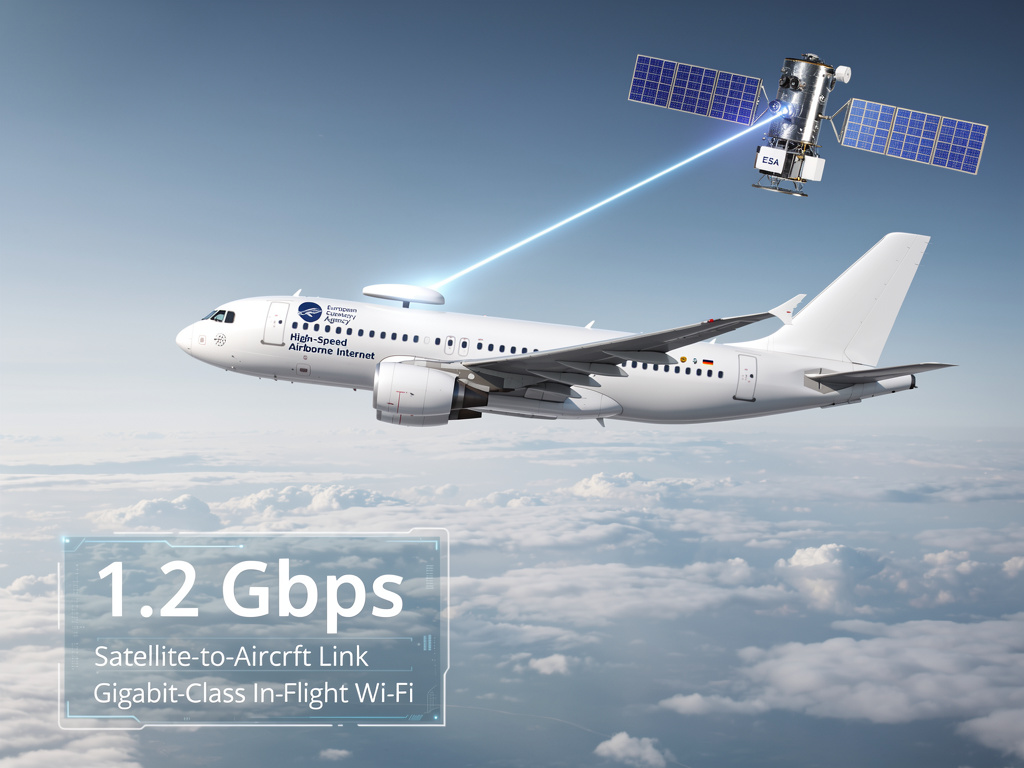
For years, airline passengers have endured sluggish, overpriced Wi-Fi connections that struggle to load a simple webpage, let alone stream a video. That frustration may soon become a relic of the past. The European Space Agency has successfully demonstrated a satellite-to-aircraft internet connection delivering speeds exceeding one gigabit per second — a technical achievement that could fundamentally alter the economics and experience of in-flight connectivity.
The test, conducted as part of ESA’s HydRON (High thRoughput Optical Network) program, used laser-based optical communication technology to beam data between a geostationary satellite and a moving aircraft. The results were striking: sustained throughput above 1 Gbps, with the potential to scale significantly higher. For context, most current in-flight Wi-Fi systems deliver between 10 and 100 Mbps to an entire aircraft, shared among hundreds of passengers. A gigabit-class connection would represent an order-of-magnitude improvement, bringing airborne internet speeds closer to what consumers expect from their home fiber connections.
Laser Links in the Sky: The Technology Behind the Test
The key innovation here is the use of free-space optical communication — essentially, laser beams transmitting data through the atmosphere and into space. Unlike traditional radio-frequency satellite links, which are constrained by limited spectrum and susceptible to interference, optical links operate at much higher frequencies, enabling dramatically greater bandwidth. As Digital Trends reported, the ESA demonstration proved that these laser links can maintain stable, high-speed connections even with the vibrations and movement inherent to commercial aviation.
The HydRON program has been in development for several years, with ESA positioning it as a cornerstone of Europe’s next-generation space communication infrastructure. The agency envisions a network of satellites equipped with optical terminals that can relay data at terabit-per-second aggregate speeds, serving not just aircraft but also ships, trains, and remote ground stations. The successful aircraft test marks a critical milestone, demonstrating that the technology works not just in controlled laboratory settings or between fixed points in orbit, but in the dynamic, real-world conditions of a moving airplane at cruising altitude.
Why Current In-Flight Wi-Fi Falls Short
To appreciate the significance of ESA’s achievement, consider the state of in-flight connectivity today. The major providers — Gogo, Viasat, and Intelsat — rely primarily on Ku-band and Ka-band satellite links, which offer limited bandwidth that must be shared across all passengers on a given flight. Airlines have invested billions in equipping their fleets with connectivity hardware, yet passenger satisfaction remains persistently low. A 2024 survey by the airline technology firm SITA found that in-flight Wi-Fi consistently ranks among the top complaints from business travelers, who increasingly expect to work productively during flights.
The problem is partly structural. Geostationary satellites, which orbit at approximately 35,786 kilometers above Earth, introduce latency of roughly 600 milliseconds for a round trip — noticeable enough to make video calls choppy and real-time applications frustrating. Low-Earth orbit constellations like SpaceX’s Starlink have addressed the latency issue by positioning satellites much closer to Earth, at altitudes between 340 and 550 kilometers, reducing round-trip latency to around 25-50 milliseconds. Starlink Aviation has begun equipping aircraft with its terminals, and several airlines have announced partnerships. But even Starlink’s current airborne service tops out at roughly 220 Mbps per aircraft under ideal conditions, according to SpaceX’s own specifications — impressive by current standards, but still a fraction of what ESA demonstrated.
Europe’s Strategic Bet on Optical Communications
ESA’s push into optical satellite communications is not happening in isolation. It reflects a broader European strategy to maintain competitiveness in space-based infrastructure at a time when American companies — SpaceX chief among them — are rapidly expanding their dominance in commercial satellite services. The agency has committed significant funding to the ScyLight (SeCure and Laser communication Technology) program, which supports the development of optical communication payloads for both government and commercial missions.
The industrial partners involved in HydRON include some of Europe’s most prominent aerospace firms. Thales Alenia Space and Airbus Defence and Space have both contributed to the development of optical terminal hardware, while smaller specialized companies have worked on the adaptive optics systems needed to maintain laser lock between a satellite and a fast-moving aircraft. According to Digital Trends, the test demonstrated not just raw speed but also the reliability of the pointing and tracking systems — a non-trivial engineering challenge when you consider that the laser beam must maintain alignment with a terminal on an aircraft traveling at 900 kilometers per hour while the satellite sits tens of thousands of kilometers away.
The Starlink Factor and the Competitive Pressure on European Industry
SpaceX’s Starlink has become the dominant force in satellite internet, with more than 6,000 satellites in orbit and a rapidly growing aviation customer base. Airlines including JSX, Hawaiian Airlines, and Qatar Airways have either deployed or announced plans to deploy Starlink terminals. Elon Musk’s company has the advantage of vertical integration — it builds its own rockets, satellites, and ground terminals — which allows it to undercut competitors on price while iterating rapidly on technology.
But Starlink’s approach has limitations that ESA’s optical technology could address. Low-Earth orbit constellations require thousands of satellites to maintain continuous coverage, creating growing concerns about orbital debris and spectrum congestion. The radio-frequency bands used by Starlink are also subject to regulatory constraints and potential interference issues, particularly as more constellations enter service. Optical communication, by contrast, does not require spectrum licensing in the traditional sense, since laser beams are highly directional and do not interfere with radio systems. This gives optical links a potential regulatory and technical advantage as the space around Earth becomes increasingly crowded.
What Airlines and Passengers Could Expect
If ESA’s technology moves from demonstration to deployment — a process that will likely take several years and require substantial investment from both satellite operators and airlines — the implications for the passenger experience would be profound. A gigabit-class connection shared among 200 passengers on a narrowbody aircraft would deliver roughly 5 Mbps per person, enough for HD video streaming. On a widebody aircraft with 350 passengers, the per-person allocation would still exceed what most current systems deliver to the entire plane. And ESA’s roadmap suggests that multi-gigabit and eventually terabit aggregate capacities are achievable as the technology matures.
For airlines, better connectivity translates directly into revenue. Carriers have long struggled to monetize in-flight Wi-Fi because passengers are unwilling to pay premium prices for a subpar experience. A genuinely fast, reliable connection could support new business models — from premium streaming partnerships to real-time cloud computing services for business travelers. Delta Air Lines, which recently announced free Wi-Fi for all passengers through its Starlink partnership, has acknowledged that connectivity is increasingly a competitive differentiator in route and carrier selection.
Remaining Technical and Commercial Hurdles
Despite the impressive test results, significant obstacles remain before optical satellite-to-aircraft links become commercially viable. Weather is the most obvious challenge: clouds, fog, and heavy precipitation can attenuate or block laser signals entirely. ESA researchers have been working on adaptive optics and wavelength diversity techniques to mitigate atmospheric effects, and hybrid systems that fall back to radio-frequency links during adverse weather are one likely solution. But this adds complexity and cost to the terminal hardware that airlines would need to install.
There is also the question of satellite infrastructure. The HydRON demonstration relied on existing assets, but a full commercial service would require a constellation — or at least a network of geostationary satellites — equipped with optical terminals and the ground infrastructure to support them. European satellite operators like Eutelsat (which merged with OneWeb in 2023) and SES are potential partners, but the capital expenditure required is substantial. Whether European governments and private investors will commit the necessary funding remains an open question, particularly given the competitive pressure from well-capitalized American rivals.
A Signal That the Race for Airborne Connectivity Is Far From Over
ESA’s successful gigabit-class satellite-to-aircraft demonstration sends a clear message: the current generation of in-flight Wi-Fi technology is not the final word. While Starlink and other radio-frequency-based systems have made impressive strides, optical communication offers a path to dramatically higher speeds and greater spectral efficiency. For the airline industry, which has spent years promising passengers a connected experience and largely underdelivering, the technology cannot mature fast enough.
The coming years will determine whether Europe can translate this technical achievement into commercial reality, or whether it will remain a laboratory success while American competitors continue to dominate the market. What is clear is that the demand is there: passengers want fast, reliable internet in the air, and airlines want to give it to them. The question is no longer whether gigabit-class airborne connectivity is possible — ESA has answered that. The question is who will deliver it first at scale, and at a price the market will bear.


 WebProNews is an iEntry Publication