
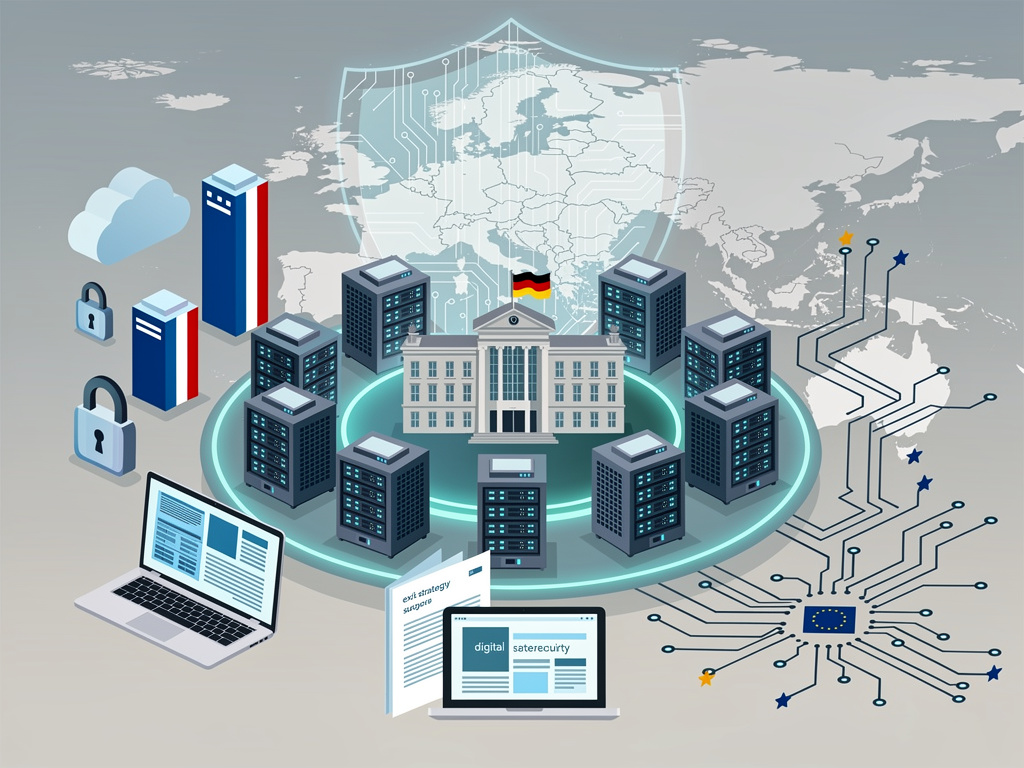
A quiet revolution is unfolding across European government offices, where IT departments are drafting contingency plans to abandon Microsoft’s ubiquitous software suite. The latest indicator of this seismic shift comes from Germany’s Federal Office for Information Security (BSI), which has joined a growing roster of public sector entities preparing migration strategies away from Redmond’s products—a movement that signals deepening concerns about data sovereignty, vendor lock-in, and the geopolitical implications of critical infrastructure dependencies.
According to TechRadar, the BSI is actively developing plans to transition away from Microsoft products if circumstances demand such action. This preparation represents more than routine IT planning; it reflects a fundamental reassessment of how European governments approach their digital infrastructure in an era of heightened technological nationalism and cybersecurity threats. The agency’s stance comes amid broader European Union initiatives to reduce dependence on American technology giants, a policy direction that has gained momentum following revelations about surveillance programs and data privacy concerns.
The German agency’s position mirrors similar movements across the continent. France’s government has been exploring alternatives to Microsoft Office, while several Scandinavian countries have implemented policies favoring open-source solutions for public administration. These parallel efforts suggest a coordinated, if unofficial, strategy among European nations to establish technological autonomy—a goal that has become increasingly urgent as digital infrastructure becomes inseparable from national security considerations.
The Economics of Digital Independence
The financial implications of such migrations extend far beyond simple software licensing costs. Microsoft’s enterprise ecosystem generates billions in annual revenue from European government contracts, with Germany alone representing a substantial portion of this income stream. Industry analysts estimate that a complete migration of German federal agencies could involve hundreds of millions of euros in transition costs, including software development, employee retraining, and temporary productivity losses during implementation phases.
However, proponents of migration argue that long-term savings and strategic benefits outweigh initial expenditures. Open-source alternatives like LibreOffice and Linux-based operating systems eliminate recurring licensing fees while providing governments with complete control over their software infrastructure. More critically, these alternatives allow agencies to audit source code for security vulnerabilities and backdoors—an impossibility with proprietary Microsoft products. The sovereignty argument resonates particularly strongly in Germany, where memories of foreign surveillance operations remain fresh and concerns about Chinese and Russian cyber-espionage continue to escalate.
Technical Challenges and Interoperability Concerns
Despite the political and economic rationale, the technical obstacles to abandoning Microsoft’s ecosystem remain formidable. Decades of institutional investment in Microsoft products have created deep dependencies that extend throughout government operations. Custom applications built on Microsoft frameworks, integration with Active Directory authentication systems, and employee familiarity with Office applications represent significant switching costs that transcend simple financial calculations.
The interoperability challenge proves especially vexing for agencies that must collaborate with international partners and private sector entities overwhelmingly standardized on Microsoft platforms. Document formatting inconsistencies, incompatible macro functions, and collaboration tool disparities can impede workflows and compromise operational efficiency. Previous migration attempts in Munich—the city famously reversed its Linux migration in 2017 after years of implementation struggles—serve as cautionary tales that inform current planning efforts. However, advocates note that open-source software has matured considerably since Munich’s initial attempt, with modern alternatives offering significantly improved compatibility and user experience.
The Broader European Digital Sovereignty Movement
The BSI’s contingency planning exists within a larger European policy framework aimed at achieving digital sovereignty. The European Union’s Digital Markets Act and Digital Services Act represent legislative efforts to constrain the market power of American technology companies, while initiatives like Gaia-X seek to establish European alternatives to American cloud computing platforms. These regulatory and infrastructure projects share a common objective: reducing European dependence on foreign technology providers whose interests may not align with European values or security requirements.
This sovereignty push has accelerated following geopolitical tensions with both Russia and China, as well as growing unease about American technology companies’ cooperation with U.S. intelligence agencies. The Schrems II decision by the European Court of Justice, which invalidated the Privacy Shield framework for transatlantic data transfers, highlighted fundamental conflicts between European privacy protections and American surveillance laws. These legal and political developments have transformed what was once primarily a procurement question into a matter of strategic autonomy.
Microsoft’s Response and Strategic Adaptations
Microsoft has not remained passive in the face of these challenges. The company has established data centers within European Union borders, offered enhanced data residency guarantees, and created specialized government cloud offerings designed to address sovereignty concerns. Microsoft’s Government Cloud for Germany, operated in partnership with Deutsche Telekom, represents an attempt to satisfy regulatory requirements while maintaining market share. These efforts demonstrate Microsoft’s recognition that European government contracts represent too valuable a market segment to cede without resistance.
Yet skeptics question whether these accommodations address fundamental concerns about foreign control of critical infrastructure. Even with data stored on European servers, the underlying software remains proprietary code controlled by an American corporation subject to U.S. legal jurisdiction. The CLOUD Act, which grants American law enforcement agencies potential access to data held by U.S. companies regardless of storage location, exemplifies the legal complexities that technical solutions cannot fully resolve. This jurisdictional reality drives European policymakers toward open-source alternatives that eliminate foreign legal exposure entirely.
Implementation Strategies and Timeline Considerations
The BSI’s approach emphasizes preparation rather than immediate action, a pragmatic stance that acknowledges both the necessity of contingency planning and the complexity of execution. This measured strategy allows the agency to develop comprehensive migration roadmaps while avoiding the disruptions that hasty transitions might precipitate. Pilot programs testing open-source alternatives in non-critical departments can provide valuable insights before broader implementation, while phased rollouts can minimize operational risks.
Timeline projections for complete migrations vary widely depending on agency size, existing infrastructure complexity, and available resources. Smaller agencies with simpler IT environments might complete transitions within two to three years, while larger federal ministries could require five to seven years for full implementation. These extended timelines reflect not just technical challenges but also organizational change management requirements—convincing thousands of civil servants to abandon familiar tools demands careful planning and substantial training investments.
Implications for the Global Technology Industry
The European government sector’s potential exodus from Microsoft’s ecosystem carries implications extending far beyond immediate revenue impacts. If major European nations successfully implement open-source alternatives, other regions may follow suit, particularly in Asia and Latin America where similar sovereignty concerns exist. This demonstration effect could fundamentally reshape enterprise software markets, challenging the dominant position that Microsoft and other American technology companies have enjoyed for decades.
The movement also signals broader shifts in how governments conceptualize technology procurement. Rather than viewing software as a commodity purchased from the lowest bidder, European agencies increasingly treat digital infrastructure as strategic assets requiring domestic control. This perspective aligns with similar thinking in defense procurement, where national security considerations override pure economic efficiency. The extension of this logic to civilian IT infrastructure represents a significant evolution in government technology policy with potentially transformative market consequences.
The Path Forward for European Digital Policy
As the BSI and other European agencies advance their contingency planning, the trajectory toward greater digital sovereignty appears increasingly inevitable, even if the pace and completeness of migration remain uncertain. Political momentum favors reducing dependence on American technology providers, while improving open-source alternatives make such transitions more technically feasible than ever before. The question is no longer whether European governments will seek alternatives to Microsoft, but rather how quickly and comprehensively they will implement such changes.
The outcome of these efforts will shape technology markets and international relations for decades to come. Success could inspire similar movements globally, fragmenting the currently unified enterprise software market along geopolitical lines. Failure might reinforce Microsoft’s dominant position while discrediting sovereignty-focused technology policies. For European governments, the stakes extend beyond software choices to encompass fundamental questions about autonomy, security, and the relationship between democratic societies and the foreign corporations that increasingly provide their digital infrastructure. The BSI’s contingency planning represents not merely an IT project but a statement of strategic intent—one that Microsoft and the broader technology industry cannot afford to ignore.


 WebProNews is an iEntry Publication