
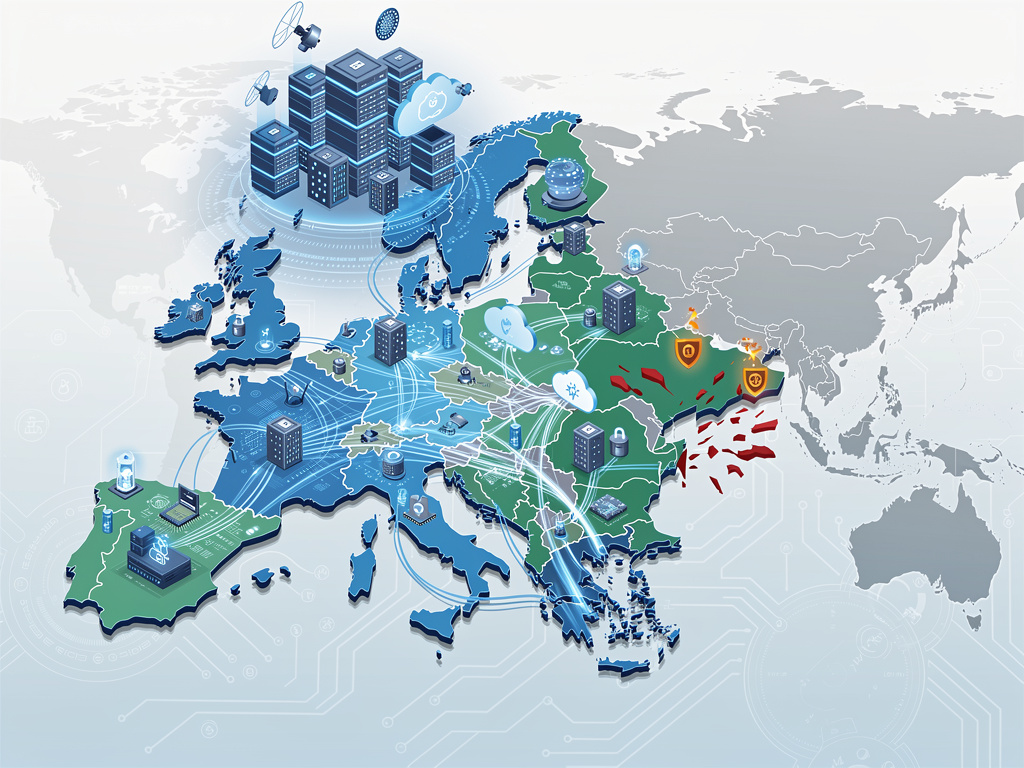
The transatlantic technology alliance, long considered a cornerstone of Western economic integration, is experiencing unprecedented strain as European governments and enterprises accelerate efforts to reduce dependence on American technology infrastructure. This strategic pivot, driven by escalating geopolitical tensions and the weaponization of economic sanctions, represents a fundamental recalibration of digital power dynamics that could reshape the global technology sector for decades to come.
According to TechCrunch, European technology leaders and policymakers are increasingly viewing American cloud services, semiconductor supply chains, and software platforms as potential vulnerabilities rather than strategic assets. This reassessment follows a series of policy decisions from Washington that have demonstrated how technology can be deployed as a geopolitical weapon, leaving European businesses and governments exposed to decisions made thousands of miles away without their input or consent.
The shift is not merely rhetorical. Major European corporations are now actively diversifying their technology partnerships, with several Fortune 500 equivalents redirecting capital expenditures toward European and Asian technology providers. Industry analysts estimate that European enterprises could redirect upward of €50 billion in technology spending over the next three years, representing one of the largest voluntary supply chain restructurings in modern economic history.
The Catalyst: When Economic Tools Become Political Weapons
The immediate catalyst for Europe’s accelerated digital sovereignty campaign stems from the increasingly unpredictable application of American sanctions policy. While economic sanctions have long been a tool of foreign policy, their extension into the technology sector has created cascading effects that European officials argue extend far beyond legitimate security concerns. The extraterritorial application of American regulations has forced European companies to choose between compliance with U.S. demands and their own commercial interests, creating what Brussels characterizes as an untenable situation.
European Commission officials, speaking on background, describe a growing frustration with what they perceive as the arbitrary nature of American technology policy. The concern extends beyond specific sanctions regimes to encompass broader questions about data sovereignty, privacy standards, and the concentration of critical digital infrastructure in the hands of a handful of American corporations whose primary allegiance is to shareholders and U.S. government directives rather than European interests.
Cloud Computing: The First Battleground
The cloud computing sector has emerged as the initial focal point for European digital independence efforts. Amazon Web Services, Microsoft Azure, and Google Cloud currently dominate the European market, processing vast quantities of sensitive government and commercial data. This concentration has become increasingly uncomfortable for European security officials who recognize that access to this data could theoretically be compelled by American law enforcement or intelligence agencies under various legal frameworks.
In response, European governments are channeling substantial resources into domestic cloud alternatives. France’s sovereign cloud initiative, Germany’s GAIA-X project, and similar programs across the continent represent billions of euros in public and private investment aimed at creating credible alternatives to American hyperscalers. While these initiatives face significant technical and commercial challenges—American cloud providers benefit from economies of scale that European competitors cannot easily replicate—the political imperative behind them continues to strengthen.
Semiconductor Supply Chains Under Scrutiny
Beyond cloud infrastructure, European policymakers are examining every layer of the technology stack for potential vulnerabilities. The semiconductor sector presents particular challenges, as the global chip supply chain represents one of the most complex and interdependent systems in modern manufacturing. While Europe lacks the advanced chip manufacturing capabilities of Taiwan and South Korea, the European Union’s Chips Act represents a €43 billion commitment to building domestic semiconductor production capacity.
This investment reflects a broader recognition that technological sovereignty requires control over fundamental building blocks of digital infrastructure. European officials studied carefully the disruptions caused by recent chip shortages and concluded that dependence on geographically concentrated supply chains—whether in Asia or America—creates unacceptable strategic risks. The goal is not complete self-sufficiency, which most analysts consider economically impractical, but rather sufficient domestic capacity to maintain critical functions during supply disruptions or geopolitical crises.
The Software Dilemma: Open Source as Strategic Asset
Software presents perhaps the most complex challenge for European digital sovereignty advocates. American companies dominate enterprise software markets, from operating systems to productivity suites to specialized business applications. However, the open-source software movement offers European technologists a potential pathway toward greater independence without requiring the massive capital investments needed for hardware manufacturing.
European governments are increasingly mandating that public sector organizations prioritize open-source solutions where feasible, both to reduce dependence on proprietary American software and to support European technology communities. This approach acknowledges that competing directly with established American software giants in proprietary markets would require decades and resources that Europe cannot easily marshal. Open-source alternatives, while sometimes less polished than commercial equivalents, offer transparency, customizability, and freedom from vendor lock-in that align with European digital sovereignty objectives.
Transatlantic Business Community Caught in the Crossfire
The push for digital sovereignty has created significant anxiety within the transatlantic business community. American technology companies have invested heavily in European operations, employing hundreds of thousands of workers and contributing substantially to European tax revenues. These companies argue that forcing artificial separation between American and European technology ecosystems would reduce efficiency, increase costs, and ultimately harm European competitiveness in global markets.
European subsidiaries of American technology giants find themselves in particularly difficult positions, simultaneously trying to address legitimate European concerns about data sovereignty while maintaining alignment with corporate headquarters. Some have proposed technical solutions such as data localization and enhanced encryption that would keep data physically within Europe while maintaining integration with global platforms. However, European regulators remain skeptical that such measures provide sufficient protection against potential American government demands for data access.
The Economic Calculus: Short-Term Pain for Long-Term Gain
European policymakers acknowledge that digital sovereignty initiatives will impose significant short-term costs on European businesses and consumers. Transitioning away from established American technology platforms requires substantial investment in new systems, employee retraining, and potentially accepting reduced functionality during transition periods. European cloud services, for instance, typically cost more and offer fewer features than their American counterparts, reflecting the scale advantages enjoyed by established providers.
However, European officials argue that these short-term costs must be weighed against the long-term risks of continued dependence on technology infrastructure controlled by foreign governments and corporations. They point to instances where American companies have been compelled to terminate service to European customers due to sanctions regimes, disrupting legitimate business operations and demonstrating the fragility of current arrangements. The economic argument for digital sovereignty rests on the premise that paying a premium for European alternatives is analogous to insurance—a cost worth bearing to protect against potentially catastrophic disruptions.
Implications for Global Technology Competition
The European push for digital sovereignty is unfolding against the backdrop of intensifying global technology competition, particularly between the United States and China. Some analysts suggest that European efforts to reduce dependence on American technology could inadvertently benefit Chinese technology companies seeking to expand their global footprint. European officials insist they are equally concerned about Chinese technological influence and are pursuing a strategy of diversification rather than simply substituting one dominant provider for another.
This triangular dynamic—with Europe seeking to establish itself as a third pole in global technology competition alongside the United States and China—represents a significant departure from the bipolar framework that has dominated recent discussions of technology geopolitics. Whether Europe can successfully execute this strategy remains uncertain. The continent lacks the massive domestic market that enables American and Chinese technology companies to achieve scale before expanding internationally, and European technology ecosystems remain fragmented along national lines despite decades of integration efforts.
The Path Forward: Cooperation or Competition?
Despite the current tensions, few observers expect a complete decoupling of American and European technology systems. The economic and technical interdependencies are simply too deep, and both sides recognize that some degree of cooperation serves mutual interests, particularly in areas such as cybersecurity and artificial intelligence governance. The question is whether transatlantic technology relationships can be restructured in ways that address European sovereignty concerns while preserving the benefits of integration.
Some European officials advocate for a framework of “strategic autonomy” rather than complete independence—maintaining the ability to operate critical systems independently when necessary while continuing to benefit from transatlantic cooperation during normal circumstances. This approach would require significant investment in redundant capabilities that might remain dormant most of the time, but would provide insurance against geopolitical disruptions. American technology companies, for their part, are exploring various models for addressing European concerns, including enhanced data localization, European governance structures for regional operations, and commitments to resist government data requests that conflict with European law.
Reshaping Digital Power Dynamics
The European digital sovereignty movement represents more than a temporary reaction to current geopolitical tensions. It reflects a fundamental reassessment of the relationship between technology, economic security, and political power in an increasingly multipolar world. For decades, European policymakers largely accepted American dominance of digital infrastructure as a benign reality, viewing American technology companies as commercial entities separate from American state power. Recent events have shattered this comfortable assumption, forcing a recognition that technology infrastructure cannot be separated from geopolitical considerations.
The success or failure of European digital sovereignty initiatives will have profound implications extending far beyond the technology sector. If Europe can successfully develop credible alternatives to American technology platforms, it may inspire similar efforts in other regions seeking to reduce dependence on dominant providers. Conversely, if European initiatives founder due to technical limitations or excessive costs, it may reinforce the dominance of existing technology giants and validate the argument that global technology markets naturally tend toward concentration. The coming years will determine whether digital sovereignty is a viable strategy for mid-sized economic powers or an expensive illusion that ultimately cannot overcome the fundamental economics of technology platforms.


 WebProNews is an iEntry Publication