
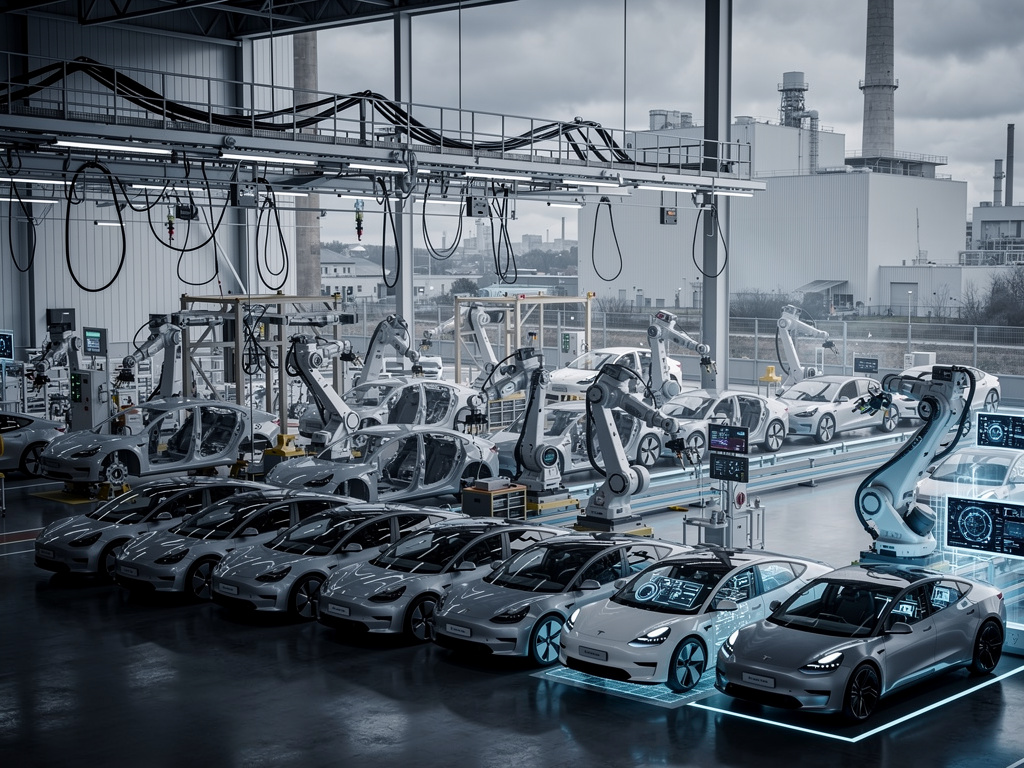
Europe’s automotive sector braces for a make-or-break 2026, hammered by Chinese imports, rampant overcapacity and the relentless march toward software-defined vehicles. Dealers reel from soaring costs and tepid demand, while manufacturers grapple with factories running at half-speed amid Beijing’s export onslaught. Suppliers, still scarred from prior disruptions, eye another turbulent year as tariffs fail to stem the tide.
The Automotive News outlines a sector under siege, with overcapacity exacerbated by surging Chinese vehicles despite EU duties. Factories idle as European output lags pre-Covid levels by 3 million units, per industry observers cited in social media analyses echoing X posts from analysts like Neil Winton.
Chinese brands doubled their European foothold in a year, now eyeing 10% share by 2030, according to AlixPartners. “Chinese automakers are set to double their European market share to 10% by 2030 as they localize while European automakers face lower capacity utilization,” the firm states.
Chinese Onslaught Defies Tariffs
EU countervailing duties of 17-35% atop 10% import levies have barely dented Beijing’s advance. BYD targets 5% of Europe’s EV sales by 2026—roughly 130,000 units in 2025 alone, up from 16,000 in 2023—while ramping China capacity to 6.55 million EVs from 2.9 million, notes Rhodium Group. “BYD has said that it is aiming to secure a 5% share of EV sales in Europe by 2026,” the report details, warning even 30% duties leave hefty profit margins intact at €4,700 per Seal U.
Europe imported $20 billion in Chinese EVs through 2025, per Reuters data, with hybrids now surging to skirt pure-EV tariffs. Chinese output floods in via new shipping routes capable of 1.7 million cars annually by 2026. AlixPartners predicts Beijing’s European production will swell by 800,000 vehicles by 2030, equivalent to Europeans shuttering 400,000 capacity—or 1.5 plants.
“China’s ‘New Operating Model’ enables automakers to bring vehicles to market twice as fast, with 40–50% less investment and a 30% cost advantage,” AlixPartners’ Yichao Zhang explains. This speed crushes legacy players developing in 60 months what Shenzhen launches in 18.
Factories Flicker, Jobs Vanish
European plants hum at 55% utilization, birthing an overcapacity crisis worth eight facilities, per Automotive Logistics. Volkswagen halts EV lines at Zwickau and Dresden, trims Osnabrück by a day weekly, eyes Emden pauses; Ford slashes Cologne to one shift from January 2026 with job cuts; Stellantis idles six plants amid inventory piles.
AlixPartners’ Andrew Bergbaum clarifies: “We do not believe that eight plants will be shut down in Europe – only that there will be overcapacity in Europe of that magnitude.” Yet 90,000 jobs evaporated in 2024 alone, with 51,500 more gone in Germany through mid-2025. EU registrations dipped 0.7% in early 2025, per ACEA.
Suppliers like ZF Friedrichshafen teeter on BB- ratings with 7% bond yields, facing covenant tests in Q3 2026. Bosch and Valeo trim as combustion chains overbuild while EV demand softens—global growth slows to 12% in 2026 from 20-23%, per S&P Global and Bloomberg.
SDV Dawn, Chip Nightmares
Software-defined vehicles transition from hype to highways, demanding AI, cybersecurity and over-the-air updates. Yet R&D budgets balloon 30-50% through 2026 for audits, per Capstone Partners. Hardware firms risk commoditization as code trumps metal.
Semiconductor woes persist: DRAM shortages loom as AI data centers siphon supply, stranding automakers. S&P Global warns of rare earths bottlenecks and trade shocks. “OEMs strengthened second-sourcing strategies… to handle residual supply-chain volatility,” notes SemiEngineering.
China’s edge shines: AI slashes development by eight months, 20% validation costs. European giants like Volkswagen, Mercedes and BMW ink tech pacts with Beijing firms for batteries, ADAS and infotainment, admitting lag.
Dealer Distress, Policy Peril
Agency models backfire, saddling dealers with costs as demand flags. New EV subsidies and overhauls offer glimmers, but 2035 CO2 rules loom amid wobbles. Corporate fleets—60% of registrations—face decarbonization mandates by 2026.
Tariff alternatives like price floors emerge: EU guidance allows minimum prices over duties, potentially aiding Volkswagen’s China-built Cupra. Yet Chinese hybrids evade, and localization in Hungary, Turkey accelerates. Bruegel urges non-price criteria for resilience.
Dr. Stephen Dyer of AlixPartners sums the peril: “China is one of the most competitive NEV markets… Chinese EV makers must focus on building strong brands… and localizing operations.” For Europe, 2026 demands agility or oblivion.
Strategic Shifts Ahead
OEMs pivot to second-sourcing, partnerships and long-term planning amid flat volumes. Suppliers eye scalable modules like e-axles over niches. Robotaxis and V2G hint at new revenue, but overcapacity bites first.
EV ‘winter’ chills growth as subsidies wane in China, Europe rethinks phase-outs. Yet BEV recovery signals persist. Adampol’s Krzysztof Szeligowski warns: “If there are no sales, the economy is brutal and production can be stopped or moved outside of Europe.”
The sector’s fate hinges on matching China’s velocity—or ceding the road.


 WebProNews is an iEntry Publication