
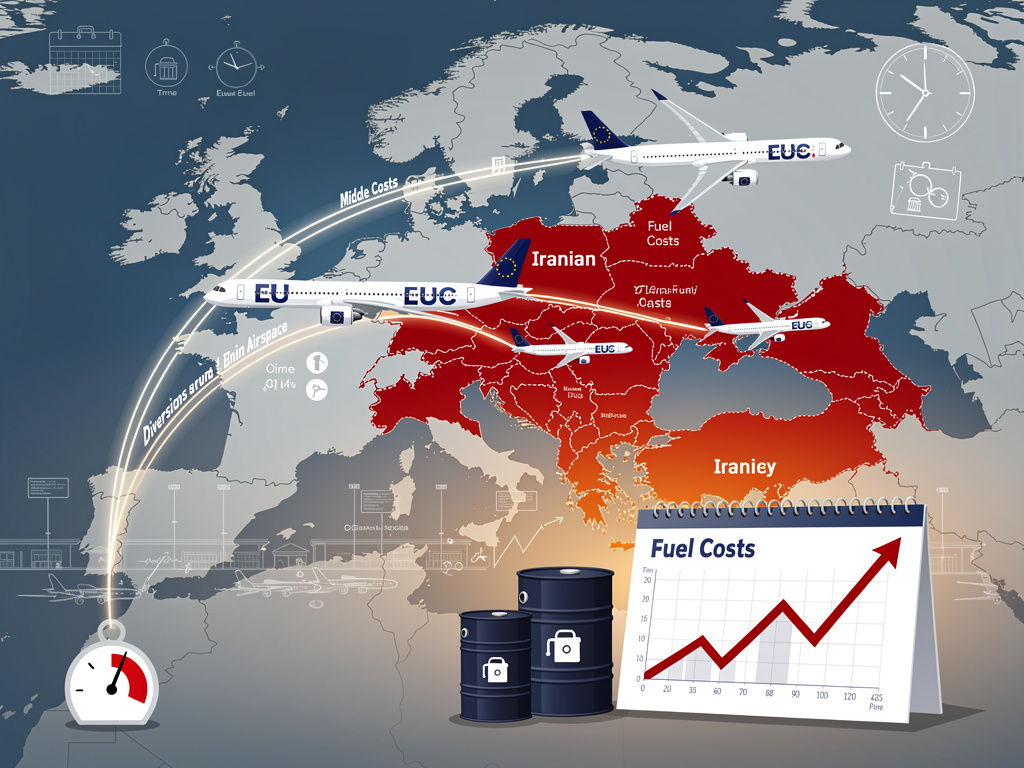
European airlines are hemorrhaging cash and adding hours to passenger journeys as escalating tensions in the Middle East force carriers to execute elaborate aerial detours around Iranian airspace. The operational nightmare, which has intensified in recent weeks, represents one of the most significant disruptions to international aviation since the outbreak of the Ukraine conflict forced similar diversions over Russian territory.
According to Business Insider, multiple European carriers have implemented hourslong diversions on routes connecting Europe to Asia and the Middle East, with some flights adding up to three additional hours to their scheduled journey times. The diversions come as geopolitical tensions in the region have reached a critical threshold, prompting aviation authorities and individual carriers to reassess the safety of transiting Iranian airspace.
The financial implications are staggering. Industry analysts estimate that each hour of additional flight time costs airlines between $5,000 and $15,000 in fuel alone, depending on aircraft type, not accounting for crew expenses, passenger compensation obligations, and the cascading effects on aircraft utilization rates. For carriers operating multiple daily flights through the affected corridors, the monthly cost escalation easily reaches into the tens of millions of dollars.
The Domino Effect on Network Operations
The operational complexity extends far beyond simple route adjustments. Airlines must recalculate fuel requirements, adjust payload capacities to accommodate additional fuel weight, and in some cases, add technical stops that were previously unnecessary. The ripple effects touch every aspect of airline operations, from crew scheduling to maintenance planning, as aircraft spend more time in the air and less time at gates where routine servicing occurs.
European carriers with significant Asian networks have been particularly hard hit. Routes from Frankfurt, London, Paris, and Amsterdam to destinations in India, Southeast Asia, and beyond traditionally relied on efficient flight paths through Iranian airspace. The current restrictions have forced these airlines to chart courses that swing far north through Central Asian airspace or south over the Arabian Peninsula, adding substantial distance and time to each journey.
Passenger Experience Takes a Hit
For passengers, the diversions translate into longer journey times, increased fatigue, and in some cases, missed connections. Business travelers who carefully planned itineraries around specific arrival times now face uncertainty, while leisure passengers discover that their direct flights have become marathon endurance tests. The situation has prompted some travelers to reconsider their routing entirely, opting for alternative connection points or even different airlines that might offer more favorable geography.
Airlines have struggled to communicate these changes effectively. While most carriers notify passengers of significant schedule changes, the fluid nature of the current situation means that routing decisions sometimes occur closer to departure time than ideal for passenger planning. Some airlines have offered rebooking options without penalty, though this gesture does little to address the fundamental problem of limited alternatives when entire regions of airspace become unavailable.
The Historical Context of Airspace Closures
This is not the first time European airlines have faced major airspace restrictions. The closure of Russian airspace to European carriers following the Ukraine invasion in 2022 forced similar diversions, particularly affecting routes to Northeast Asia. However, the Iranian situation presents unique challenges due to the region’s geographic position as a critical bridge between Europe and South Asia, making alternative routes significantly longer and more complex from a navigation and overflight permissions standpoint.
The aviation insurance industry has also responded to the heightened risks. Premiums for routes in the region have increased substantially, adding another layer of cost to already expensive diversions. Some insurers have imposed additional requirements or exclusions for flights operating in proximity to conflict zones, forcing airlines to make difficult decisions about which routes remain economically viable under current conditions.
Regulatory Agencies Walk a Tightrope
European aviation safety regulators, including the European Union Aviation Safety Agency (EASA), have issued guidance to carriers regarding operations in the affected region, though they have stopped short of imposing blanket prohibitions. Instead, they have adopted a risk-based approach that allows individual airlines to make their own assessments based on current intelligence and their specific operational circumstances. This flexibility acknowledges the rapidly evolving nature of the situation while placing ultimate responsibility on carriers.
The approach contrasts with more prescriptive responses to previous crises, reflecting both the complexity of the current geopolitical situation and the economic realities facing an industry still recovering from pandemic-related losses. Airlines appreciate the flexibility but also recognize the liability implications of making independent safety decisions in such a volatile environment.
Economic Pressure Mounts on Struggling Carriers
The timing could hardly be worse for European aviation. Many carriers entered 2024 with optimistic growth projections, expecting strong demand for international travel to finally translate into sustained profitability. The Iranian airspace situation threatens those projections, adding unexpected costs at a time when airlines can ill afford additional financial pressure. Some analysts have already begun revising their earnings estimates for affected carriers, anticipating that the diversions will materially impact quarterly results.
Smaller carriers with limited financial reserves face particularly acute challenges. While major flag carriers can absorb short-term cost increases, regional airlines operating thin-margin long-haul routes may find certain services become unprofitable under current conditions. Industry observers expect some route suspensions or frequency reductions if the situation persists beyond the immediate term.
Technology and Planning Adaptations
Airlines have deployed sophisticated flight planning software to optimize their diverted routes, seeking to minimize the time and fuel penalties while maintaining safety margins. These systems consider multiple variables including weather patterns, available alternate airports, air traffic control capacity along alternative routes, and real-time fuel prices at potential refueling stops. The computational complexity has increased exponentially as planners must now account for dynamic exclusion zones that can shift with little notice.
Some carriers have invested in additional fuel capacity modifications for specific aircraft in their fleets, allowing them to operate longer sectors without technical stops. While these modifications require significant upfront investment and regulatory approval, they offer long-term operational flexibility that proves valuable in the current environment and could provide advantages in future disruption scenarios.
The Competitive Implications
The diversions have created an uneven competitive playing field. Airlines based in regions unaffected by the restrictions, particularly Gulf carriers and some Asian airlines, can maintain more direct routing on certain city pairs, giving them a significant advantage in travel time and operating costs. This geographic advantage threatens to shift market share on key routes, with long-term implications for European carriers’ competitive position in the lucrative Europe-Asia market.
Some European airlines have responded by adjusting their network strategies, emphasizing routes where their geographic position provides advantages or where competition from Middle Eastern carriers is less intense. Others have explored codeshare arrangements and partnerships that allow them to offer customers alternatives while minimizing their own exposure to the most affected routes.
Looking Ahead: Uncertainty as the New Normal
Aviation industry executives privately acknowledge that the current situation may represent a new operational reality rather than a temporary disruption. With geopolitical tensions showing few signs of abating, airlines are beginning to plan for extended periods of restricted airspace access. This longer-term perspective requires fundamental rethinking of network design, aircraft deployment, and financial modeling.
The situation underscores the vulnerability of international aviation to geopolitical events beyond carriers’ control. As airlines invest billions in new aircraft and route development, the Iranian airspace crisis serves as a stark reminder that even the most carefully constructed business plans can be upended by events in distant regions. For European carriers, the challenge now is to adapt quickly while maintaining service quality and financial stability in an increasingly unpredictable operating environment. The coming months will test the resilience and adaptability of an industry that has already endured unprecedented challenges in recent years.


 WebProNews is an iEntry Publication