
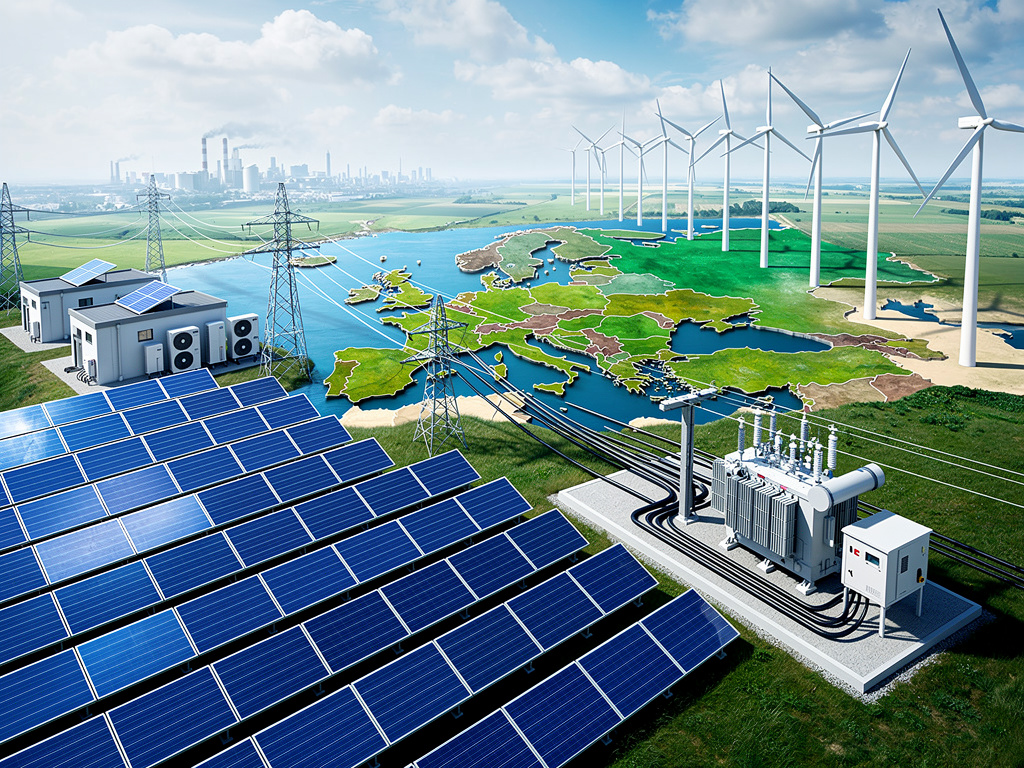
Europe’s Renewable Revolution: Surging Toward a Sustainable Horizon in 2025
In the heart of Europe’s energy transformation, 2025 has emerged as a pivotal year, marked by significant strides in renewable sources that are reshaping the continent’s power systems. According to the latest data from Eurostat, the statistical office of the European Union, renewable energy’s share in the EU’s final energy consumption climbed to 25.4% in 2024, with projections indicating further growth into 2025. This uptick, driven primarily by expansions in solar, wind, and heat pump technologies, underscores a broader push toward meeting ambitious climate goals. Industry experts view this as not just statistical progress but a fundamental shift in how Europe generates and consumes power, influenced by policy, innovation, and market dynamics.
The momentum is evident in quarterly figures. Eurostat’s report on renewables in electricity generation for the third quarter of 2025 reveals that 49.3% of net electricity in the EU came from renewable sources, a 3.8% increase from the same period in 2024. Countries like Denmark led the pack with an astonishing 95.9% renewable share, followed by Austria at 93.3% and Estonia at 85.6%. This data, detailed in Eurostat’s news article, highlights how solar power contributed 38.3%, wind 30.7%, and hydro 23.3% to the renewable mix. For insiders in the energy sector, these numbers signal accelerating deployment rates that could redefine grid stability and investment strategies across the bloc.
Yet, this progress isn’t uniform. Nations such as Malta, Czechia, and Slovakia lag with shares below 22%, pointing to infrastructural and economic hurdles. The European Environment Agency (EEA) notes in its analysis that achieving the EU’s 42.5% renewable target by 2030 will demand doubling past deployment speeds, necessitating a profound overhaul of energy infrastructures. As reported in the EEA’s indicator page, the 2024 increase was about one percentage point, largely fueled by solar and wind expansions, but sustaining this requires addressing supply chain bottlenecks and regulatory harmonization.
Accelerating Deployment Amid Policy Shifts
Delving deeper, the supply of renewable energy in the EU grew by 3.4% in 2024, reaching approximately 11.3 million terajoules, as per preliminary Eurostat data. This contrasts sharply with declining fossil fuel supplies, like a 10% drop in brown coal and 13.8% in hard coal. Such trends, outlined in Eurostat’s July 2025 article, illustrate a deliberate pivot away from carbon-intensive sources. For energy professionals, this data is crucial for forecasting market shifts, particularly in how renewables are integrating with existing grids to enhance resilience against price volatility.
National stories add layers to this narrative. Croatia, for instance, has leveraged its hydroelectric heritage since 1895, now complementing it with solar and wind to aim for 2030 targets by 2025. Wikipedia’s entry on renewable energy in the EU details how Croatia plans to add 350 MW of solar in 2022-2023 and more thereafter, positioning it as a model for smaller economies. This contrasts with larger players like Germany, where renewable integration grapples with industrial demands, yet contributes to the EU’s overall upward trajectory.
Broader economic indicators tie into this energy story. Posts on X from sources like World of Statistics highlight EU GDP growth projections for 2025 at around 1.1%, with inflation stable at 2.1%, per Eurostat data. These figures suggest that renewable investments are bolstering economic stability, as energy costs stabilize amid global uncertainties. The European Commission’s spring forecast, shared on X by @EU_Commission, projects varied growth rates, with Malta at 4.1% and Germany at 0%, underscoring how renewable-rich nations may fare better in recovery.
Technological Innovations Driving the Charge
Innovation is at the core of this surge. Heat pumps, mentioned prominently in EEA reports, have seen rapid adoption, contributing to the renewable share’s growth. Eurostat’s interactive publication Shedding Light on Energy in Europe – 2025 Edition, updated in March 2025, provides visualizations showing non-renewable waste’s role diminishing as renewables expand. This tool, linked directly to live databases, allows insiders to track real-time shifts, revealing how solar’s dominance in Q3 2025 electricity generation reflects technological maturation and cost reductions.
Wind power’s evolution is equally compelling. With 30.7% of renewable electricity from wind in Q3 2025, per Eurostat, offshore projects in the North Sea are scaling up, supported by EU funding. Ember’s 2024 European Electricity Review, accessible via Ember’s report, notes crucial strides in electricity transition, with low-carbon sources hitting records. Extending into 2025, Ember’s follow-up analysis emphasizes how wind and solar are displacing gas, which accounted for 16% of the EU mix according to Low Carbon Power data.
Nuclear’s interplay with renewables adds complexity. Low Carbon Power’s overview of the EU electricity generation mix for 2025 shows nuclear at 23%, complementing wind (17%) and gas (16%). This hybrid approach ensures baseload stability, vital for industries reliant on consistent power. As X posts from Statisight discuss, Ireland’s projected 9.1% GDP growth in 2025 ties to tech and pharma exports, indirectly benefiting from stable, green energy supplies across the EU.
Economic Ripples and Investment Opportunities
The economic implications are profound. Eurostat’s recent news on primary energy consumption dropping 0.8% in 2024 to 1,202 million tonnes of oil equivalent brings the EU closer to its 2030 target of 992.5 Mtoe. Detailed in Eurostat’s December 2025 article, this reduction highlights efficiency gains from renewables. For investors, this translates to opportunities in green bonds and infrastructure projects, as the bloc’s energy system transforms.
Trade balances also reflect this shift. The euro area’s goods trade surplus rose to €18.4 billion in October 2025, up from €7.1 billion the previous year, with exports increasing 1.0%, as per Eurostat’s euro indicators. This resilience, amid stable inflation at 2.1% reported in Eurostat’s latest update, suggests renewables are cushioning against energy import dependencies, particularly from volatile global markets.
Agricultural productivity, up 9.2% in 2025 per Eurostat, intersects with energy trends through bioenergy. The Eurostat article on agricultural labour ties this to broader sustainability, where renewable integration supports rural economies via biomass and wind farms on farmland.
Challenges in Uniform Adoption
Despite these advances, challenges persist. Industrial production rose modestly by 0.8% in the euro area in October 2025, per Eurostat’s indicators, but sectors like manufacturing face higher costs during transition. X discussions from users like Karma Zapati point to Germany’s stagnation and France’s deficits, exacerbated by energy shifts, yet these are offset by renewable-driven recoveries elsewhere.
Policy coherence remains key. The EU’s upcoming HICP methodological changes in 2026, as pre-announced by Eurostat, will refine how energy prices are tracked, potentially influencing investment decisions. Meanwhile, Ember’s 2025 insights, in their January report, project continued low-carbon growth, urging faster grid modernizations.
Social media sentiment on X, from accounts like World Insights listing EU GDPs, reflects optimism, with Poland’s $0.9 trillion economy benefiting from renewable expansions. This public discourse amplifies the need for inclusive policies to ensure all member states participate in the green surge.
Future Trajectories and Strategic Imperatives
Looking ahead, the EU’s renewable trajectory hinges on innovation and collaboration. With 21 countries showing increased renewable shares in Q3 2025, led by Estonia’s 20.6 percentage point jump, the momentum is building. Eurostat’s updated Eurostatistics article, visualized at Eurostat’s November 2025 release, provides macroeconomic overviews that insiders can leverage for strategic planning.
Investment in emerging technologies, like advanced batteries for solar storage, will be crucial. As the EEA emphasizes, doubling deployment rates demands cross-border grids and funding, potentially unlocking trillions in economic value.
Ultimately, 2025 stands as a testament to Europe’s commitment to sustainability, blending data-driven insights with bold action. For industry leaders, navigating this evolving terrain means embracing renewables not as an option, but as the cornerstone of future prosperity.


 WebProNews is an iEntry Publication