
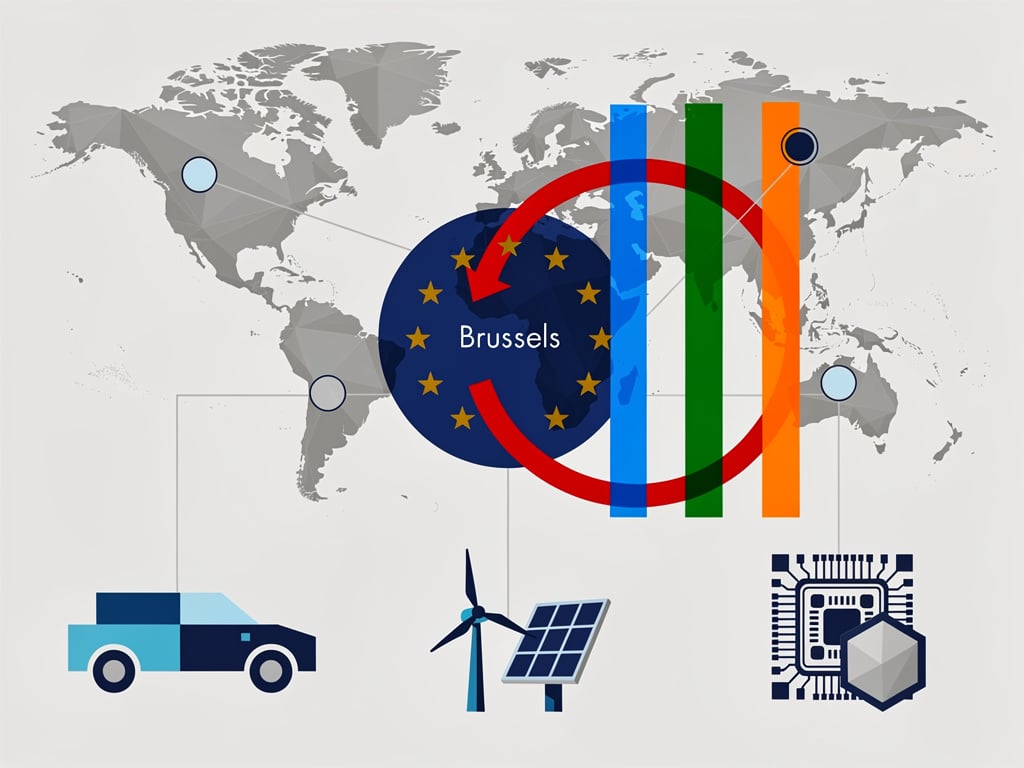
Brussels is preparing rules that would compel European companies to cap purchases of critical components from any single supplier. The move signals a hardening stance toward Beijing after years of warnings about overdependence went largely unheeded. Officials describe the proposal as a structural fix. It aims to shield key industries from sudden export bans or price spikes that have already disrupted production lines.
The plan, first reported by the Financial Times, would limit companies to sourcing no more than 30 to 40 percent of certain critical parts from one vendor. Firms would need to secure the remainder from at least two or three additional suppliers. None of those could come from the same country. The restrictions target sectors where China holds commanding positions. Think rare earth magnets for electric motors and wind turbines. Battery materials. Semiconductors. Defense components. Industrial chemicals and machinery parts.
Trade Commissioner Maros Sefcovic confirmed the Commission is weighing dedicated legislation. “Diversification requires a dedicated instrument,” he said Friday, according to a Reuters report published today. Companies would gain protection against general supply disruptions and targeted government policies. China’s recent curbs on rare earth exports offered a vivid example. Those measures briefly paralyzed some European automotive output last year.
And the timing feels deliberate. The EU’s trade deficit with China has ballooned to around €360 billion. Repeated talks on market access and industrial overcapacity produced few concessions. European leaders now declare the current trading relationship unsustainable. The Commission’s shift from voluntary guidelines to binding caps marks a departure from past policy. It builds on the Critical Raw Materials Act, which already seeks to prevent any single third country from supplying more than 65 percent of the bloc’s annual needs for strategic minerals.
Yet implementation won’t prove simple. Compliance costs could climb sharply for manufacturers already squeezed by high energy prices and slower growth. Smaller suppliers outside China often lack the scale or technology to match Chinese prices. New contracts might raise input expenses by double digits in some cases. Executives at firms dependent on just one or two Asian sources have quietly expressed concern. They worry about short-term shortages while alternative networks ramp up.
Recent business surveys paint a mixed picture. Over 70 percent of European companies operating in China reviewed their sourcing strategies in the past two years, a Reuters story from December detailed. About half reported that their Chinese suppliers had begun shifting production elsewhere. Still, roughly one-fifth of those firms continue to import critical components from China without ready substitutes. The gap between rhetoric in Brussels and daily procurement decisions in factories remains wide.
EU industry commissioner Stéphane Séjourné has prodded companies to move faster. In a May Bloomberg interview, he warned that businesses haven’t done enough to reduce major exposures. The message carries weight. Policymakers remember how quickly Russia weaponized gas supplies in 2022. They see parallel risks in Beijing’s control over processed minerals and advanced components. Dependence on China for 100 percent of certain rare earth refining and 60 percent of lithium processing no longer looks like smart economics. It looks like a vulnerability.
Supporters frame the proposal as targeted resilience. Not full decoupling. They point to the Critical Raw Materials Act’s goals of boosting domestic extraction, recycling, and processing to 10 percent or more of EU needs by decade’s end. Partnerships with allies in the Americas, Australia, and Africa would fill other gaps. The new supplier caps would sit alongside those efforts. They would force a minimum level of geographic spread that markets alone have failed to deliver.
Critics counter that the rules could distort competition and invite retaliation. Chinese officials have long criticized Western de-risking as protectionism. Beijing might respond with its own restrictions or subsidies that further undercut European producers. Some member states, particularly those with strong export ties to China, remain uneasy about measures that could escalate tensions. Germany and France have pushed for strategic autonomy, yet both fear higher costs passed on to consumers and loss of competitiveness against American and Asian rivals.
So the Commission walks a narrow path. It must design rules strict enough to change behavior but flexible enough to avoid crippling key industries. Early drafts reportedly include phased implementation and exemptions for smaller firms. Enforcement would likely fall to national authorities with oversight from Brussels. Details on exact product lists and thresholds remain under discussion. Officials hope to present a formal proposal later this year.
Global supply chain specialists have watched similar experiments in the United States. Washington’s tariffs, subsidies, and friend-shoring incentives produced mixed results. Some production returned home or moved to Mexico and Vietnam. Other chains grew more complex and opaque, creating fresh points of failure, a Wall Street Journal analysis from 2024 noted. Europe now risks repeating parts of that experience. But with stricter percentage limits and explicit country-of-origin rules, the EU approach could prove more prescriptive than anything attempted in Washington.
Industry groups have begun to weigh in. Many endorse the goal of greater security. Few welcome new compliance burdens. The European Union Chamber of Commerce in China has documented how its members are already diversifying. Its reports show both progress and persistent single-source risks. One executive quoted in chamber materials described the dilemma. Companies want to stay in the Chinese market for sales. They cannot afford to depend on it for essential inputs.
The proposal also reflects broader geopolitical recalibration. After the pandemic exposed fragile links and Russia’s war highlighted energy dangers, European policymakers treat supply concentration as a national security issue. Clean energy ambitions amplify the stakes. Wind farms need permanent magnets. Electric vehicles require batteries and motors. Semiconductors power everything from autos to defense systems. Losing access to any of these for even a few months could derail the green transition and economic plans.
Whether the caps deliver meaningful change will depend on follow-through. Past EU initiatives on critical materials set ambitious targets but moved slowly on approvals and investment. This time the language sounds tougher. Sefcovic’s public acknowledgment of a new instrument suggests political momentum at the highest levels. All 27 commissioners reportedly agreed in late May that the China trade relationship had become unsustainable.
Markets will test the seriousness of these plans quickly. Stock reactions to the latest reports have been muted. Investors appear to treat the idea as another incremental step rather than a seismic shift. But if legislation advances with real teeth and deadlines, procurement departments across the continent will have to redraw supplier maps. Alternative sources in India, Southeast Asia, Latin America, and within Europe itself would gain sudden appeal. Costs would rise. Innovation in recycling and substitution might accelerate.
China, for its part, continues to expand its own manufacturing dominance. Recent announcements of new EV plants in Europe show Beijing’s willingness to localize production when it suits strategic goals. That dual track — exporting aggressively while controlling upstream materials — keeps pressure on Brussels. The EU must balance openness to Chinese investment with determination to avoid strategic dependence.
The coming months will reveal how far member states are willing to go. Drafting the rules is one thing. Securing unanimous or qualified majority support in the Council is another. France pushes for toughness. Germany worries about its auto sector. Eastern members eye opportunities in new supply chains. The usual Brussels bargaining lies ahead.
Still, the direction looks set. After years of studies, strategies, and soft warnings, the European Commission is moving toward hard limits on single-supplier risk. The era of treating supply chain security as optional appears to be ending. Companies that ignored earlier signals may soon face regulatory consequences. And the global trading system will absorb yet another layer of fragmentation born from geopolitical caution.


 WebProNews is an iEntry Publication