
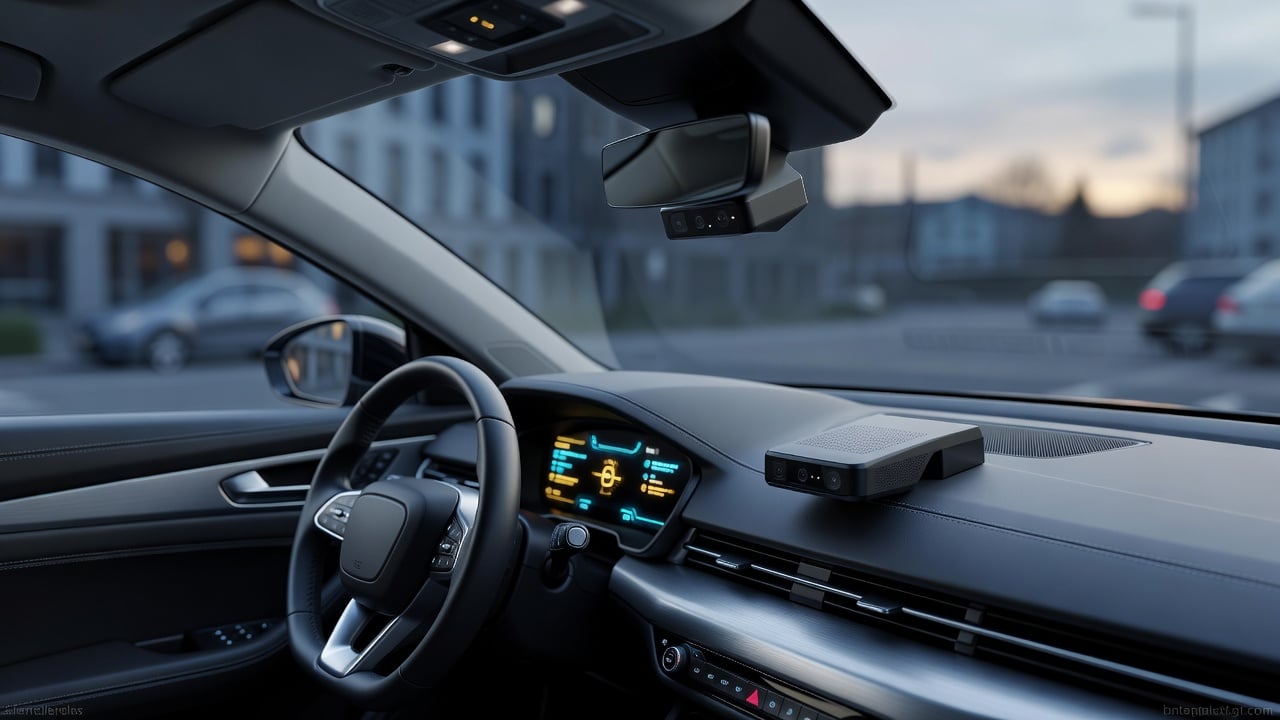
Brussels has drawn a firm line. From July 7, 2026, every new passenger car and van sold in the European Union must carry a camera that watches the driver. The rule forms the centerpiece of the second phase of the bloc’s General Safety Regulation. And it signals a decisive shift in how governments force safety technology into vehicles.
Advanced emergency braking that spots pedestrians and cyclists joins the list. So does a system that tracks eye movements and issues escalating alerts when attention wanders. Better forward visibility, fresh tire-wear tests, and expanded safety glass round out the package. These mandates build directly on requirements introduced in 2024. That first wave already forced intelligent speed assistance onto new models. The latest additions target distraction and vulnerable road users with greater precision.
The European Commission announced the rules took effect with little fanfare. “European roads are among the safest in the world, but the number of deaths and injuries from road accidents is still too high,” its statement read. The long-term target remains moving “as close as possible to zero fatalities” by 2050 under the Vision Zero banner. Officials argue the new systems will protect pedestrians, cut distraction-related crashes, and speed the spread of driver-assistance features across the fleet. (European Commission)
Yet the cabin camera provokes unease. It monitors gaze direction, head position, and behavioral cues in real time. Warnings trigger after roughly six seconds of diverted attention at moderate speeds or 3.5 seconds above 50 km/h. The system processes data locally. No video is stored or transmitted under normal operation. Even so, privacy advocates question the precedent of always-on interior monitoring. Safety researchers counter that inattention causes a large share of accidents. A timely nudge, they say, saves lives.
The Next Web reported the rollout on July 9, noting the tension. “Privacy advocates are warier of always-on cabin cameras, even when the systems are designed to work in the moment rather than record,” the article stated. It highlighted how the regulation blurs lines between assistance and future automation while pushing the industry toward software-defined vehicles packed with sensors. (The Next Web)
Manufacturers received extra development time precisely because these features demand reliability. Pedestrian detection in varied lighting, accurate distraction alerts without false positives, self-diagnostics that pass periodic inspections. All must function day or night. Neonode, a supplier of driver-monitoring software, described the deadline as both challenge and opportunity. Its materials emphasize synthetic data to accelerate feature development and position brands ahead on safety ratings. The company notes that 82 percent of European buyers weigh Euro NCAP scores when choosing vehicles. Compliance, it argues, can become a competitive edge. (Neonode)
Europe now leads where the United States lags. The European Transport Safety Council published a detailed comparison in November 2025. Many GSR-mandated systems have no direct equivalent in U.S. federal standards. These include advanced driver distraction warning, intelligent speed assistance on all vehicles, emergency lane-keeping, and specific protections for vulnerable road users. The gap drew fresh attention after crashes involving vehicles operating under supervised automation in the U.S. “The US crash highlights European oversight gap,” the ETSC memorandum observed while citing studies on risks from ever-larger vehicles. (ETSC)
Discussions on X reflected the divide. Users questioned whether the cameras represent safety or surveillance. Some posts warned of future mission creep toward monitoring seatbelt use or phone handling. Others pointed to closed-loop design and GDPR compliance. No footage is recorded. Alerts stay inside the vehicle. Regulators insist the systems avoid biometric identification. Still, the hardware exists. Its presence invites debate about data security and potential expansion.
Carmakers face real costs. Retrofitting production lines, validating camera performance across millions of units, updating type-approval documentation. Yet many already offer similar technology as optional equipment. The mandate simply removes the choice. It also raises average vehicle prices modestly while delivering fleet-wide safety gains. Early data from markets with voluntary adoption suggest distraction warnings reduce certain crash types. Full impact will emerge over years as the regulated fleet grows.
The regulation does more than add gadgets. It rewrites expectations. Drivers now share the cabin with watchful sensors. Vehicles become data-processing platforms that intervene when humans falter. This evolution aligns with broader moves toward connected and automated driving. The Netherlands recently approved supervised full self-driving trials for Tesla, testing the same legal framework that underpins these mandates.
Critics see overreach. They worry normalized interior cameras could normalize broader monitoring. Supporters see overdue progress. Human error still dominates crash statistics. Technology that keeps eyes on the road offers measurable protection. The EU chose the latter path. Its rules now bind every new car sold on the continent.
Buyers will notice the difference. A subtle camera above the steering column. Occasional chimes or vibrations if attention drifts. Stronger braking when a cyclist appears suddenly. These features arrive not as luxury options but as legal minimums. The era of purely mechanical driver responsibility has ended. A hybrid model takes its place, one where machines watch the humans who still hold the wheel.
Questions remain. Will false alerts annoy drivers into disabling systems? Can the technology adapt to diverse faces, lighting conditions, and driving styles without bias? How will enforcement and roadworthiness tests evolve? Regulators promise ongoing review. For now, the hardware ships. The cameras turn on. And European roads enter a new phase of enforced vigilance.


 WebProNews is an iEntry Publication