
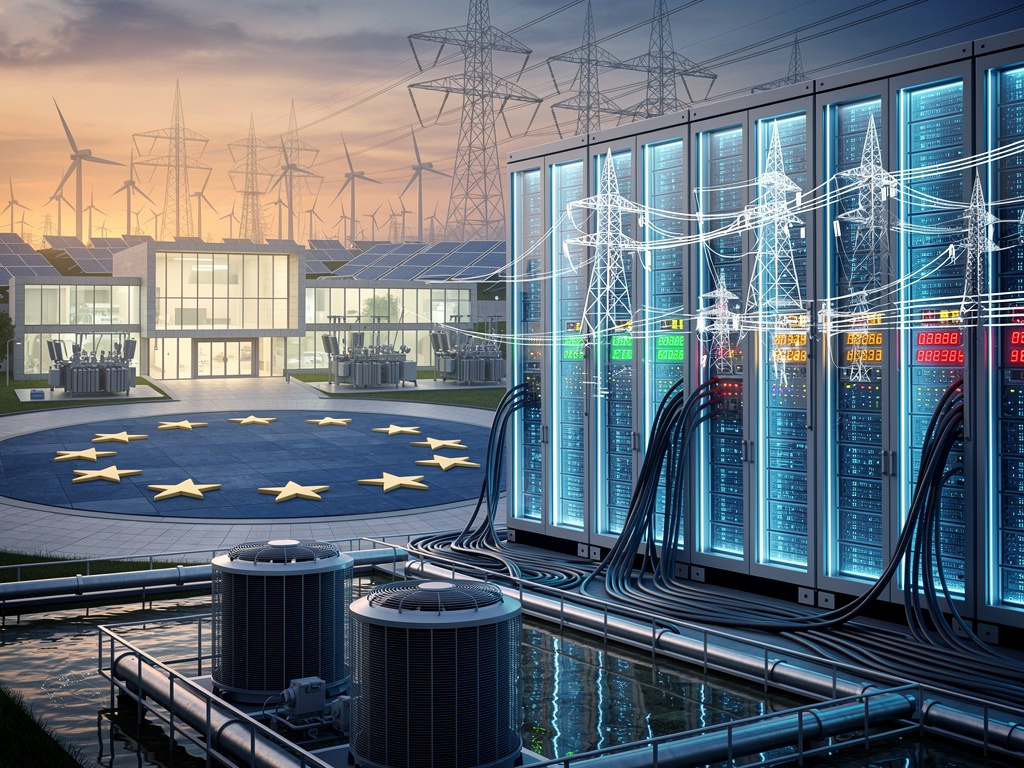
The European Union has issued a direct challenge to technology companies planning major artificial intelligence infrastructure projects across the bloc. Officials now expect data centers and high-performance computing facilities that power large language models and other AI systems to meet strict environmental standards or risk being denied approval to operate. This position, outlined in recent communications from the European Commission, reflects growing concern that the massive energy demands of modern AI could undermine the region’s climate targets.
Data centers already account for a significant share of electricity consumption in many member states. With the rapid expansion of generative AI, those numbers are projected to climb sharply. Training a single large model can require energy equivalent to the annual consumption of hundreds of households, while inference—the process of actually using these models—multiplies the load when deployed at global scale. The Commission has made clear that new facilities must demonstrate compatibility with the EU’s 2030 climate and energy targets as well as the longer-term goal of climate neutrality by 2050.
This stance builds on existing regulations such as the Energy Efficiency Directive and the forthcoming Energy Performance of Buildings Directive. Under these frameworks, operators face requirements to report energy use, implement waste heat recovery systems, and prioritize renewable power purchase agreements. What has changed is the explicit linkage between AI development and these environmental rules. Brussels is signaling that permission to build or expand data centers will increasingly depend on how well proposals align with decarbonization pathways.
Several member states have already begun translating this guidance into national policy. France, which hosts significant cloud and AI infrastructure, has introduced tighter permitting processes that evaluate projected power demand against available clean energy capacity. The Netherlands, facing grid congestion in key regions, has placed temporary moratoriums on new hyperscale projects until operators can prove they will not strain local electricity networks. Germany has emphasized the need for data centers to participate in demand-response programs that help balance the grid during periods of low renewable generation.
Industry reaction has been mixed. Some companies view the requirements as a necessary evolution that will drive genuine innovation in energy-efficient computing. Others worry that the added compliance burden could slow deployment of AI capabilities at a time when global competition, particularly from the United States and China, is intensifying. Executives at several American cloud providers have privately expressed concern that European rules could make the region less attractive for new investment compared with jurisdictions offering faster approvals and fewer environmental conditions.
The scale of the challenge is substantial. According to projections from the International Energy Agency, global data center electricity consumption could more than double by 2026 if current AI growth trends continue. In Europe, where many countries already import significant amounts of electricity or rely on aging infrastructure, the pressure is acute. A single hyperscale AI training cluster can draw as much power as a medium-sized city. When multiple such facilities are planned within the same region, the cumulative impact on transmission grids becomes a serious technical and political issue.
Renewable energy supply represents only part of the solution. Even when operators secure power purchase agreements for solar and wind generation, the intermittent nature of those sources creates timing mismatches. AI workloads tend to run continuously, whereas solar output peaks during daylight hours. This reality has pushed companies to explore various flexibility measures including battery storage, grid-scale balancing services, and even temporary workload shifting to other geographic regions. The Commission has indicated that such measures will be evaluated as part of overall compliance assessments.
Waste heat recovery has emerged as another focus area. Modern computing hardware generates enormous amounts of heat that is typically dissipated through cooling systems. In countries with district heating networks, particularly in northern Europe, there is growing interest in capturing this thermal energy for residential and commercial use. Pilot projects have demonstrated that data center waste heat can meaningfully reduce reliance on gas boilers, but scaling these systems requires careful planning of facility locations and significant upfront investment in heat exchangers and distribution pipes.
Water consumption also features in the debate. Many data centers rely on evaporative cooling that can consume millions of liters annually. In water-stressed regions this raises additional sustainability questions. The Commission has encouraged adoption of closed-loop or air-based cooling technologies, though these often come with efficiency trade-offs or higher electricity use. Finding the right balance between energy and water impacts remains an active area of engineering research.
Public sentiment across Europe adds another dimension. While citizens broadly support AI development for its economic potential, polls consistently show strong backing for climate action. Any perception that tech companies are prioritizing profits over environmental responsibility risks triggering regulatory backlash or community opposition to new facilities. Several proposed projects have already faced local protests over concerns about noise, visual impact, and resource consumption.
The financial implications are considerable. Meeting the EU’s standards will require substantial capital expenditure on more efficient servers, advanced cooling, renewable energy infrastructure, and sophisticated energy management systems. Smaller players may struggle to compete, potentially leading to further market concentration among a handful of well-resourced hyperscalers. At the same time, companies that successfully adapt could gain competitive advantage through genuine green credentials that appeal to both regulators and environmentally conscious customers.
Investment in next-generation computing architectures offers one pathway forward. Specialized AI chips that deliver more calculations per watt are already reducing energy intensity compared with general-purpose processors. Techniques such as model distillation, quantization, and efficient attention mechanisms can dramatically lower the computational requirements of AI systems without sacrificing too much capability. Research into neuromorphic and optical computing, while still largely experimental, could eventually yield orders-of-magnitude improvements in energy efficiency.
Policy makers are also exploring how to align incentives more effectively. The European Chips Act and various funding programs under Horizon Europe already support research into sustainable computing. Additional measures under consideration include tax credits for facilities that exceed minimum efficiency standards, faster permitting for projects that incorporate district heating, and potential carbon border adjustment mechanisms that would penalize AI services with high embodied emissions.
The Commission has stressed that its approach is not intended to slow AI innovation but to ensure it develops within planetary boundaries. Officials point to the region’s experience with renewable energy deployment as evidence that ambitious targets can drive technological progress rather than hinder it. They argue that Europe’s rigorous environmental framework could ultimately become a competitive strength by fostering AI systems that are both powerful and responsible.
For technology companies, the message is clear. Those planning significant AI infrastructure investments in Europe must integrate climate considerations from the earliest stages of project development. This includes transparent modeling of energy and water impacts, concrete plans for renewable sourcing and flexibility measures, and meaningful engagement with local communities and grid operators. Superficial greenwashing will likely prove insufficient as regulators increase scrutiny and demand verifiable results.
The coming years will test whether these expectations can be met at the required scale and speed. Success would demonstrate that advanced AI and aggressive climate goals can coexist. Failure could lead to fragmented development across the continent, with some member states relaxing standards to attract investment while others maintain stricter approaches. The outcome will influence not only Europe’s technological competitiveness but also its credibility on global climate leadership.
As data center proposals continue to multiply, the tension between AI ambitions and environmental limits has moved from theoretical discussion to concrete regulatory reality. The EU’s position establishes a precedent that other regions may follow as they grapple with similar pressures. Technology firms now face the task of redesigning their infrastructure strategies to satisfy both the explosive demand for computational power and the non-negotiable requirement to respect climate constraints. The next wave of data center construction in Europe will reveal how successfully that balance can be achieved.


 WebProNews is an iEntry Publication