
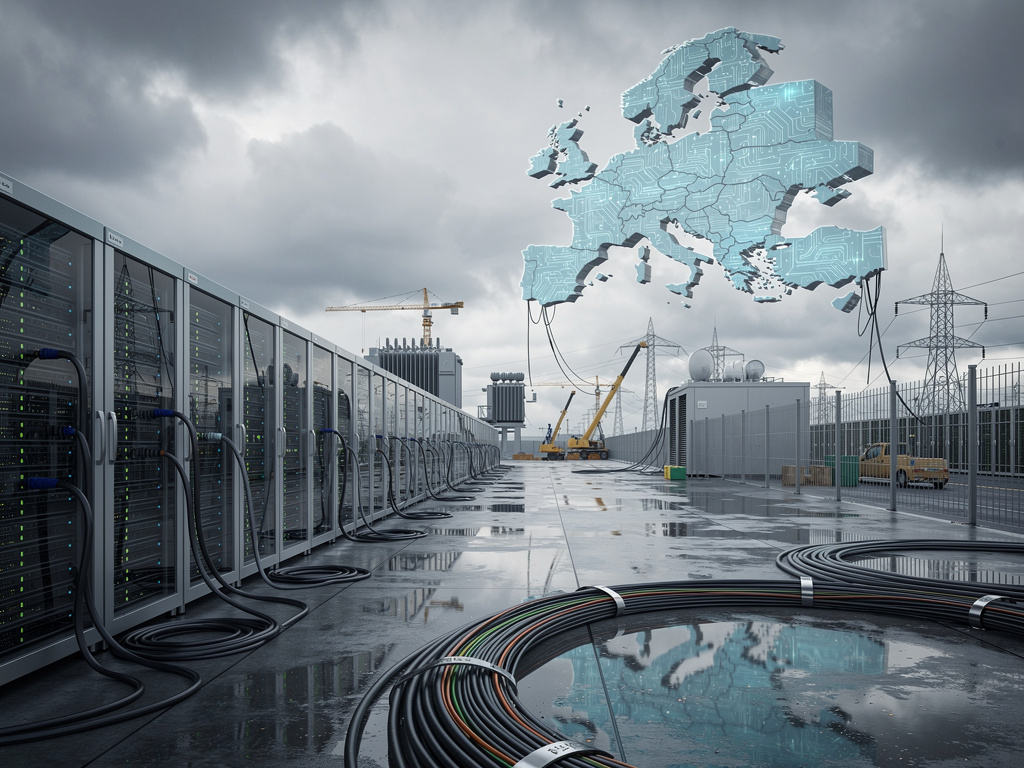
The European Union’s ambitious plan to construct a massive artificial intelligence data centre has hit significant obstacles, pushing back timelines and exposing cracks in the bloc’s strategy for technological independence. According to a report published by The Next Web, the project known as the AI Gigafactory faces delays stemming from funding shortfalls and coordination challenges among member states. This development raises fresh questions about Europe’s capacity to keep pace with global competitors in the race to build advanced computing infrastructure.
The initiative originally aimed to create one of the world’s largest concentrations of computing power dedicated to artificial intelligence training and inference. Planners envisioned a facility spanning multiple hectares, equipped with tens of thousands of high-performance graphics processing units and custom accelerators. Such a site would theoretically allow European researchers and companies to develop large language models and other complex systems without depending on foreign cloud providers. Yet the path toward realization has proven far more complicated than initial projections suggested.
Funding represents the most immediate barrier. The European Commission had hoped to draw from multiple sources, including the Digital Europe Programme, Horizon Europe research grants, and national contributions from countries such as France, Germany, and the Netherlands. However, several promised commitments have not materialized at the expected scale. Private investors, initially attracted by the prospect of public matching funds, have grown cautious as macroeconomic conditions tightened across the continent. Inflation, higher interest rates, and energy price volatility have made the enormous capital expenditure required for such a project look riskier than it did two years ago.
Energy supply forms another critical constraint. Modern AI data centres consume electricity at a scale comparable to small cities. A single facility of the proposed size could require several hundred megawatts of continuous power, much of it needed to run servers and even more to cool them. European grids, already strained by the transition away from Russian gas and the variable output of renewable sources, struggle to guarantee the firm capacity these installations demand. Negotiations with utility companies in potential host regions have dragged on longer than anticipated, further contributing to the slippage in schedules.
Location debates have added layers of complexity. Several member states positioned themselves as candidates, each highlighting local advantages. Finland emphasized its cold climate and abundant carbon-free nuclear and hydroelectric power. Spain pointed to its solar resources and lower land costs. Eastern European nations offered cheaper labor and generous tax incentives. The absence of a clear decision-making framework at the EU level has turned the selection process into a protracted political negotiation rather than a straightforward technical evaluation. Each round of discussions has introduced new conditions and demands, slowing momentum.
The delays carry consequences beyond mere inconvenience. European technology firms seeking to train foundational models currently rent capacity from American hyperscalers or, in some cases, Chinese providers. This arrangement creates both direct financial costs and strategic vulnerabilities. Data residency rules under the General Data Protection Regulation add compliance overhead when information crosses borders. More significantly, reliance on foreign infrastructure means European organizations must accept the priorities and scheduling constraints set by overseas companies whose business models may not always align with continental interests.
Industry leaders have expressed measured frustration. Representatives from groups such as the European AI Alliance and the Confederation of European Business have called for accelerated action while acknowledging the genuine difficulties involved. They argue that without substantial sovereign capacity, Europe risks falling further behind in a field where computational resources increasingly determine competitive advantage. Startups in particular face steep bills when scaling their models, often forcing them to seek funding rounds primarily to cover cloud computing expenses rather than product development.
The situation also highlights deeper structural issues within European innovation policy. Fragmentation across national borders remains a persistent obstacle. While the single market provides a theoretical foundation for continent-wide projects, practical implementation still requires harmonizing regulations, tax regimes, permitting processes, and subsidy schemes that differ markedly between countries. The AI Gigafactory was meant to serve as a demonstration that these barriers could be overcome, yet its troubles suggest the opposite lesson may be emerging.
Alternative approaches have begun to surface in policy discussions. Rather than concentrating resources in a single enormous site, some experts advocate for a distributed network of specialized facilities connected through high-speed fiber links. This model would spread both the energy burden and the economic benefits across multiple regions. It could also allow for more modular expansion as technology evolves. Proponents point to existing high-performance computing networks, such as those coordinated through EuroHPC, as proof that distributed architectures can work effectively for scientific workloads. Whether such a system could deliver the same economies of scale for commercial AI training remains an open question.
Supply chain considerations compound the challenge. Advanced AI chips remain overwhelmingly manufactured in Taiwan and designed primarily by companies based in the United States. European efforts to develop indigenous silicon, through initiatives like the European Processor Initiative, have progressed more slowly than hoped. Without control over the semiconductor layer, any data centre project will continue to depend on global supply chains vulnerable to geopolitical tensions. Recent export restrictions between the United States and China have served as a reminder of how quickly access to critical components can change.
Workforce availability presents yet another dimension. Building and operating a facility at this scale requires thousands of specialized engineers, data center technicians, and AI researchers. Europe produces talented graduates, but many choose to pursue opportunities in North America or Asia where compensation packages and research environments often appear more attractive. Retention strategies, including improved visa policies for non-EU talent and increased investment in domestic doctoral programs, will need to accompany any serious infrastructure push.
Despite current setbacks, the underlying rationale for the project has not disappeared. Demand for AI computing continues to grow exponentially across sectors ranging from pharmaceutical research to automotive engineering. European businesses that adopt these technologies risk falling behind global peers if they cannot access sufficient resources. Public sector applications in areas such as climate modeling, healthcare diagnostics, and security analysis similarly require massive computational capacity that exceeds what most national facilities currently provide.
The European Commission has signaled willingness to adapt its approach. Recent communications suggest a shift toward more flexible financing mechanisms that could include green bonds, public-private partnership structures with clearer risk allocation, and potentially direct equity stakes in key projects. Officials have also indicated that multiple sites might receive support rather than attempting to designate a single winner. This evolution reflects lessons learned from previous large-scale technology initiatives that sometimes suffered from overly rigid planning.
Private sector interest has not entirely evaporated. Several major European telecommunications operators and industrial conglomerates maintain active discussions about participating in AI infrastructure. Their involvement could bring operational expertise developed through years of managing large networks and energy systems. The question is whether they can mobilize capital at the speed required to close the growing gap with facilities already operating or under construction in other parts of the world.
International cooperation offers another potential avenue. Partnerships with like-minded democracies such as the United Kingdom, Canada, and Japan could pool resources and share best practices. Joint procurement of equipment might achieve better pricing and supply security. Collaborative governance frameworks could establish common standards for energy efficiency, data protection, and ethical AI development. However, translating these concepts into concrete agreements takes time, something the current situation suggests is in short supply.
The delays affecting the AI Gigafactory should not be viewed in isolation. They mirror broader difficulties Europe has encountered in executing ambitious technology programs, from semiconductor manufacturing targets under the Chips Act to battery gigafactories for electric vehicles. Each case reveals tensions between grand strategic visions and the practical realities of execution across a diverse union of 27 member states with varying economic conditions and political priorities.
Looking forward, resolution will likely require stronger leadership from the highest levels of European institutions. Clear deadlines, dedicated funding streams insulated from annual budget negotiations, and streamlined approval processes could restore confidence among both public and private stakeholders. Technical decisions about architecture and location need to be insulated from excessive political influence while still ensuring fair distribution of benefits.
The coming months will prove decisive. If funding gaps can be closed and construction permits accelerated, the project might regain lost ground. Failure to do so could lead to a fundamental reassessment of Europe’s approach to AI infrastructure. In that scenario, the continent might pivot toward becoming a sophisticated consumer of AI services developed elsewhere rather than a producer of foundational technologies. Such an outcome would carry long-term implications for economic competitiveness, strategic autonomy, and the ability to shape global standards in an increasingly AI-driven world.
The challenges are substantial, but so are the potential rewards of success. A functioning European AI computing facility of significant scale would provide a platform for innovation across countless applications. It would reduce dependency on foreign providers, create high-value jobs, and signal to the world that the continent remains committed to technological leadership. Achieving that vision will demand persistence, creativity in financing, and a willingness to adapt plans to changing circumstances. The current stumbling phase, while disappointing, may ultimately force the development of more sustainable and effective strategies for the years ahead.


 WebProNews is an iEntry Publication