
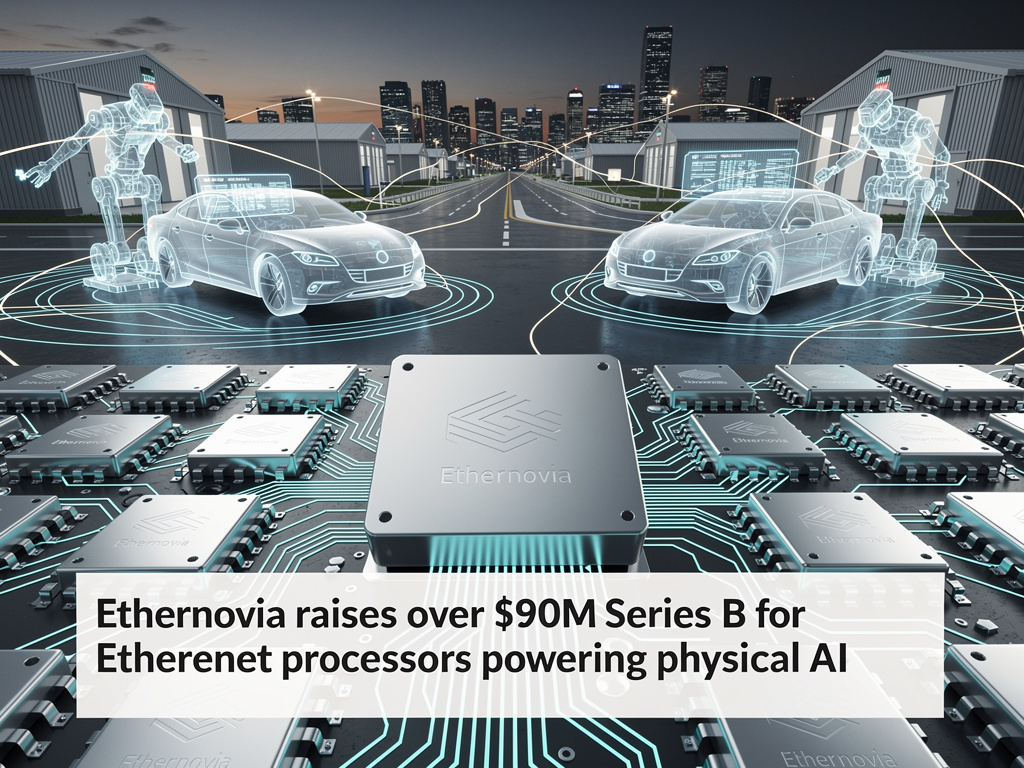
SAN JOSE, Calif.—Silicon Valley startup Ethernovia has secured more than $90 million in a Series B funding round, positioning itself at the heart of what its CEO calls the “era of physical AI.” The financing, announced this week, comes as investors pour capital into technologies enabling machines that observe, reason and act in real-world settings, from self-driving cars to industrial robots.
Co-founder and CEO Ramin Shirani, speaking at the New York Stock Exchange, described the fresh capital as vital for expanding commercialization, bolstering go-to-market efforts and hiring top engineers. “The biggest asset of the company is our engineering talent,” Shirani told NYSE Live on YouTube. “We’re going to continue hiring the best engineers and the best of the breed in the world.”
Funding Fuels Expansion Amid AI Shift
The round was led by Maverick Silicon and Socratic Partners, with participation from Conduit Capital, CDIB-TEN Capital and others including Qualcomm Ventures, AMD Ventures and Porsche SE, according to Forbes. Ethernovia, founded in 2018, specializes in high-performance Ethernet packet processors designed as the data backbone for autonomous vehicles, robots and edge devices.
Shirani emphasized the timing: “We’re at a point in physical AI and the evolution from cloud and data center AI to physical AI where there’s a lot of push to robots and autonomous vehicles.” This raise, he said, is “fundamental for our roadmap from a go-to-market perspective.”
From Automotive Roots to Broader AI Frontier
Ethernovia began by targeting the “nervous system” of autonomous vehicles but has broadened its focus as AI migrates to physical applications. “Physical AI is basically autonomous machines that can think, reason, and take action in the environment,” Shirani explained in the NYSE interview. The company’s chips handle deterministic Ethernet connectivity, crucial for low-latency data flow in time-sensitive systems.
Posts on X highlight the technology’s edge. One industry observer noted, “Physical AI breaks when networks introduce uncertainty. Determinism matters,” praising Ethernovia’s infrastructure for software-defined vehicles and robotics. The startup’s processors enable seamless data movement from sensors to AI compute units like CPUs and GPUs.
Investors Eye Deterministic Networking Edge
SiliconANGLE reported the funding will advance Ethernet packet processors for automotive and edge AI, addressing bottlenecks in high-bandwidth, real-time environments. Unlike general-purpose networking, Ethernovia’s solutions prioritize predictability, essential for safety-critical applications.
Shirani defined physical AI clearly: “Machines that can observe their surrounding… understand and… reason and be able to then take action in the physical environment.” Connectivity forms the foundation, linking sensors to processing cores in robots, vehicles and edge devices—what he termed the “AI pipe.”
2026 Roadmap Targets Commercial Ramp
For 2026, Ethernovia plans to deploy the capital toward engineering, operations and customer-facing teams to accelerate its product roadmap. Yahoo Finance noted the company’s push into robotics beyond automotive, riding investor enthusiasm for physical AI amid hype around humanoid robots and autonomy.
The funding reflects broader momentum. Just-Auto detailed how the capital supports automotive Ethernet chip development for intelligent machines. Strategic backers like Porsche SE signal confidence in Ethernovia’s role in next-generation vehicles.
Challenges in Real-Time AI Connectivity
While AI processors and sensors dominate headlines, Shirani stressed networking as the overlooked enabler. “There’s a lot of emphasis on AI processors, sensors, but really what makes a lot of sense is the nervous system of the machine,” he said. Ethernovia’s tech ensures data integrity across distributed systems in dynamic environments.
Industry sentiment on X underscores the stakes. Posts describe Ethernovia as revolutionizing the “nervous system” for physical AI, with one calling it a leap for AI integration into real-world uses. The company’s Silicon Valley base and engineering focus position it against incumbents in Ethernet semiconductors.
Strategic Backers and Market Positioning
Qualcomm Ventures and AMD Ventures’ involvement bridges mobile, computing and automotive worlds, per Yahoo Finance Singapore. Porsche SE’s stake aligns with its push into software-defined vehicles. These partners provide not just capital but validation and potential integration paths.
Shirani founded Ethernovia amid rising demand for zonal architectures in cars, where Ethernet replaces slower protocols. Expansion to robots taps similar needs for scalable, low-power networking in edge AI deployments.
Physical AI’s Demands Reshape Semiconductors
The shift demands chips handling terabits of data with microsecond precision. Ethernovia’s packet processors support time-sensitive networking (TSN) standards, vital for synchronized operations in factories or fleets of drones. This differentiates it in a field crowded with AI accelerators but sparse on connectivity specialists.
As physical AI scales—think warehouse robots coordinating in real time or vehicles platooning—reliable intra-machine communication becomes a chokepoint. Ethernovia aims to own this layer, much like Ethernet did for data centers.
Talent and Execution as Core Strengths
Hiring remains priority one. Shirani reiterated engineering as the firm’s bedrock, drawing talent versed in automotive-grade silicon and AI pipelines. In a competitive market, this talent war echoes broader chip industry pressures.
Ethernovia’s blog frames the raise as scaling “leading-edge autonomy and physical AI networking chips,” signaling production ramps ahead.
Investor Rush Signals Maturing Opportunity
The deal caps a week of big AI and robotics financings, per Crunchbase reports on funding trends. Ethernovia’s valuation and terms remain undisclosed, but the oversubscribed round suggests strong interest. For insiders, it marks Ethernet’s evolution from networking staple to AI-critical infrastructure.
Shirani’s vision: Ethernovia as the connective tissue enabling machines to “think autonomously.” With $90 million in tow, the startup is wiring the innards of tomorrow’s intelligent world.


 WebProNews is an iEntry Publication