
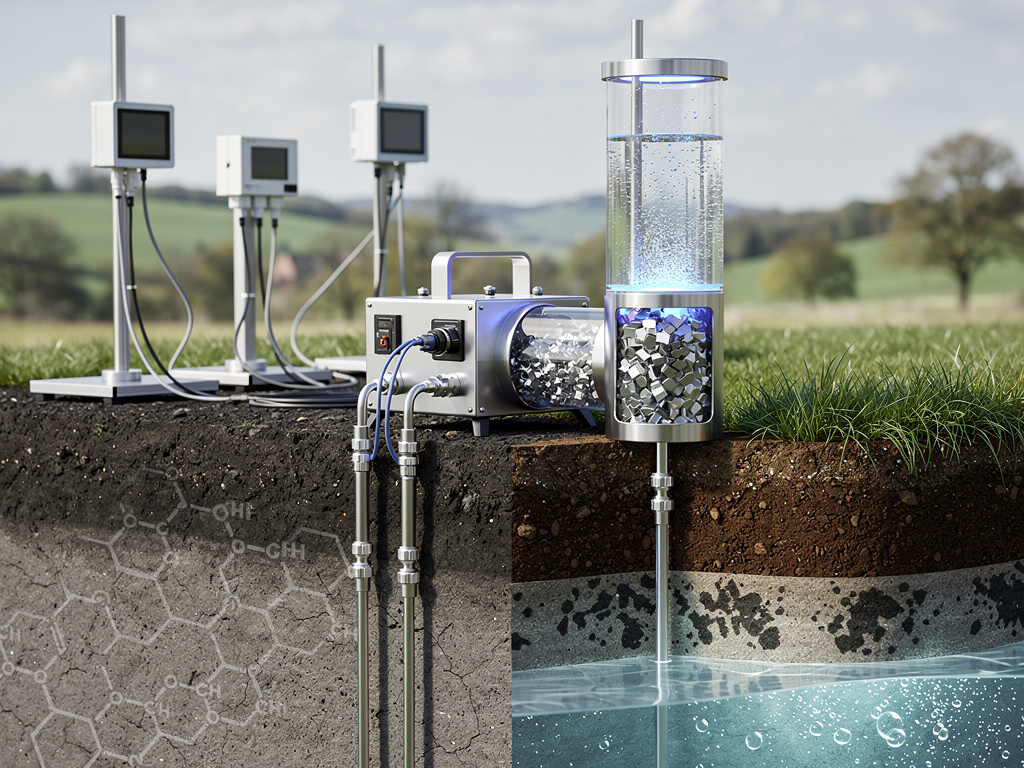
Zapping Legacy Poisons: Electrolysis Emerges as a Game-Changer in Toxic Waste Remediation
In the shadow of abandoned industrial sites across Europe and beyond, a silent crisis lingers: soils and groundwater poisoned by persistent organic pollutants like DDT and lindane. These chemicals, once hailed as miracle pesticides, now haunt ecosystems, seeping into food chains and threatening human health decades after their bans. But a breakthrough from researchers at ETH Zurich promises a radical shift, using electrolysis to not only neutralize these toxins but transform them into valuable resources. This innovation, detailed in a recent study, could redefine how we tackle some of the most stubborn environmental contaminants.
The process hinges on electrochemical reduction, where an electric current drives reactions that break down hazardous molecules on-site. Unlike traditional methods that involve digging up contaminated earth and incinerating it—often at great expense and with significant carbon emissions—this approach treats pollutants directly in the ground or extracted slurries. ETH Zurich’s team, led by chemists and environmental engineers, has demonstrated that by applying a carefully controlled voltage to electrodes immersed in contaminated media, they can cleave chlorine atoms from compounds like lindane, rendering them harmless and even yielding byproducts like benzene derivatives useful in pharmaceuticals or plastics.
What sets this apart is its circular economy angle. Instead of merely destroying waste, the method recovers materials that can feed back into industrial processes. For instance, the dechlorination of lindane produces intermediates that can be purified and sold, offsetting remediation costs. Early tests on Swiss sites contaminated from past pesticide production showed over 90% degradation efficiency, with minimal energy input compared to thermal treatments.
Breaking Down Barriers in Remediation Tech
Scaling this up poses challenges, but the ETH team has engineered modular electrolysis units that can be deployed directly at polluted locations, avoiding the logistics nightmare of transporting tons of hazardous soil. The system’s design incorporates robust electrodes made from carbon-based materials, resistant to fouling in complex soil matrices. According to the researchers, this adaptability makes it suitable for diverse contaminants, from chlorinated hydrocarbons to potentially even PFAS, the so-called “forever chemicals.”
Integration with renewable energy sources amplifies its appeal. By powering the electrolysis with solar or wind-generated electricity, the process achieves near-zero emissions, aligning with global sustainability goals. A pilot project in a former lindane production facility near Basel illustrated this potential: over six months, the setup processed 500 cubic meters of contaminated groundwater, recovering valuable hydrocarbons while purifying the water to potable standards.
Industry experts note that while electrolysis isn’t new—it’s been used in water treatment for decades—this application to legacy pollutants marks a significant evolution. “We’re moving from reactive cleanup to proactive resource recovery,” says one environmental consultant familiar with the work. The economic incentives are clear: remediation costs, which can run into billions for large sites, could be halved by selling recovered chemicals.
From Lab to Field: Real-World Applications
The ETH innovation builds on broader trends in electrochemical technologies. A review in the journal PMC highlights electrodialysis applications in wastewater treatment, showing how electric fields separate ions and organics, a principle echoed in the Zurich process. That 2020 study outlined progress in membrane-based systems, but recent advancements have pushed boundaries further, incorporating nanomaterials for enhanced selectivity.
In a parallel development, researchers at the University of Adelaide have adapted electrolysis for seawater hydrogen production without desalination, as reported in posts on X from users discussing clean energy innovations. This technique, which avoids chemical additives, mirrors the purity focus in ETH’s method, suggesting cross-pollination potential between hydrogen fuel and contamination cleanup sectors.
Moreover, a comprehensive evaluation in MDPI from April 2025 delves into various water electrolysis technologies, including proton exchange membrane and solid oxide cells. It emphasizes modeling approaches that predict performance, which could be applied to optimize the ETH system’s electrode configurations for different soil types.
Innovations Sparking a Circular Economy
The promise extends to global hotspots. In the U.S., Superfund sites laden with DDT residues could benefit, where current pump-and-treat methods fall short on efficiency. ETH’s on-site electrolysis offers a faster alternative, potentially reducing cleanup timelines from years to months. Cost analyses in a Hydrogen Tech World article project that by 2030, such technologies could lower the levelized cost of hydrogen production, with spillover benefits for environmental applications.
Recent news underscores the urgency. A November 2025 piece in Phys.org echoes the ETH findings, noting the breakthrough’s role in sustainable remediation. It details how the process converts toxins into commodities, fostering a circular economy that turns environmental liabilities into assets.
On X, discussions around wastewater-to-energy conversions highlight public interest. Posts from accounts like Shining Science describe breakthroughs in producing green hydrogen from sewage, aligning with ETH’s resource recovery ethos. These sentiments reflect growing optimism that electrochemical methods could address water scarcity and pollution simultaneously.
Overcoming Technical Hurdles
Despite the hype, challenges remain. Electrode degradation in highly contaminated environments can limit longevity, requiring ongoing research into durable materials like graphene composites. A 2025 review in ScienceDirect on electrochemical innovations for water management discusses such issues, advocating for hybrid systems that combine electrolysis with filtration for multispecies removal.
Energy efficiency is another focal point. The ETH process consumes about 5-10 kWh per kilogram of pollutant degraded, competitive with incineration but improvable through better catalysts. Innovations in anion exchange membrane electrolysis, as explored in the MDPI review, offer pathways to reduce voltage requirements, potentially integrating with ETH’s framework.
Field trials are expanding. In collaboration with Swiss environmental agencies, ETH plans to test the system on a larger scale at a lindane-contaminated site in the Alps, monitoring ecological recovery over two years. Preliminary data suggest not only toxin removal but also soil microbiome restoration, as the mild electrochemical conditions avoid the scorched-earth effects of harsher methods.
Policy and Market Implications
Governments are taking note. The European Union’s Green Deal emphasizes technologies like this for achieving net-zero goals, with funding streams available for electrochemical remediation pilots. In the U.S., the EPA’s recent guidelines on PFAS cleanup could accelerate adoption, especially if electrolysis proves effective against these compounds.
Market projections are bullish. A ScienceDirect article from April 2025 on green hydrogen advancements forecasts rapid growth in electrolysis tech, with applications spilling into environmental sectors. By 2030, the global market for electrochemical water treatment could exceed $10 billion, driven by innovations like ETH’s.
Industry insiders predict partnerships between academia and corporations. Chemical giants like BASF, with histories in pesticide production, might invest in these technologies to address legacy liabilities. “It’s not just cleanup; it’s reinvention,” notes an analyst from a leading consulting firm.
Expanding Horizons Beyond Pesticides
The versatility of electrolysis opens doors to broader applications. Recent X posts discuss electrochemical disinfection for ponds, using low currents to eliminate pathogens without infrastructure overhauls. This grassroots approach complements ETH’s industrial-scale solution, potentially aiding developing regions with contaminated water sources.
In energy contexts, a Live Science report from days ago details a method doubling hydrogen output from water splitting, cutting costs. Such efficiencies could power large remediation projects, linking clean energy production with pollution control.
Furthermore, a Nature Energy article from two weeks ago on chemical processes in energy systems stresses the need for scalable electrochemical solutions. It aligns with ETH’s emphasis on systems-level thinking, where electrolysis integrates into broader environmental management strategies.
Future-Proofing Against Emerging Threats
As climate change exacerbates contamination through flooding and erosion, adaptive technologies like this become essential. ETH researchers are exploring AI-driven monitoring to optimize electrolysis parameters in real-time, responding to varying pollutant concentrations.
Collaborative efforts are key. A three-week-old ScienceDirect piece on scaling electrochemical technologies highlights progress in mature processes like chlor-alkali electrolysis, lessons from which inform newer applications.
Public engagement is rising, with X users sharing stories of innovations like AI-powered solar boats for water purification, signaling a cultural shift toward tech-driven environmentalism.
Pushing the Envelope in Sustainability
The ETH breakthrough isn’t isolated; it’s part of a wave. Interesting Engineering’s coverage of graphene-oxide membranes for rapid desalination suggests hybrid systems combining filtration with electrolysis for comprehensive water treatment.
In India, startups like Electrox are purifying millions of liters of sewage daily using electrochemical reactors, as noted in X posts from The Better India. These examples illustrate global momentum, where electrolysis tackles diverse contamination challenges.
Ultimately, this innovation could transform how we view waste—not as a burden, but as a resource mine. By zapping toxins into oblivion and harvesting value, electrolysis paves the way for a cleaner, more resourceful future. As one ETH researcher put it, “We’re not just solving problems; we’re creating opportunities from the messes of the past.”


 WebProNews is an iEntry Publication