
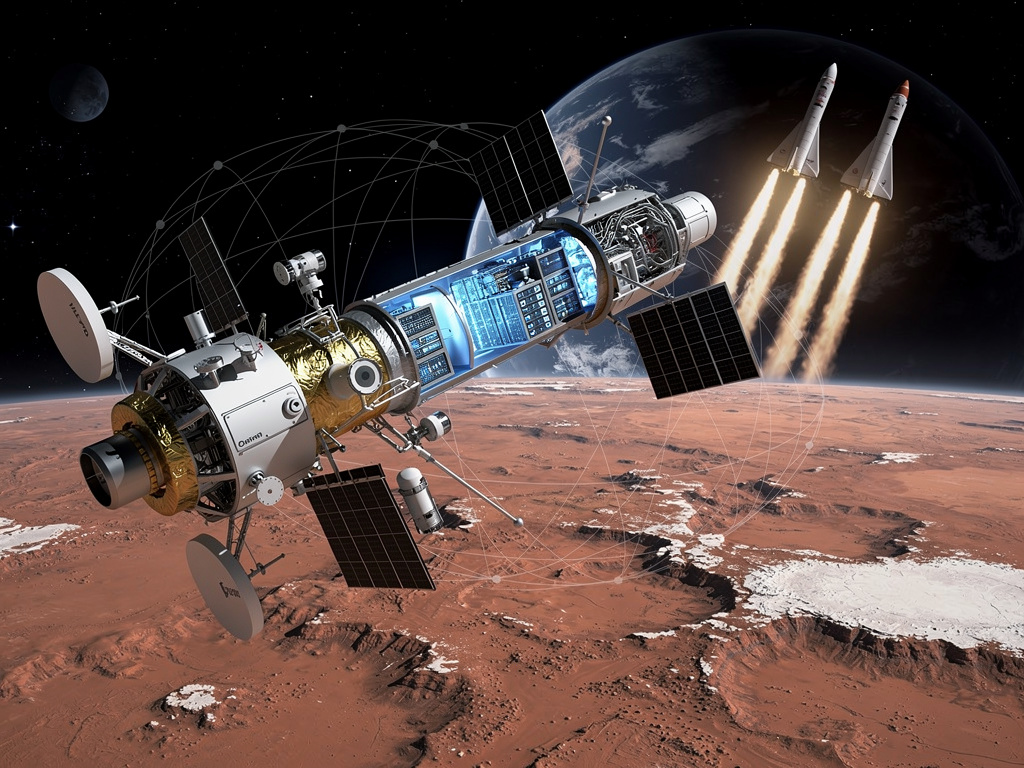
Relativity Space announced last week it would fly a NASA science mission to Mars by 2028. The company has never reached orbit. Its Terran R rocket remains untested. Yet former Google chief Eric Schmidt now steers the venture, drawn by the chance to place computing power in deep space.
The mission, named Aeolus, pairs NASA instruments with a privately built spacecraft and launch vehicle. NASA supplies an atmospheric profiling suite developed at its Ames Research Center. Relativity handles the orbiter, the rocket, cruise operations and a radar sounder of its own design. The agency expects daily global maps of Martian winds, temperatures, dust and clouds. Such data could sharpen models for future landings, whether robotic or crewed.
NASA described the arrangement as a fresh model. Public science meets private infrastructure. Administrator Jared Isaacman put it plainly. “By pairing NASA’s world-class instruments with commercial innovation and investment, we can deliver more science, more often.”
But the bet carries real exposure. Relativity’s first rocket, Terran 1, lifted off in 2023 only to fail during flight. The firm pivoted to the larger Terran R. Cash ran short. Schmidt stepped in during 2025. He acquired a controlling stake and took the chief executive role. The move followed months of financial strain detailed later by Bloomberg.
Schmidt’s interest runs deeper than rockets. He has spoken of orbiting data centers. Aeolus will test that idea in practice. The spacecraft includes what Relativity calls a Relay Data Center. Servers and storage will ride in Mars orbit. They can run AI models locally. Optical and radio links will stream large data volumes back to Earth. The hardware also doubles as a communications relay for assets on the Martian surface.
Relativity framed Aeolus as the first flight in its new Interplanetary Sciences Program. The company says a philanthropic customer is paying. It has not identified that backer. Schmidt’s own philanthropic efforts have long supported scientific research. Observers note the overlap. The firm promises to release all scientific data, algorithms and automation lessons openly.
The announcement drew quick comparisons to Elon Musk’s ambitions. Musk and Schmidt have clashed publicly over artificial intelligence risks. SpaceX has sent many payloads toward Mars on its Starship development path but has yet to complete a dedicated private science mission to the planet. If Aeolus flies on time, Schmidt’s team could claim the first private arrival at Mars. A big if, given the timeline.
Technical details remain sparse. Relativity has not released spacecraft specifications or the full mission price. The Terran R must still prove itself. Recent company updates show progress on engine testing and stage hardware, yet no orbital attempt has occurred. SpaceNews reported the 2028 target follows the firm’s shift toward privately funded planetary projects.
From the start, Relativity sold itself on 3D printing. Founders Tim Ellis and Jordan Noone, both veterans of SpaceX and Blue Origin, promised rapid production of large rocket parts. The approach aimed to slash costs and speed iteration. Early results were mixed. The Terran 1 test flight reached space but broke apart before completing its mission. Engineers learned from the failure. They scaled up for Terran R, targeting heavier payloads and reusability.
Schmidt’s arrival changed the tone. He brought experience from Google and national security circles. He also injected capital at a moment when investors had grown wary. TechCrunch noted the acquisition gave Schmidt leverage to steer the company toward his data ambitions. The Mars orbiter now serves as both science platform and technology demonstrator.
Aeolus instruments focus on the Martian atmosphere. A Doppler wind and temperature sensor, thermal limb sounder, surface radiometric sensors and wide-field camera form the core suite from Ames. The company-built radar sounder will probe shallow subsurface ice and geology. Combined, the payload should reveal climate history, habitability clues and promising sites for future landers.
Yet questions linger about execution. Commercial partners have delivered for NASA before. SpaceX ferries cargo and crew to the station. Smaller firms have landed on the Moon, sometimes at awkward angles. Some have gone bankrupt. NASA officials acknowledge the risk. They see upside in faster, cheaper access.
Schmidt himself has written about expanding American leadership in space through commercial partnerships. In a recent post on LinkedIn he argued for applying the model used for launch services to broader planetary science. The Aeolus deal tests that thesis in orbit around another planet.
Industry watchers reacted with a mix of excitement and skepticism. On X, users pointed to SpaceX’s parallel work on orbital computing. One post asked whether Relativity had suddenly become the Mars company while SpaceX chased data-center revenue. Others highlighted the sheer number of firsts required: first Terran R flight, first interplanetary mission, first on-board AI data center at Mars.
Relativity’s own statement struck an optimistic note. “Relativity’s vision is to make access to space more open, reliable and routine, advancing science and innovation beyond Earth,” Schmidt said according to SpaceNews.
The 2028 launch window is tight. Development of the spacecraft must run in parallel with rocket qualification. Integration, testing and the long cruise to Mars leave little margin for delay. Past private Mars attempts have slipped. Impulse Space and Relativity once eyed a 2024 lander that later moved to 2026. That project no longer appears central to current plans.
Still, the pieces align in unusual ways. A former Google leader who worries about AI now flies AI hardware to Mars. A rocket firm rescued from cash shortages now carries NASA instruments. A philanthropic arrangement shields the mission from full congressional scrutiny while inviting scrutiny of its own.
Success would hand Schmidt a symbolic victory over Musk in the race to Mars. It would also demonstrate that 3D-printed rockets can support deep-space science. Failure would reinforce doubts about unproven players in high-stakes exploration.
Either outcome will shape how NASA buys future planetary missions. The agency has signaled more such partnerships lie ahead. Private capital, private hardware and public instruments could become standard. The question is whether companies like Relativity can deliver before the next launch window closes.
For now the hardware sits in California factories and test stands at Stennis Space Center. Engineers race the calendar. Schmidt watches from the executive suite. And Mars waits, silent as ever, for the first private visitor that just might carry a data center in its payload bay.


 WebProNews is an iEntry Publication