
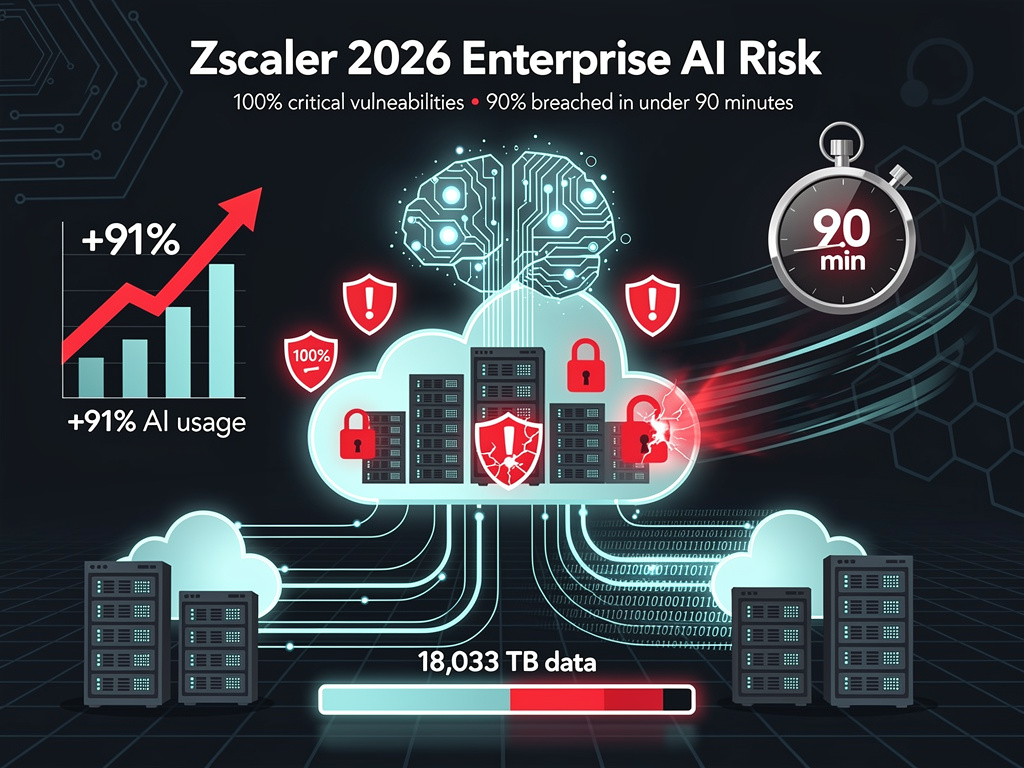
Enterprise adoption of artificial intelligence has exploded, but so have the vulnerabilities exposing companies to rapid breaches. Zscaler’s ThreatLabz 2026 AI Security Report, released January 27, 2026, reveals that critical flaws were detected in 100% of tested AI systems, with a median time to first critical failure of just 16 minutes and 90% compromised in under 90 minutes. The analysis draws from 989.3 billion AI and machine learning transactions across nearly 9,000 organizations on the Zscaler Zero Trust Exchange platform throughout 2025, highlighting a 91% year-over-year surge in AI activity amid glaring oversight gaps.
While AI promises productivity gains, the report underscores how this growth outpaces security measures. “These findings signal that AI governance has transitioned from a policy discussion to an immediate operational necessity,” Zscaler analysts stated. Enterprises transferred 18,033 terabytes of data to AI applications in 2025—a 93% increase—turning tools like ChatGPT into massive repositories of corporate secrets, with 410 million data loss prevention violations linked to the platform alone, including attempts to share Social Security numbers, source code, and medical records, per the Infosecurity Magazine coverage.
Finance and insurance led with 23% of AI traffic, followed by technology’s 202% growth and education’s 184% rise. Engineering departments drove 48.9% of usage, IT 31.8%, and marketing 6.9%. Geographically, the U.S. accounted for 38% of transactions, India 14%, and Canada 5%. OpenAI dominated monthly, trailed by Codelium and Perplexity.
Explosive Growth Masks Hidden Risks
The report’s red-team testing exposed immediate realities beyond hypotheticals: systems fail under adversarial conditions almost instantly. “When enterprise AI systems are tested under real adversarial conditions, they break almost immediately,” Zscaler noted in its GlobeNewswire press release. Many organizations lack even basic inventories of AI models or embedded features in SaaS tools, amplifying unmanaged risks from “embedded AI” in everyday platforms.
ChatGPT logged 115 billion transactions, Codeium 42 billion, making standalone AI a high-volume data conduit. Data exfiltration risks loom large, with Grammarly handling 3,615 terabytes and ChatGPT 2,021 terabytes. “AI can no longer be considered as a simple productivity tool but a primary vector for autonomous, machine-speed attacks by both crimeware and nation-state,” said Deepen Desai, EVP for Cybersecurity at Zscaler.
This surge coincides with agentic AI’s rise—autonomous agents capable of reconnaissance, exploitation, and lateral movement—demanding defenders adapt at machine speed, not human pace.
Vulnerabilities Exposed at Machine Speed
Zscaler’s controlled scans confirmed universal critical vulnerabilities, with some flaws triggering failures in seconds. The StockTitan summary emphasized 90% compromise under 90 minutes, urging AI-native Zero Trust for visibility, least-privilege access, encrypted traffic inspection, and lateral movement containment.
Help Net Security reported Zscaler’s parallel launch of an AI Security Suite addressing asset inventory, secure access, and lifecycle defenses, aligning with NIST AI Risk Management Framework and EU AI Act. “Organizations also struggle to control access and enforce policy as AI traffic shifts to new protocols and non-human patterns that traditional security tools cannot govern,” the outlet quoted, noting integrations with OpenAI, Anthropic, AWS, Microsoft, and Google.
Threats extend to prompt injection and data poisoning corrupting models, per Zscaler’s product insights, alongside open-source AI risks like unvetted code and backdoors.
Data Flood Fuels Breach Potential
The 18,033 TB data transfer equates to 3.6 billion digital photos, painting AI platforms as prime cyber targets. Finance’s dominance reflects high-stakes data flows, while tech and education’s growth signals broad exposure. “Enterprise AI systems are vulnerable at machine speed,” GlobeNewswire reiterated, with Zscaler’s report warning of tipping points where AI shifts from tool to attack vector.
Markets Insider echoed findings on embedded AI as unmanaged risk sources, with ChatGPT’s transaction volume underscoring blocking needs—59.9% of prior-year AI traffic blocked enterprise-wide. Yahoo Finance noted Zscaler’s stock rise post-launch, viewing the suite as positioning against competitors in AI governance.
SecurityBrief highlighted methodology: 989.3 billion transactions from 9,000 organizations over 3,400 apps, proving oversight lags as adoption accelerates 200% in key sectors.
Zero Trust Emerges as Imperative
Zscaler’s suite offers AI asset management for shadow AI detection, risk-based controls, and CXO reporting. “Without this level of deep inspection and automated guardrails, enterprises are essentially flying blind,” per Help Net Security. It includes MCP gateways for secure automation and AI Deception to neutralize model attacks.
Investing News Network stressed board-level AI governance priority amid vulnerabilities. The report anticipates agentic AI automating full attack chains, per Infosecurity Magazine, forcing real-time defenses.
QuiverQuant detailed red-teaming and automated assessments, addressing traditional tools’ blindness to AI protocols.
Global Patterns Signal Urgency
U.S.-led traffic reflects innovation hubs, but India’s 14% share highlights emerging-market risks. Engineering’s lead usage ties to code tools like Codeium, vulnerable to injection exploits. Prior Zscaler reports, like 2025’s 3,000% surge analysis of 536 billion transactions, showed ChatGPT at 45.2% but most-blocked, per Nasdaq coverage—a trend persisting into 2026.
StreetInsider and MarketScreener reinforced 100% flaw detection, positioning Zero Trust + AI as essential. As agentic threats loom, enterprises must inventory, monitor, and enforce policies to harness AI without catastrophe.
Zscaler’s data paints a clear directive: secure AI now or face machine-speed fallout.


 WebProNews is an iEntry Publication