
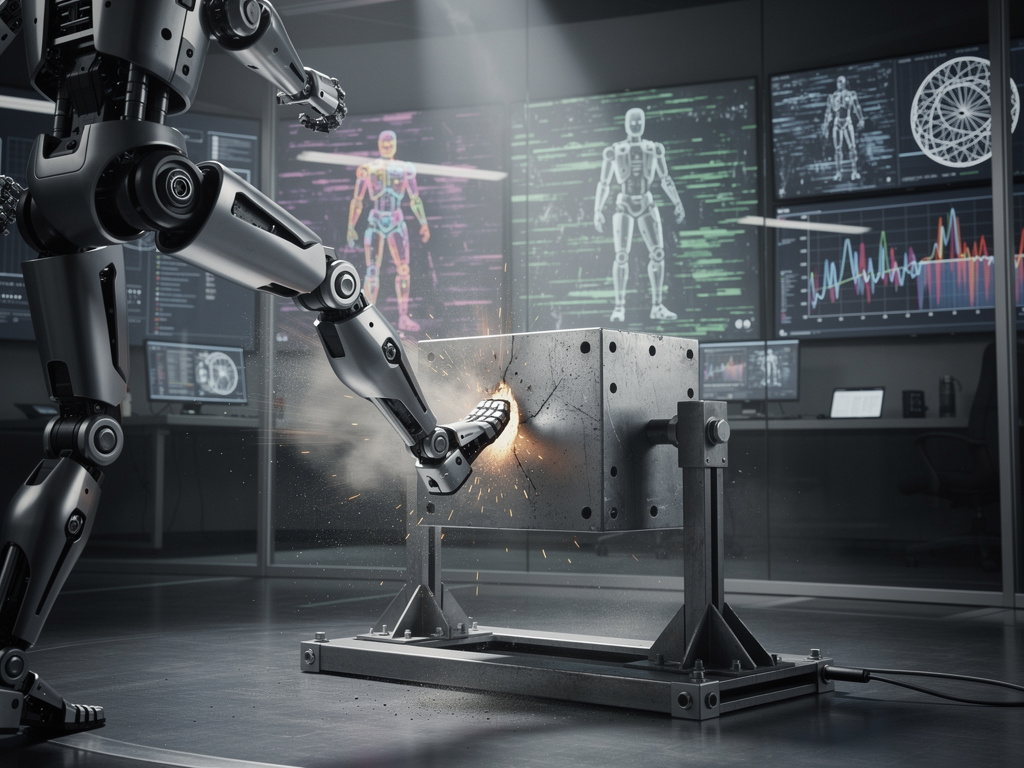
The CEO’s Gambit: A Robot’s Kick That Shook the Tech World
In the fast-evolving realm of humanoid robotics, where skepticism often shadows innovation, a recent stunt by Chinese firm EngineAI has captured global attention. The company’s CEO, Zhao Tongyang, voluntarily subjected himself to a powerful kick from their latest creation, the T800 humanoid robot, all in a bid to quash rumors that its capabilities were nothing more than computer-generated illusions. This dramatic demonstration, captured on video and widely shared, underscores the lengths to which robotics companies will go to prove authenticity in an era rife with deepfakes and digital deception.
The incident unfolded amid growing doubts about EngineAI’s promotional footage, which showcased the T800 performing feats of agility and strength that many online commentators dismissed as fabricated. To counter this, Zhao donned protective gear and stepped into a makeshift arena, allowing the robot to deliver a front kick that sent him sprawling to the ground. The raw, unedited clip, released by the company, aimed to provide irrefutable evidence of the machine’s real-world prowess.
EngineAI, a Shenzhen-based startup, has been pushing boundaries in humanoid development, drawing inspiration from cinematic icons like the Terminator series—hence the T800 moniker. The company’s aggressive marketing tactics have included videos of the robot running, jumping, and even engaging in simulated combat, but these have frequently sparked debates over their legitimacy. By putting his own body on the line, Zhao not only silenced some critics but also highlighted the physical risks involved in advancing this technology.
The Spark of Controversy
The backlash began shortly after EngineAI unveiled initial demos of the T800 in late 2025. Social media platforms buzzed with accusations of CGI enhancement, with users pointing to seemingly unnatural movements and physics-defying actions. According to reports from Interesting Engineering, the company responded by releasing behind-the-scenes footage, but it wasn’t enough to convince everyone. This skepticism is not unfounded; the robotics sector has seen its share of overhyped claims, from Boston Dynamics’ acrobatic machines to Tesla’s Optimus prototypes, often leading to public disillusionment.
Zhao’s decision to participate in the kick demo was both bold and calculated. Clad in padding reminiscent of martial arts gear, he positioned himself for the impact, which the robot executed with precision. The video shows the CEO being knocked back several feet, a testament to the T800’s force generation capabilities. As detailed in a piece by Futurism, the robot “promptly proceeds to lay out” its creator, emphasizing the raw power on display.
This event isn’t just a publicity stunt; it reflects broader challenges in the industry. Robotics firms must navigate a fine line between showcasing potential and maintaining credibility. EngineAI’s approach echoes historical precedents, such as when inventors like Thomas Edison demonstrated their creations through public spectacles to build trust and attract investment.
Inside EngineAI’s Vision
Founded in the heart of China’s tech hub, EngineAI has rapidly ascended by focusing on affordable, versatile humanoids. The T800 model boasts advanced AI integration, allowing it to mimic human-like movements with startling accuracy. Sources from CNN describe the kick as part of a “simulated battle,” designed to demonstrate the robot’s combat readiness and counter CGI claims head-on.
Industry insiders note that EngineAI’s strategy aligns with a surge in humanoid robotics investment, driven by applications in manufacturing, healthcare, and even entertainment. The company’s CEO has publicly stated that the T800 can generate forces equivalent to a 75kg impact, as seen in the demo. This capability stems from sophisticated actuators and machine learning algorithms that enable dynamic balance and power delivery.
However, the stunt raises questions about safety protocols. While Zhao emerged unscathed, the potential for mishaps in such demonstrations is high. Comparisons to other robotics pioneers, like those at Figure AI or Agility Robotics, reveal a pattern where physical proofs are increasingly used to validate claims amid investor scrutiny.
Ripples Across Social Media
The video’s release ignited a firestorm on platforms like X, formerly Twitter, where users expressed a mix of awe, humor, and concern. Posts highlighted sentiments ranging from admiration for Zhao’s bravery to fears of a “robot revolution,” with some drawing parallels to dystopian sci-fi narratives. Drawing from various X discussions, the general buzz portrays the event as a pivotal moment in human-robot interaction, blending excitement with ethical debates.
Media outlets amplified the story, with NotebookCheck.net likening the robot’s kick to Jackie Chan’s martial arts prowess, underscoring the cultural flair in EngineAI’s presentation. This comparison not only entertains but also positions the T800 as a blend of technology and spectacle, appealing to a global audience.
Critics, however, argue that such antics distract from substantive advancements. In the context of China’s push for technological self-reliance, EngineAI’s move could be seen as a statement of national innovation prowess, especially against Western competitors. The incident has spurred conversations about the authenticity of tech demos in an age where AI-generated content blurs reality.
Technological Underpinnings
Delving deeper into the T800’s design, the robot incorporates cutting-edge sensors and neural networks that allow for real-time environmental adaptation. According to insights from Humanoids Daily, the kick demonstration was a “visceral proof of life,” showcasing the machine’s ability to interact forcefully yet controllably with humans.
EngineAI’s engineers have emphasized the role of proprioceptive feedback systems, which enable the robot to gauge force and adjust accordingly. This technology draws from advancements in biomechanics, ensuring that movements are not just scripted but responsive. The CEO’s willingness to test this firsthand speaks to confidence in the system’s reliability, though it also highlights the experimental nature of the field.
Comparisons with peers reveal EngineAI’s edge in cost-effectiveness. While companies like Boston Dynamics focus on high-end, specialized robots, EngineAI aims for mass-market appeal, potentially disrupting sectors like logistics and elder care. The kick video, while sensational, serves as a benchmark for evaluating humanoid strength in practical scenarios.
Industry Implications and Ethical Considerations
The broader impact of this event extends to investment trends in robotics. Venture capital has poured into humanoid projects, with firms betting on their transformative potential. As reported by Mike Kalil’s blog, the stunt was an “attempt to prove the Shenzhen startup’s new T800 humanoid is real,” potentially boosting EngineAI’s funding prospects.
Ethically, the demonstration prompts reflection on human-robot boundaries. Is it appropriate for executives to risk injury for marketing? This question resonates in an industry where safety is paramount, especially as robots integrate into daily life. Regulatory bodies in China and beyond may scrutinize such practices, pushing for standardized testing protocols.
Moreover, the event fuels discussions on AI governance. With robots capable of physical force, ensuring they operate within ethical frameworks becomes crucial. EngineAI’s transparency in sharing raw footage could set a precedent, encouraging others to adopt similar verification methods.
Global Reactions and Future Prospects
Internationally, reactions have varied. In the U.S., outlets like OutKick described the CEO getting “obliterated,” capturing the visceral appeal. European media, meanwhile, have focused on innovation implications, viewing it as a challenge to Western dominance in tech.
Looking ahead, EngineAI plans to expand the T800’s applications, from industrial tasks to consumer services. The kick incident may accelerate partnerships, as it demonstrates tangible capabilities. Industry analysts predict that such bold proofs will become more common, as companies vie for attention in a crowded market.
Yet, challenges remain. Scaling production while maintaining quality, addressing energy efficiency, and navigating geopolitical tensions could shape EngineAI’s trajectory. Zhao’s gambit might inspire a new wave of experiential marketing, where leaders literally put skin in the game.
Evolving Dynamics in Robotics
As the sector matures, incidents like this highlight the interplay between hype and reality. EngineAI’s approach contrasts with more conservative strategies, potentially redefining how advancements are communicated. Referencing earlier coverage from Interesting Engineering, the initial CGI rumors underscore the need for robust validation in promotional materials.
The T800’s kick also symbolizes progress in human-machine symbiosis. By enduring the blow, Zhao bridged the gap between creator and creation, humanizing the technology while proving its might. This narrative resonates in a world increasingly reliant on automation.
Ultimately, the event positions EngineAI as a daring player, willing to confront doubts directly. As robotics continues to advance, such moments will likely define the path forward, blending spectacle with substance to captivate and convince.
Beyond the Kick: Long-Term Visions
Peering into the future, EngineAI’s ambitions extend to collaborative robots that assist in hazardous environments. The T800’s demonstrated strength could translate to search-and-rescue operations or construction, where physical power is essential. Insights from Futurism suggest this “attack” on the CEO was a calculated risk to showcase untapped potential.
Investor interest has surged post-video, with speculation about IPOs or acquisitions. In China’s competitive tech ecosystem, standing out requires innovation and audacity, qualities Zhao exemplified.
The incident also sparks philosophical debates: As robots grow more capable, how do we define their role in society? EngineAI’s stunt invites us to reconsider these boundaries, fostering a dialogue that’s as impactful as the kick itself.
Reflections on Innovation’s Edge
In retrospect, Zhao’s decision mirrors historical tech milestones, like Steve Jobs’ dramatic product unveils. By personalizing the demonstration, he forged an emotional connection with audiences, transcending technical specs.
Coverage from CNN reinforces that the purpose was to “counter claims that its latest model was created using CGI,” a goal seemingly achieved through viral spread.
As the dust settles, EngineAI emerges stronger, its T800 no longer just a concept but a proven entity. This chapter in robotics history reminds us that sometimes, to move forward, one must take a step back—literally.


 WebProNews is an iEntry Publication