
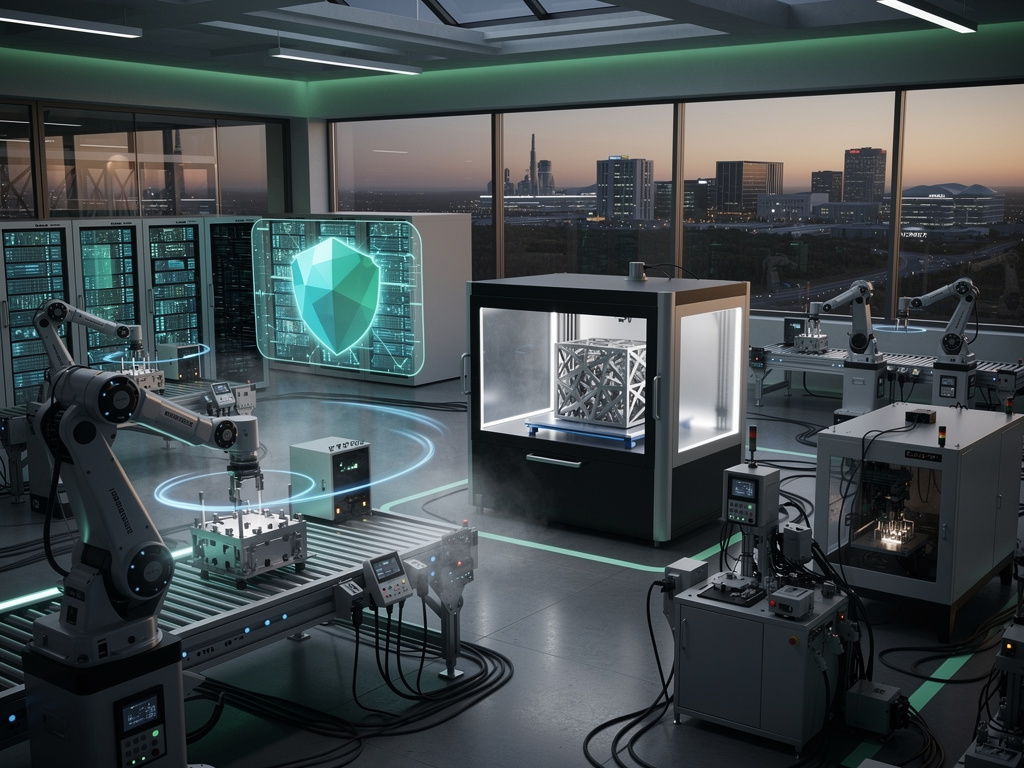
In the rapidly evolving world of manufacturing, a new wave of technologies is poised to redefine efficiency, innovation, and global competition. From artificial intelligence optimizing production lines to advanced robotics handling intricate assembly tasks, these tools are not just enhancements but fundamental shifts that could determine which companies thrive in the coming decades. According to a recent market assessment by InsightAce Analytic Pvt. Ltd., detailed in a report published on OpenPR, the global market for these emerging technologies is projected to experience robust growth, driven by demands for sustainability, customization, and resilience against supply chain disruptions.
The report highlights key areas such as additive manufacturing, also known as 3D printing, which allows for rapid prototyping and on-demand production, reducing waste and lead times. IoT-enabled smart factories are another cornerstone, where interconnected devices provide real-time data analytics to predict maintenance needs and streamline operations. Meanwhile, AI and machine learning algorithms are being integrated to forecast demand, automate quality control, and even design products autonomously, marking a departure from traditional human-centric processes.
This transformation is fueled by broader economic pressures, including labor shortages in developed economies and the push for decarbonization. Manufacturers are increasingly adopting these technologies to cut costs and meet regulatory standards, with the InsightAce report estimating a compound annual growth rate that could push the market value into the hundreds of billions by 2035. Industry insiders note that early adopters, particularly in automotive and aerospace sectors, are already seeing returns on investment through improved scalability and reduced downtime.
Navigating the Evolving Arena of Industry Rivals
Among the frontrunners in this space are companies like Siemens AG and General Electric, which have invested heavily in digital twins—virtual replicas of physical assets that simulate performance under various conditions. These tools enable predictive analytics, helping firms avoid costly failures. A recent article in Forbes underscores how such innovations are creating a divide between tech-savvy manufacturers and laggards, with Siemens reporting double-digit efficiency gains in its smart factories.
Competition is intensifying as startups enter the fray, challenging established players. For instance, firms like Desktop Metal are revolutionizing metal 3D printing, making it accessible for smaller operations, while established giants like Honeywell are expanding into AI-driven supply chain management. The InsightAce analysis points to regional dynamics, with Asia-Pacific leading in adoption due to its vast manufacturing base, particularly in China and India, where government incentives for Industry 4.0 initiatives are accelerating implementation.
However, barriers remain, including high initial costs and the need for skilled talent to manage these systems. Cybersecurity risks also loom large, as interconnected factories become prime targets for attacks. Recent news from X (formerly Twitter) highlights incidents where ransomware has halted production lines, prompting calls for robust digital defenses integrated into emerging tech deployments.
Unpacking Growth Drivers and Market Projections
Looking ahead to the 2026-2035 period, the outlook is optimistic yet cautious. The InsightAce report forecasts significant expansion in biotechnology applications within manufacturing, such as biofabrication for medical devices, which could open new revenue streams. This aligns with global trends toward personalized medicine and sustainable materials, where technologies like nanotechnology enable the creation of stronger, lighter composites.
Sustainability is a major driver, with emerging tech facilitating circular economies. For example, blockchain is being used to trace material origins, ensuring ethical sourcing, as detailed in a Bloomberg piece on how AI optimizes energy use in factories, potentially reducing carbon footprints by up to 20%. Manufacturers are under pressure from investors and regulators to adopt these practices, turning environmental compliance into a competitive edge.
Economic forecasts suggest that by 2030, the integration of augmented reality (AR) for worker training could address skill gaps, allowing remote experts to guide on-site teams via holographic interfaces. This is particularly relevant in post-pandemic recovery, where hybrid work models extend to industrial settings. Insights from a McKinsey report emphasize that companies investing in AR and VR could see productivity boosts of 15-20%, reshaping workforce dynamics.
Spotlight on Key Innovators and Strategic Moves
Delving deeper into the competitive environment, major players are forming strategic alliances to bolster their positions. ABB Ltd., a leader in robotics, has partnered with software firms to enhance AI capabilities in its automation systems, as reported in industry updates on X. This collaboration model is becoming standard, allowing specialization while sharing risks in R&D.
Emerging technologies are also disrupting traditional supply chains. Quantum computing, though nascent, promises to solve complex optimization problems, such as routing logistics in real-time. A Reuters analysis explores how firms like IBM are piloting quantum applications in manufacturing simulations, potentially revolutionizing inventory management by 2030.
Challenges in adoption include interoperability—ensuring different tech systems communicate seamlessly. The InsightAce report warns that without standards, fragmentation could slow growth. Recent web searches reveal initiatives by organizations like the International Society of Automation to develop protocols, fostering a more cohesive ecosystem.
Regional Variations and Global Implications
Geographically, North America remains a hub for innovation, with heavy investments in R&D from companies like Rockwell Automation. The region’s focus on advanced materials, such as carbon nanotubes for electronics manufacturing, positions it for leadership in high-tech sectors. In contrast, Europe’s emphasis on regulatory compliance drives adoption of green technologies, with the EU’s Green Deal incentivizing AI for energy-efficient processes.
In emerging markets, affordability is key. Low-cost IoT sensors are enabling small and medium enterprises (SMEs) in Latin America and Africa to leapfrog traditional methods, as noted in a World Bank feature. This democratization could level the playing field, allowing SMEs to compete with conglomerates.
Global trade tensions add complexity. Tariffs on tech imports, highlighted in recent X threads about U.S.-China relations, may force manufacturers to localize production using automated systems, accelerating tech adoption but increasing upfront costs.
Technological Synergies and Future Horizons
The synergy between technologies is creating multiplier effects. For instance, combining AI with 5G networks enables ultra-low latency in robotic operations, ideal for precision tasks in semiconductor manufacturing. A MIT Technology Review deep dive illustrates how this integration could cut production times by half, boosting output in high-demand industries.
Investment trends show venture capital pouring into startups focused on sustainable tech, such as biodegradable polymers produced via automated bioreactors. Bloomberg reports indicate that funding in this area surged 30% last year, signaling investor confidence in long-term viability.
As we approach 2026, the focus will shift to scalable implementations. Pilot projects, like those in Tesla’s Gigafactories using AI for battery production, serve as blueprints. The InsightAce outlook predicts that by 2035, over 70% of global manufacturing will incorporate at least one emerging technology, fundamentally altering operational paradigms.
Risks, Regulations, and Ethical Considerations
Yet, risks abound. Job displacement from automation is a hot topic, with unions pushing for retraining programs. A Guardian investigation reveals mixed outcomes: while some workers transition to higher-skilled roles, others face unemployment, necessitating policy interventions.
Regulatory landscapes are evolving too. Data privacy laws, such as GDPR in Europe, impact how AI handles manufacturing data. Compliance adds layers of complexity but also opportunities for tech providers specializing in secure systems.
Ethically, the use of AI in decision-making raises questions about bias in algorithms that could affect product quality or worker safety. Industry forums on X are abuzz with discussions on ethical AI frameworks, urging manufacturers to prioritize transparency.
Innovation Pipelines and Long-Term Strategies
Looking further out, breakthroughs in neuromorphic computing—chips mimicking brain functions—could enhance machine learning in factories, enabling adaptive responses to unforeseen disruptions. Research from IEEE Spectrum suggests this could be mainstream by 2030, revolutionizing predictive maintenance.
Corporate strategies are adapting. Mergers and acquisitions are rampant, with firms like Bosch acquiring AI startups to integrate cutting-edge capabilities. The InsightAce report details how such moves consolidate market power, potentially leading to oligopolies if not monitored.
For insiders, the key takeaway is proactive adaptation. Companies must invest in upskilling and partnerships to navigate this tech-driven shift, ensuring they not only survive but lead in the transformed manufacturing arena.
Emerging Frontiers and Untapped Potential
Beyond core technologies, advancements in edge computing are enabling decentralized processing, reducing reliance on central servers and enhancing factory resilience. A ZDNet article explores its role in remote monitoring, crucial for global operations amid geopolitical uncertainties.
Sustainability tech, like carbon capture integrated into production lines, is gaining traction. Web searches show pilots in chemical manufacturing where AI optimizes capture efficiency, aligning with net-zero goals by 2050.
Finally, the human element persists. While tech automates, innovation stems from creative minds. As the 2035 horizon approaches, blending human ingenuity with emerging tools will define success, promising a manufacturing sector that’s smarter, greener, and more agile than ever before.


 WebProNews is an iEntry Publication