
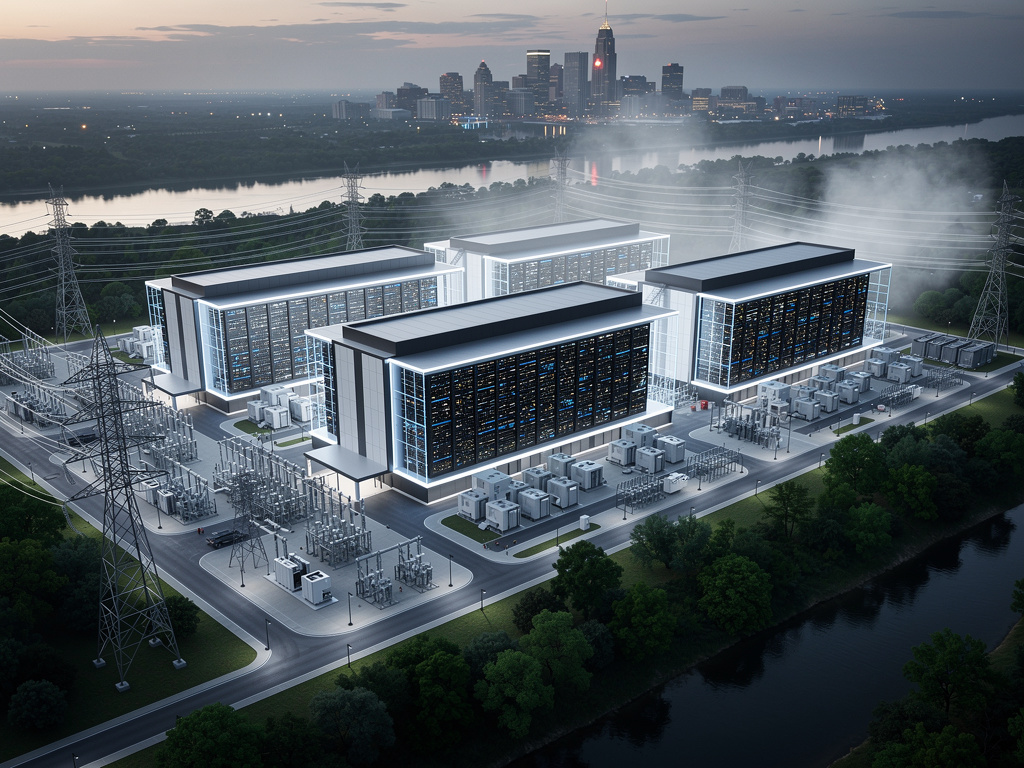
The Gigawatt Gambit: Elon Musk’s xAI Pushes Boundaries with Colossus Supercomputer’s Massive Expansion
Elon Musk’s artificial intelligence venture, xAI, is making waves in the tech world with its ambitious expansion of the Colossus supercomputer cluster. Recent announcements reveal that the company has acquired a third building in Memphis, Tennessee, propelling its AI training capacity toward an astonishing 2 gigawatts of power draw. This move underscores Musk’s relentless drive to dominate the AI arena, where computational might is the ultimate currency. Drawing from reports across major outlets, this development positions xAI as a formidable player, potentially outpacing rivals in raw processing power.
The Colossus project, first unveiled in 2024, has evolved rapidly from a 100,000 GPU cluster to what could soon be the world’s most potent AI training system. According to details shared on xAI’s official site, the initial build was completed in just 122 days, a feat that shattered industry timelines. Now, with the addition of this third facility, dubbed MACROHARDRR in a playful nod to challenging tech giants like Microsoft, xAI is scaling up dramatically. Posts from Musk on X highlight the progression, noting that the expansion will integrate hundreds of thousands more GPUs, primarily from Nvidia’s advanced lines like the GB200 and GB300.
This escalation in power consumption raises eyebrows, as 2 gigawatts rivals the output of a large nuclear reactor and could strain local energy grids. Industry observers point out that such demands come at a time when data centers worldwide are already under scrutiny for their environmental footprint. Yet, Musk’s vision appears undeterred, framing Colossus as essential for training Grok, xAI’s chatbot, and supporting broader ventures like SpaceX.
Scaling Ambitions and Technical Feats
The third building acquisition, reported by Reuters, aims to boost xAI’s infrastructure to nearly 2 gigawatts, a threshold that few, if any, AI systems have approached. This follows the original Colossus site, repurposed from an old Electrolux factory, and a second expansion branded as Colossus 2. Bloomberg’s coverage details how the Memphis complex is being transformed into a hub for unprecedented AI compute, with Musk posting on X about plans to reach one million GPUs in the near future.
Technical insights from sources like Tom’s Hardware emphasize the engineering marvels involved. The system relies on liquid-cooled Nvidia H100 and H200 GPUs, with upcoming integrations of even more efficient models. Musk has publicly stated that Colossus 2 will be the first gigawatt-plus AI training supercomputer, a claim echoed in his X posts from August 2025. This rapid buildup contrasts sharply with traditional data center projects, which often take years to plan and execute.
Beyond hardware, the expansion intensifies debates over energy use. As noted in an article from Interesting Engineering, xAI’s power draw nearing 2 gigawatts has sparked discussions on sustainability. Critics argue that such consumption could exacerbate electricity shortages, especially in regions like Tennessee, where grid capacity is finite. Proponents, however, see it as a necessary investment in advancing AI capabilities that could yield breakthroughs in fields from autonomous vehicles to space exploration.
Power Plays and Competitive Edges
Musk’s strategy with xAI is deeply intertwined with his ecosystem of companies. Wikipedia’s entry on Colossus notes its role in training Grok while providing compute support to X (formerly Twitter) and SpaceX. This cross-pollination allows for synergies, such as accelerating Tesla’s Full Self-Driving development through shared AI insights, though Musk has clarified on X that no formal licensing is involved. The macro view suggests xAI is positioning itself to have more AI compute than all competitors combined within five years, a bold prediction from Musk’s recent posts.
Financially, the endeavor is colossal. Estimates from Tom’s Hardware question the costs, pondering if Musk can sustain the funding amid his multifaceted empire. The purchase of the third building, as detailed in Bloomberg, involved repurposing existing structures to cut timelines, a tactic that saved millions compared to ground-up construction. Yet, the energy bills alone could run into the hundreds of millions annually, prompting speculation on funding sources, including potential investments from Musk’s other ventures.
Competitively, this puts xAI in direct contention with heavyweights like OpenAI, Google, and Microsoft. Musk’s jabs at rivals, evident in the “Macrohard” branding—a clear dig at Microsoft—add a layer of rivalry. Reports from Invezz highlight how this expansion takes xAI’s training capacity close to 2 gigawatts, potentially enabling models far larger and more sophisticated than current offerings. Industry insiders suggest this could lead to leaps in natural language processing and multimodal AI, areas where Grok is already gaining traction.
Energy Debates and Infrastructure Challenges
The environmental implications of Colossus’s growth cannot be ignored. As power demands surge, questions arise about sourcing sustainable energy. Interesting Engineering’s piece delves into the intensifying debate, noting that xAI’s operations could consume as much electricity as a mid-sized city. Musk has addressed this indirectly on X, emphasizing efficiency gains from advanced GPUs, but critics call for more transparency on carbon footprints.
Infrastructure-wise, the Memphis location was chosen for its ready-to-repurpose buildings, as per Wikipedia. This expedited deployment, with the original cluster online in months rather than years, showcases xAI’s agile approach. However, scaling to 2 gigawatts requires robust cooling and power systems. Details from The Information reveal plans for supersized data centers equipped to handle the heat generated by millions of chips, involving advanced liquid cooling to maintain performance.
Local impacts are also significant. Reuters reports indicate that the expansion could create jobs in Tennessee, boosting the economy, but it might strain utilities. Utility providers in the area are reportedly preparing upgrades, though the timeline remains tight. This mirrors broader trends where AI firms are negotiating directly with energy companies to secure dedicated supplies, sometimes even exploring on-site power generation.
Innovation Horizons and Future Trajectories
Looking ahead, xAI’s roadmap points to even greater scales. Musk’s X posts from late 2025 tease high-volume production integrations, potentially linking Colossus with Neuralink’s brain-computer interfaces. A December 2025 post announces streamlined surgical procedures for Neuralink in 2026, hinting at AI-driven advancements enabled by Colossus’s compute power. This convergence could revolutionize human-machine interactions, extending beyond chatbots to real-world applications.
Technologically, the push toward 2 gigawatts enables training of “gigantic” models, as Musk described on X. Bloomberg’s analysis suggests this could result in AI systems capable of unprecedented reasoning and creativity, outstripping current limitations. For industry insiders, this means watching how xAI leverages this power—perhaps in open-sourcing tools or challenging proprietary models from competitors.
Challenges persist, including regulatory hurdles. As AI compute grows, governments are eyeing oversight, especially on energy use and data privacy. The Information notes that xAI’s rapid pace might invite scrutiny, but Musk’s track record of navigating such waters—seen in Tesla and SpaceX—suggests resilience. Ultimately, this expansion cements xAI’s role in shaping AI’s future, where power, quite literally, equates to progress.
Strategic Implications for the AI Ecosystem
The broader effects on the AI sector are profound. With Colossus nearing 2 gigawatts, xAI could accelerate the development of general artificial intelligence, a goal Musk has long championed. References in Tom’s Hardware to Musk’s five-year compute dominance prediction underscore a shift toward centralized, massive-scale training clusters. This contrasts with distributed computing models favored by some rivals, potentially giving xAI an edge in model coherence and speed.
Partnerships play a key role. Nvidia’s involvement, supplying the bulk of GPUs, is crucial, as highlighted in Musk’s X acknowledgments of Nvidia CEO Jensen Huang. This symbiosis drives innovation, with custom networking like CX8 enabling seamless integration of hundreds of thousands of units. Industry reports from Invezz suggest that such collaborations could lower costs over time, making exascale computing more accessible.
Ethically, the power surge prompts reflections on equitable AI development. While xAI aims to “understand the universe,” as per its mission, the energy intensity raises questions about accessibility for smaller players. Debates in Interesting Engineering point to a divide where only well-funded entities like xAI can compete, potentially monopolizing advancements.
Pioneering Paths Amid Uncertainties
As xAI forges ahead, the Colossus expansion exemplifies Musk’s high-stakes approach. From the initial 100,000 H100 GPUs to projections of a million, the trajectory is meteoric. Wikipedia chronicles this evolution, noting operational starts in July 2024 and continuous upgrades. For tech insiders, this signals a new era where AI progress is measured in gigawatts, not just algorithms.
Uncertainties loom, particularly around sustainability. Musk’s X posts dismiss some criticisms, but the reality of grid strain is evident. Solutions might include renewable integrations, with rumors of solar tie-ins from Tesla’s energy arm. Reuters coverage anticipates that xAI will address these in upcoming announcements, balancing innovation with responsibility.
In the end, Colossus’s march toward 2 gigawatts embodies the audacious spirit driving AI forward. It challenges norms, sparks debates, and promises transformations that could redefine technology’s role in society. As Musk continues to push limits, the world watches to see if this gigawatt gambit pays off.


 WebProNews is an iEntry Publication