
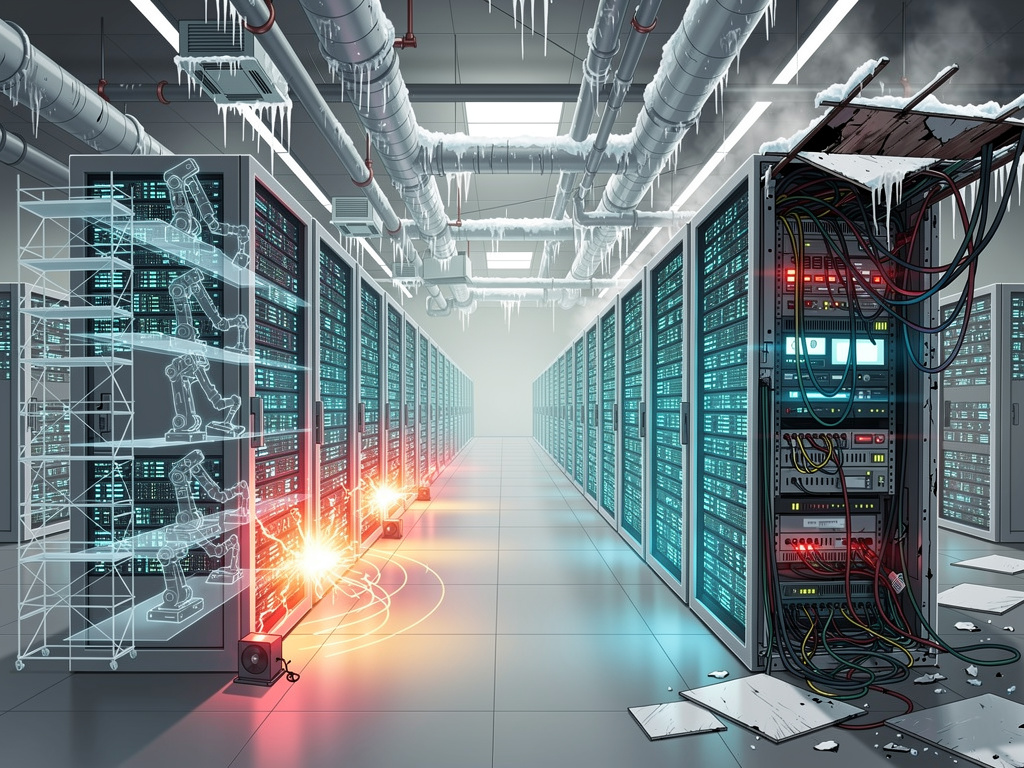
When Elon Musk pushed his artificial intelligence startup xAI to build one of the world’s most powerful supercomputers in just 122 days, he framed it as a triumph of velocity over bureaucracy. The Memphis, Tennessee facility known as Colossus — packed with 100,000 Nvidia GPUs — was supposed to be a monument to what happens when you strip away red tape and let engineers sprint. It was, by almost any measure, an extraordinary feat of construction speed. But speed, it turns out, has consequences.
Now xAI is essentially rebuilding Colossus from the inside out, according to a report from Futurism, which detailed how the rushed construction led to systemic infrastructure failures that have plagued the facility for months. The problems are not cosmetic. They are fundamental — rooted in cooling systems that can’t handle the thermal load, electrical configurations that weren’t properly validated, and a building that was, in some respects, assembled before it was fully designed.
The story of Colossus is really two stories. One is about Musk’s well-documented obsession with speed as a competitive weapon, a philosophy that served him at SpaceX and Tesla but may have met its match in the unforgiving physics of data center thermal management. The other is about what happens when the AI arms race pressures companies to deploy infrastructure faster than engineering best practices allow.
Colossus went live in September 2024. Within weeks, problems surfaced. Cooling failures caused GPU clusters to overheat and shut down. Technicians discovered that the liquid cooling systems — essential for dissipating the enormous heat generated by tens of thousands of high-performance chips running simultaneously — had been installed with deficiencies that limited their effectiveness. Some cooling loops reportedly weren’t circulating fluid properly. Others had leaks.
The electrical systems fared little better. According to sources cited by Futurism, power distribution units were misconfigured, leading to uneven loads that triggered cascading shutdowns across server racks. In a facility designed to train some of the most compute-intensive AI models on the planet, reliability isn’t optional. Every hour of downtime represents not just wasted electricity but lost training runs — work that, in many cases, has to be restarted from scratch.
Musk’s response has been characteristically aggressive. Rather than accept a degraded facility, xAI has embarked on what amounts to a large-scale retrofit. Cooling infrastructure is being ripped out and replaced. Electrical systems are being reconfigured. The company is essentially performing the careful, methodical engineering work it skipped the first time — except now it’s doing it around live equipment in an operational data center, which is significantly harder and more expensive than doing it right during initial construction.
The irony is thick. Musk has long evangelized the idea that traditional construction timelines are bloated and that moving fast, even if it means breaking things, ultimately produces better outcomes. “The best part is no part. The best process is no process,” he has said repeatedly, a mantra borrowed from his work at SpaceX. But data centers are not rockets. A rocket either works or it doesn’t on launch day. A data center has to work every single day, under continuous thermal and electrical stress, for years.
Industry veterans have watched the Colossus saga with a mixture of fascination and vindication. Building a 100,000-GPU cluster is genuinely difficult even under ideal circumstances. Google, Microsoft, and Amazon — companies with decades of data center experience — typically spend 18 to 24 months on facilities of comparable scale. They do this not because they’re slow or bureaucratic, but because the engineering tolerances involved in cooling and powering that many chips simultaneously are extraordinarily tight.
A single GPU in Nvidia’s H100 family can draw over 700 watts under full load. Multiply that by 100,000 and you’re looking at a facility that needs to manage 70 megawatts of heat dissipation from the chips alone — before accounting for networking equipment, storage systems, and other infrastructure. The cooling challenge isn’t just about volume; it’s about precision. Hot spots can develop in unpredictable ways, and liquid cooling systems need to be meticulously — that is, carefully and thoroughly — balanced to ensure even thermal distribution across thousands of nodes.
Musk didn’t build Colossus in a vacuum. The Memphis project was driven by competitive urgency. OpenAI, the company Musk co-founded and then left acrimoniously, had been scaling its compute infrastructure aggressively. Google DeepMind was deploying its own custom TPU chips at massive scale. And Microsoft was pouring billions into data center expansion to support its partnership with OpenAI. Musk, arriving late to the generative AI race with xAI’s Grok chatbot, felt he couldn’t afford a two-year construction timeline.
So he compressed it. Dramatically.
The 122-day timeline became a talking point, something Musk highlighted on his social media platform X as evidence of xAI’s superiority. And the market took notice. xAI raised billions in funding, with investors apparently reassured by the speed at which the company was building physical infrastructure. The implicit message was clear: this team executes.
But execution and functionality are different things. Reports from workers at the Memphis facility, some of which surfaced on X and were aggregated by tech publications, painted a picture of a construction process that prioritized completion dates over commissioning rigor. Commissioning — the systematic process of testing and validating every subsystem before a data center goes live — is where most of the schedule fat sits in traditional builds. It’s also where most problems get caught and fixed cheaply.
Skip commissioning, and you find problems in production. Which is exactly what happened.
The Memphis facility’s troubles also drew scrutiny from local officials and environmental groups. The massive power demands of Colossus raised questions about strain on the local electrical grid, and the rapid permitting process that allowed construction to proceed so quickly became a point of controversy. Futurism noted that the facility’s environmental impact had been a source of tension with the surrounding community, adding a political dimension to what was already a complex technical and operational challenge.
For Musk, the Colossus rebuild represents something rare: a public acknowledgment, implicit if not explicit, that moving too fast can create more problems than it solves. He hasn’t said this directly, of course. On X, he continues to tout xAI’s progress and Grok’s capabilities. But the physical reality of workers tearing out cooling pipes and rewiring power distribution units in Memphis tells its own story.
The broader AI industry should pay attention. The race to build ever-larger GPU clusters is intensifying, with multiple companies announcing plans for facilities housing 200,000 or even 500,000 GPUs. Nvidia’s next-generation Blackwell architecture promises even higher performance per chip — but also higher power consumption and thermal output. The infrastructure challenges don’t get easier as you scale up. They get exponentially harder.
And the stakes are rising. Training a frontier AI model can cost hundreds of millions of dollars in compute time. If your cooling system fails midway through a training run that’s been going for weeks, you don’t just lose the electricity. You lose the entire run. The economic penalty for unreliable infrastructure at this scale is staggering.
Meta learned a version of this lesson when it encountered delays and technical challenges building out its own AI training infrastructure. Microsoft has dealt with cooling issues at some of its Azure data centers. Even Google, arguably the most experienced operator of hyperscale computing facilities in the world, has had to iterate on its cooling designs as chip power densities have increased. The difference is that these companies generally catch and fix problems before going live, or at least before they become systemic.
xAI’s situation is different because the problems appear to be structural rather than incidental. You can patch a software bug remotely. You can’t patch a cooling loop that was installed incorrectly without sending technicians to physically replace hardware. And doing that work in a facility that’s trying to remain operational — training Grok models while workers swap out infrastructure around the servers — introduces its own risks. One wrong move and you could take down an entire rack, or worse, an entire cooling zone.
The financial implications are significant. xAI was last valued at approximately $50 billion, a figure predicated in part on the company’s ability to train competitive AI models quickly. Every month that Colossus operates below its theoretical capacity is a month that xAI falls further behind competitors who are training on fully operational clusters. And the cost of the rebuild itself — new cooling components, additional labor, extended commissioning — adds to what was already an enormously expensive project.
There’s a management lesson here that extends well beyond AI infrastructure. Musk’s approach to construction at xAI mirrors his approach at Twitter (now X), where he slashed staff and systems with similar urgency, only to spend months rebuilding capabilities that turned out to be more important than he initially believed. The pattern is consistent: move fast, discover that some of the things you skipped were actually load-bearing, then quietly rebuild them while insisting publicly that everything is going according to plan.
Sometimes this works. SpaceX’s iterative approach to rocket development — build fast, blow things up, learn, rebuild — has produced genuinely impressive results. But rockets are tested in discrete events. Data centers are tested continuously, under load, every minute of every day. The failure mode isn’t a spectacular explosion that teaches you something. It’s a slow degradation of performance that costs you money and competitive position without providing any useful engineering feedback.
Colossus is not a failure. It exists. It runs. Grok models are being trained on it. But it is operating well below its potential, and the cost of getting it to full capability is turning out to be far higher than it would have been if the facility had been built on a more conventional timeline. The 122-day miracle is looking less miraculous with each passing month.
For the rest of the industry, the lesson is straightforward but easy to forget in the heat of competition: there is no shortcut around physics. You can compress timelines for software development, for hiring, for fundraising. But when you’re managing 70 megawatts of thermal energy in a building full of the most expensive chips on earth, the laws of thermodynamics don’t care how fast you want to move.
Musk will almost certainly get Colossus working properly. He has the money, the engineers, and the stubbornness to see it through. But the next time someone in the AI industry announces they’ve built a supercomputer in record time, the smart money will ask a simple follow-up question: does it actually work?


 WebProNews is an iEntry Publication