
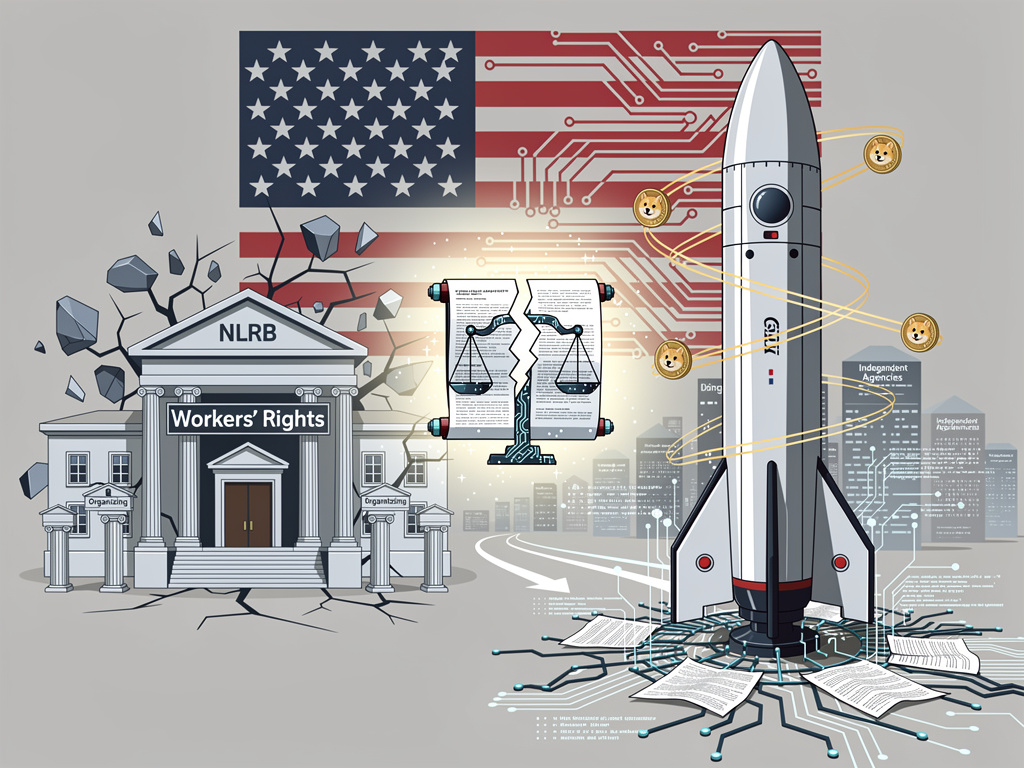
For nearly a century, the National Labor Relations Board has served as the federal government’s primary arbiter of workplace disputes, a New Deal-era institution designed to protect workers’ rights to organize and bargain collectively. Now, that institution faces an existential threat — and the man leading the charge against it is the same billionaire who runs America’s most strategically important rocket company and holds extraordinary influence within the current administration.
SpaceX, the aerospace manufacturer and space transportation company founded by Elon Musk, has been waging an aggressive legal campaign to have the NLRB declared unconstitutional, a fight that has escalated dramatically in recent months and now intersects with broader efforts by the Trump administration and Musk’s Department of Government Efficiency to shrink the federal workforce and eliminate regulatory agencies deemed hostile to business interests.
A Constitutional Challenge Born From Fired Engineers
The origins of SpaceX’s battle with the NLRB trace back to 2022, when the company fired eight employees who had circulated an open letter criticizing Musk’s behavior on social media, particularly his controversial posts on the platform now known as X. The employees argued that Musk’s public conduct was damaging to the company’s reputation and creating a hostile work environment. SpaceX terminated them, and the NLRB’s general counsel subsequently filed a complaint alleging the firings violated federal labor law.
Rather than contest the merits of the case through the standard administrative process, SpaceX took an extraordinary step: it filed a federal lawsuit in January 2024 in the Southern District of Texas, arguing that the NLRB’s entire structure is unconstitutional. The company’s legal theory rests on several pillars — that the agency’s administrative law judges are improperly insulated from presidential removal, that its combination of prosecutorial and adjudicative functions violates due process, and that its proceedings deny companies their Seventh Amendment right to a jury trial. As The New York Times reported, this legal strategy represented a deliberate escalation that went far beyond the typical employer response to an unfair labor practice complaint.
The DOGE Connection and the Gutting of an Agency
What makes SpaceX’s legal challenge uniquely potent is the confluence of judicial strategy and political power. Musk, through his role leading the Department of Government Efficiency — the cost-cutting initiative established by President Trump — has gained unprecedented access to the levers of federal power. While DOGE’s official mandate involves identifying waste and inefficiency across the government, critics and labor advocates have raised alarm that Musk’s dual role creates a glaring conflict of interest when the targets of government downsizing include agencies that regulate his own companies.
The NLRB has seen its workforce decimated in recent months. According to reporting by The New York Times, the agency has experienced significant staff reductions that have hampered its ability to investigate complaints, process elections, and enforce orders. Regional offices have been shuttered or consolidated, and career staff with decades of institutional knowledge have been pushed out through a combination of early retirement offers, reductions in force, and what former employees describe as a deliberate campaign to make working conditions untenable. The agency’s budget, already stretched thin after years of congressional neglect, has been further squeezed.
A Legal Theory That Found Its Moment
SpaceX’s constitutional arguments against the NLRB did not emerge from a vacuum. They draw heavily on a broader conservative legal movement, championed by organizations like the Federalist Society and litigated by firms with deep ties to the business community, that has sought to curtail the power of independent regulatory agencies. The Supreme Court’s 2024 decision in Loper Bright Enterprises v. Raimondo, which overturned the Chevron doctrine of judicial deference to agency interpretations of ambiguous statutes, signaled a judiciary increasingly skeptical of administrative state power.
Federal judges appointed during the Trump administration have proven receptive to these arguments. In SpaceX’s case, the company strategically filed in a Texas district court known for business-friendly rulings. The judge in the case issued a preliminary injunction halting the NLRB proceedings against SpaceX, finding that the company had raised serious constitutional questions that merited full consideration. That ruling, labor law scholars noted, was itself remarkable — courts have historically been reluctant to interfere with ongoing administrative proceedings, particularly before they have reached a final decision that could be reviewed through normal appellate channels.
The Ripple Effects Across American Labor Relations
The implications of SpaceX’s challenge extend far beyond one company’s dispute with a handful of former engineers. If courts ultimately rule that the NLRB’s structure is unconstitutional, the decision could effectively paralyze federal labor law enforcement. The National Labor Relations Act, signed by President Franklin D. Roosevelt in 1935, established the framework through which millions of American workers exercise their right to form unions, engage in collective bargaining, and take concerted action to improve their working conditions. Without a functioning enforcement mechanism, those rights exist largely on paper.
Other companies have taken notice. Amazon, Starbucks, and Trader Joe’s — all of which have faced significant NLRB complaints in recent years related to their responses to unionization efforts — have filed similar constitutional challenges or signaled support for SpaceX’s legal theories. The strategy has created a potential cascade effect: the more companies challenge the NLRB’s authority, the more resources the already-depleted agency must devote to defending its own existence rather than fulfilling its statutory mission.
Labor’s Counteroffensive and the Political Calculus
Union leaders and labor advocates have responded with a mixture of legal defense and political mobilization. The AFL-CIO has filed amicus briefs in the SpaceX case, arguing that the constitutional challenges are meritless and that the NLRB’s structure has been repeatedly upheld by courts over its nine-decade history. Legal scholars sympathetic to labor have pointed out that the removal protections SpaceX challenges were specifically designed to insulate the agency from political pressure — precisely the kind of pressure that Musk, with his unique position straddling government and industry, is now in a position to exert.
Democratic members of Congress have introduced legislation that would reinforce the NLRB’s statutory authority and provide emergency funding to address staff shortages, though such measures face virtually no prospect of passage in the current Congress. Senator Bernie Sanders of Vermont has called Musk’s simultaneous campaign against the NLRB through the courts and through DOGE “the most brazen conflict of interest in modern American government,” while Representative Bobby Scott of Virginia has demanded investigations into whether DOGE personnel have accessed NLRB case files or internal deliberations related to pending matters involving Musk’s companies.
The Broader Question of Regulatory Independence
At its core, the SpaceX-NLRB confrontation raises fundamental questions about the future of independent regulatory agencies in the American system of government. The independent agency model — in which expert bodies are granted a degree of insulation from direct presidential control to ensure decisions are made on technical and legal merits rather than political considerations — has been a cornerstone of federal governance since the Progressive Era. The Interstate Commerce Commission, the Federal Reserve, the Securities and Exchange Commission, and the Federal Trade Commission all operate under variations of this model.
Conservative legal theorists have long argued that this structure violates the Constitution’s vesting of executive power in the president, contending that the chief executive must have the authority to remove any officer exercising executive functions. The Supreme Court has moved incrementally in this direction, striking down certain multi-layered removal protections in cases like Seila Law v. Consumer Financial Protection Bureau (2020) and Collins v. Yellen (2021). SpaceX’s case could provide the vehicle for a more sweeping ruling that calls into question the independence of numerous federal agencies.
What Comes Next for Workers and Employers Alike
The practical consequences are already being felt on the ground. NLRB regional directors report that case processing times have ballooned as staffing levels have plummeted. Union election petitions that once took weeks to process now languish for months. Workers who file unfair labor practice charges face the prospect of waiting years for resolution — if their cases are investigated at all. For employers, the uncertainty is also significant: without clear, enforceable rules, companies that want to comply with labor law in good faith find themselves operating without reliable guidance.
As The New York Times noted, the SpaceX case is expected to eventually reach the Supreme Court, where a conservative supermajority has shown increasing willingness to rein in administrative agencies. The timeline remains uncertain — the case could take another year or more to work through the appellate courts — but the direction of travel appears clear. Whether the nation’s labor relations framework survives this challenge intact, or emerges fundamentally transformed, may depend on how the judiciary balances its skepticism of the administrative state against the practical necessity of institutions that have governed American workplaces for the better part of a century.
For Elon Musk, the stakes are both ideological and deeply personal. A ruling that the NLRB is unconstitutional would not only eliminate the agency pursuing claims against SpaceX but would also remove a regulatory body that has investigated labor practices at Tesla, another Musk-controlled company, on multiple occasions. It would represent the most significant victory yet in a campaign that has seen Musk leverage his wealth, his companies, his media platform, and his political access in pursuit of a vision of American governance with dramatically fewer checks on corporate power. For the workers who depend on federal labor protections, the outcome could define the terms of employment in America for a generation.


 WebProNews is an iEntry Publication