
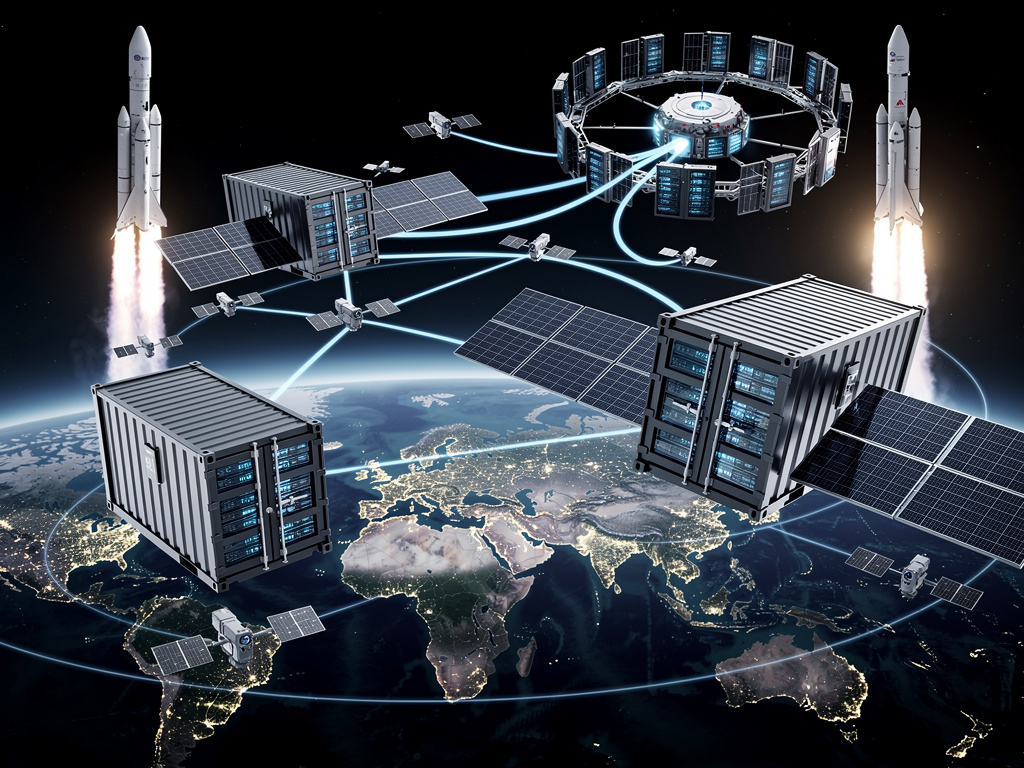
Orbiting the Future: Elon Musk’s Sudden Crusade for Space-Based Data Centers
Elon Musk has never been one to shy away from bold visions, but his recent flurry of commentary on deploying data centers in space marks a notable shift in his public discourse. Over the past few weeks, the SpaceX CEO has taken to social media and interviews to champion the idea of orbital computing infrastructure, positioning it as a game-changer for artificial intelligence and global connectivity. This surge in rhetoric coincides with growing interest from tech giants in extraterrestrial solutions to Earth’s mounting data demands, driven by the explosive growth of AI models that require immense computational power.
Musk’s enthusiasm isn’t isolated. Reports indicate that competitors like Jeff Bezos’ Blue Origin are also exploring similar concepts, turning what was once science fiction into a potential new frontier for the industry. According to a recent piece in The Information, Musk’s amplified talk on space data centers may stem from strategic positioning amid SpaceX’s ambitious plans, including an anticipated initial public offering. The article suggests that prominent tech figures seem to be echoing each other on this topic, raising questions about coordinated hype or genuine innovation convergence.
At the heart of Musk’s pitch is the promise of unparalleled efficiency. By placing data centers in orbit, companies could leverage abundant solar energy, reduced latency via satellite networks, and escape the earthly constraints of land, power grids, and environmental regulations. Musk has publicly stated on X that scaling up Starlink’s V3 satellites could form the backbone of such systems, potentially delivering multi-gigabit speeds with minimal delays. This aligns with broader industry trends where energy-hungry AI training pushes the limits of terrestrial infrastructure.
The Technological Foundations Taking Shape
SpaceX’s Starlink constellation, already the world’s largest satellite network, provides a ready platform for this evolution. Musk has highlighted how the next-generation V3 satellites, set for launch via the Starship rocket, could be “scaled up” to handle data center functions. A report from Data Center Dynamics details Musk’s claim that these satellites, equipped with high-speed laser links, would enable orbital computing by early 2026, assuming Starship’s development stays on track. The optimism hinges on Starship’s ability to deploy dozens of these larger satellites per launch, a feat that could dramatically lower costs.
Beyond SpaceX, other players are advancing parallel efforts. Nvidia-backed Starcloud recently made headlines by training the first AI model in space aboard its Starcloud-1 satellite, running Google’s Gemma model. As covered in a CNBC article, this milestone demonstrates the feasibility of orbital AI processing, where models can be fine-tuned in space and results beamed back to Earth. Such developments underscore the potential for space-based systems to handle the “bitstreams” of AI generation more efficiently than ground-based alternatives.
Musk’s posts on X emphasize the latency advantages, noting that light travels faster in vacuum than through fiber optics, potentially cutting global delays to under 10 milliseconds. He envisions sun-synchronous orbits for constant solar power, allowing satellites to generate over 100 kilowatts if optimized. This isn’t mere speculation; SpaceX already operates more satellites than the rest of the world combined, giving it a substantial edge in deployment expertise.
Competitive Pressures and Market Dynamics
The rivalry with Bezos adds intrigue to Musk’s vocal push. Blue Origin is reportedly developing its own orbital data center technology, with Bezos predicting that space facilities will surpass Earth-based servers in performance within decades. A story in Technology.org frames this as a heated space race, where both billionaires eye the skies to solve AI’s power crunch. Musk’s commentary may be a preemptive strike, especially as SpaceX gears up for a possible 2026 IPO aiming for a $1.5 trillion valuation.
Financial motivations loom large. Another Data Center Dynamics report suggests the IPO could fund these orbital ambitions, with Musk confirming on social media that proceeds would support space data centers. This comes amid big tech’s pivot toward space, as evidenced by Alphabet’s Project Suncatcher, which explores orbital AI infrastructure. ARK Invest’s newsletter, in its issue 487, discusses how such projects could scale computing power exponentially, with SpaceX’s plans complementing efforts from Nvidia and others.
Critics, however, question the timelines and risks. Starship remains in prototype stages, and orbital data centers face hurdles like thermal management in vacuum and vulnerability to space debris. Musk’s own X posts acknowledge the need for radical rocket improvements to make this viable, tying back to his long-standing goal of multiplanetary life. Yet, the potential rewards are immense: infinite solar energy could power AI at scales impossible on Earth, where data centers already consume vast electricity.
Strategic Implications for AI and Connectivity
Musk’s vision extends beyond hardware to societal impact. He argues that orbital compute will be the “lowest cost way to generate AI bitstreams” within three years, outpacing terrestrial growth. This could democratize AI access, particularly in underserved regions. For instance, Starlink has already connected schools and hospitals in Africa, as Musk noted on X, potentially lifting millions out of poverty through reliable internet. Expanding to data centers could amplify this, enabling real-time AI applications in remote areas without massive infrastructure investments.
The integration with Starlink’s direct-to-cell capabilities adds another layer. Musk announced the completion of the first such constellation, offering 10 megabits per beam to unmodified phones in isolated spots. Future iterations promise higher bandwidth, blending connectivity with computing. An Ars Technica article quotes Musk on how this could transform space activities, from autonomous assembly to vast solar arrays.
Industry insiders see this as a pivot point. With AI demanding ever-more power—projections suggest data centers could consume 8% of U.S. electricity by 2030—space offers a sustainable alternative. Musk’s emphasis on the sun as a “free fusion reactor” critiques earthly fusion efforts, advocating for orbital solar farms that could beam power or data back efficiently.
Challenges and Broader Industry Shifts
Despite the hype, engineering obstacles remain formidable. Deploying and maintaining orbital data centers requires advancements in robotics for assembly and repair, as well as robust cybersecurity against cosmic radiation and potential hacks. Musk’s X commentary on lunar factories and mass drivers hints at even grander scales, like terawatt-level power generation, but these are years away.
Competition isn’t limited to Bezos; startups like Starcloud are proving concepts with Nvidia’s backing, training models in orbit to bypass Earth’s energy limits. A People report highlights the billionaire rivalry, but broader participation suggests a maturing field. SpaceX’s lead in satellite numbers positions it favorably, yet regulatory hurdles, such as international space treaties, could complicate deployments.
Musk’s sudden focus may also tie to his Mars ambitions. A Reuters analysis notes that the IPO’s risks are amplified by these extraterrestrial goals, balancing Starlink’s revenue stability against speculative ventures. Investors must weigh the allure of orbital dominance against execution uncertainties.
Pioneering a New Era in Computing
As Musk continues to amplify this narrative—recent X posts tout Starlink expansions to places like São Tomé and Príncipe—the industry watches closely. Orbital data centers could redefine global infrastructure, making high-performance computing ubiquitous and sustainable. By leveraging SpaceX’s ecosystem, Musk aims to outpace rivals, turning satellites from mere relays into computational powerhouses.
The convergence of AI, space tech, and renewable energy in orbit represents a bold bet on humanity’s future. While skeptics point to delays, successes like Starcloud’s AI training validate the path. Musk’s rhetoric, as dissected in The Information, might be the spark that ignites widespread adoption.
Ultimately, this push could accelerate the shift from ground-bound systems to a cosmic network, where data flows as freely as sunlight. With SpaceX’s IPO on the horizon, the stakes are high, promising a revolution that extends far beyond Earth’s atmosphere.


 WebProNews is an iEntry Publication