
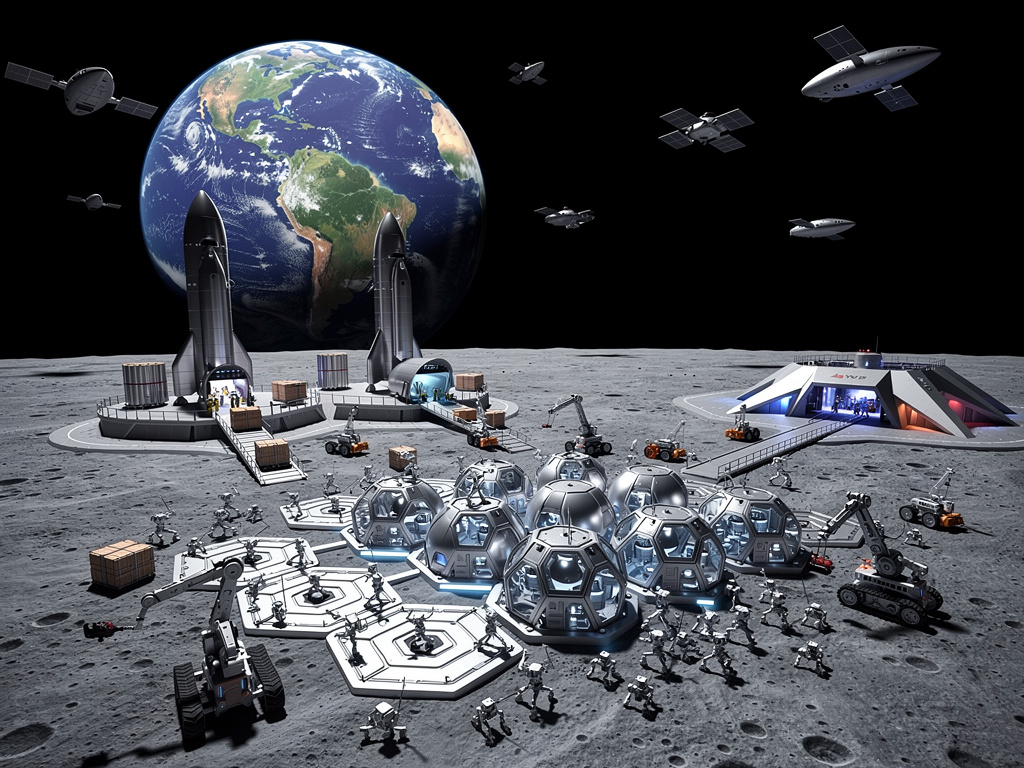
For more than two decades, Elon Musk has evangelized a singular, audacious vision: making humanity a multiplanetary species by colonizing Mars. That dream has defined SpaceX since its founding in 2002, shaping everything from the Falcon 9 rocket to the colossal Starship launch system currently undergoing testing in South Texas. But in a striking strategic shift, Musk has signaled that the Red Planet may have to wait — at least temporarily — while SpaceX turns its attention to Earth’s nearest celestial neighbor.
In a post on his social media platform X, Musk declared that SpaceX would be shifting its near-term focus toward building what he described as a “self-growing city” on the moon before pursuing a full-scale Mars colonization effort. The announcement, first reported by Fox Business, represents a significant recalibration of priorities for the world’s most valuable private space company and has sent ripples through the aerospace industry, government agencies, and the investment community alike.
A Strategic Recalculation: Why the Moon Comes First
The logic behind Musk’s pivot, while surprising to some longtime Mars enthusiasts, is rooted in practical engineering and economic considerations. The moon is roughly 238,900 miles from Earth, compared to Mars’s average distance of approximately 140 million miles. A trip to the lunar surface takes about three days; a journey to Mars requires six to nine months under current propulsion technology. These differences are not merely academic — they have profound implications for supply chains, emergency contingencies, crew safety, and the iterative development cycles that SpaceX has used to revolutionize rocketry.
Building a permanent, self-sustaining settlement on the moon would allow SpaceX to test and refine the technologies, logistics, and governance frameworks necessary for an eventual Mars colony — but at a fraction of the risk and cost. Life support systems, in-situ resource utilization (ISRU) techniques for extracting water ice and producing oxygen and rocket propellant from lunar regolith, habitat construction using 3D printing, and closed-loop agricultural systems could all be validated on the moon before being deployed hundreds of millions of miles away. A failure on the moon, while dangerous, would be recoverable in ways that a failure on Mars simply would not be.
The Concept of a ‘Self-Growing City’ and What It Means
Musk’s use of the phrase “self-growing city” is deliberate and revealing. It suggests a settlement designed not merely to survive but to expand autonomously — one that can manufacture its own building materials, generate its own power, grow its own food, and produce the components necessary to scale without constant resupply from Earth. This concept goes far beyond the traditional notion of a lunar base or outpost staffed by a handful of rotating astronauts. Instead, it envisions a permanent, expanding community with the industrial capacity to sustain and enlarge itself over time.
Such a vision aligns with concepts that have been explored in academic and governmental circles for years. NASA’s Artemis program, which aims to return American astronauts to the lunar surface, has always included long-term goals of establishing a sustained human presence on the moon. The agency’s Gateway lunar space station, various commercial lunar payload services (CLPS) contracts, and partnerships with companies like Blue Origin and Intuitive Machines all point toward a broader ecosystem of lunar development. But Musk’s framing — a city, not a base — elevates the ambition considerably and positions SpaceX as the potential anchor tenant of a new lunar economy.
SpaceX’s Starship: The Workhorse for Lunar Ambitions
Central to this entire endeavor is Starship, the fully reusable super heavy-lift launch vehicle that SpaceX has been developing at its Starbase facility in Boca Chica, Texas. Standing nearly 400 feet tall and capable of carrying over 100 metric tons to low Earth orbit, Starship is already under contract with NASA as the Human Landing System (HLS) for the Artemis III mission, which aims to land astronauts near the lunar south pole. A modified version of Starship, designed to land on and launch from the moon’s surface, is being developed specifically for this purpose.
The vehicle’s massive payload capacity is what makes Musk’s vision of a self-growing lunar city even theoretically possible. Traditional rockets could deliver small payloads to the moon — scientific instruments, rovers, small habitat modules. Starship, by contrast, could deliver entire prefabricated structures, industrial equipment, mining machinery, and the raw materials needed to bootstrap a settlement. Multiple Starship flights could, in theory, deliver the equivalent tonnage of an entire small town’s infrastructure in a relatively compressed timeframe. SpaceX’s aggressive launch cadence goals — Musk has spoken of eventually launching Starship multiple times per day — would be essential to sustaining such an effort.
The Geopolitical Dimension: A New Space Race Takes Shape
Musk’s announcement does not exist in a vacuum. It comes at a time of intensifying geopolitical competition in space, particularly between the United States and China. China has made no secret of its lunar ambitions, with plans for a permanent research station at the moon’s south pole — the International Lunar Research Station (ILRS) — developed in partnership with Russia and potentially other nations. Chinese missions have already achieved significant milestones, including the first landing on the far side of the moon with Chang’e 4 and the successful return of lunar samples from the far side with Chang’e 6.
The prospect of a Chinese-led permanent lunar presence has added urgency to American efforts. The Trump administration has been vocal about maintaining U.S. dominance in space, and SpaceX’s pivot toward lunar development dovetails neatly with broader national security and economic competitiveness objectives. A self-sustaining American-led city on the moon would represent not just a technological achievement but a geopolitical statement — one that could shape international norms around lunar resource extraction, territorial claims, and the governance of off-world settlements for decades to come.
Economic Implications and the Emerging Lunar Economy
The financial dimensions of Musk’s lunar pivot are staggering. Estimates for establishing a permanent lunar settlement range from hundreds of billions to trillions of dollars, depending on scope and timeline. But the potential economic returns are equally enormous. Lunar water ice, concentrated at the poles, could be converted into hydrogen and oxygen — the components of rocket fuel — creating an orbital refueling infrastructure that would dramatically reduce the cost of deep-space missions. Helium-3, abundant on the moon but rare on Earth, is a potential fuel for future fusion reactors. Rare earth elements and other minerals could be extracted and either returned to Earth or used in space-based manufacturing.
SpaceX, as a private company, would need to develop viable business models to sustain such an effort. Revenue streams could include NASA and Department of Defense contracts, commercial payload delivery services, lunar tourism, and the sale of propellant and other resources to other space agencies and private companies. The company’s existing Starlink satellite internet business, which generates billions in annual revenue, provides a template for how SpaceX might monetize lunar infrastructure — perhaps through a lunar communications and navigation network that other operators would pay to access.
What This Means for the Mars Timeline
The critical question for Mars advocates is whether this lunar focus represents a delay or an acceleration of the ultimate goal. Musk has long targeted the late 2020s for initial crewed Mars missions, though most industry observers have viewed those timelines as aspirational at best. By redirecting near-term resources toward the moon, SpaceX may actually be taking the faster path to Mars — building the industrial base, operational experience, and technological toolkit that would make a Mars settlement viable rather than merely possible.
A self-growing city on the moon would serve as a proving ground for virtually every system needed on Mars: power generation, habitat pressurization, radiation shielding, food production, waste recycling, medical care, and the psychological challenges of long-duration isolation. It would also create a cadre of experienced off-world builders and operators — people who have lived and worked beyond Earth and can bring that expertise to an even more challenging environment. In Musk’s calculus, the moon may not be a detour from Mars but the essential prerequisite.
The Road Ahead: Challenges and Uncertainties
For all its ambition, Musk’s vision faces formidable obstacles. Starship has yet to complete a fully successful orbital mission with payload delivery and landing. The lunar variant of the vehicle requires orbital refueling — a technology that has never been demonstrated at scale. Regulatory hurdles, environmental reviews, and international treaty obligations under the Outer Space Treaty of 1967 add layers of complexity. And the sheer human challenge of building a permanent settlement in the moon’s harsh environment — with its extreme temperature swings, abrasive regolith, micrometeorite bombardment, and lack of atmosphere — cannot be underestimated.
Yet if any private entity has the track record, resources, and sheer audacity to attempt such a feat, it is SpaceX. The company has already revolutionized orbital launch with reusable rockets, built the world’s largest satellite constellation, and secured contracts worth billions from NASA and the U.S. military. Musk’s lunar pivot may ultimately be remembered not as a retreat from Mars but as the moment the dream of a multiplanetary civilization became an engineering program with a credible near-term milestone. The moon, long romanticized by poets and dismissed by Mars purists, may be about to become the most consequential construction site in human history.


 WebProNews is an iEntry Publication