
Musk’s Davos Oracle: Bold Visions of a Robot-Dominated Tomorrow
Elon Musk’s debut at the World Economic Forum in Davos this year marked a pivotal moment for the tech mogul, long a critic of the event but now stepping into its spotlight. On January 22, 2026, Musk delivered a series of audacious predictions that sent ripples through the global business elite, focusing on artificial intelligence, robotics, and energy constraints. Drawing from his roles at Tesla, SpaceX, and xAI, he painted a future where robots outnumber humans and AI eclipses human intellect, but not without significant hurdles. This appearance, his first at the forum, came amid a backdrop of economic uncertainty and rapid technological shifts, making his insights particularly resonant for industry leaders.
Musk emphasized that AI surpassing human intelligence is imminent, potentially by next year, driven by exponential advances in computing power and software. He warned, however, that the real bottleneck isn’t technology itself but electricity supply, a theme echoed in his recent posts on X where he highlighted the shift in AI constraints from chips to voltage transformers and power generation. This perspective aligns with broader industry concerns about sustainable energy for data centers, as AI demands soar.
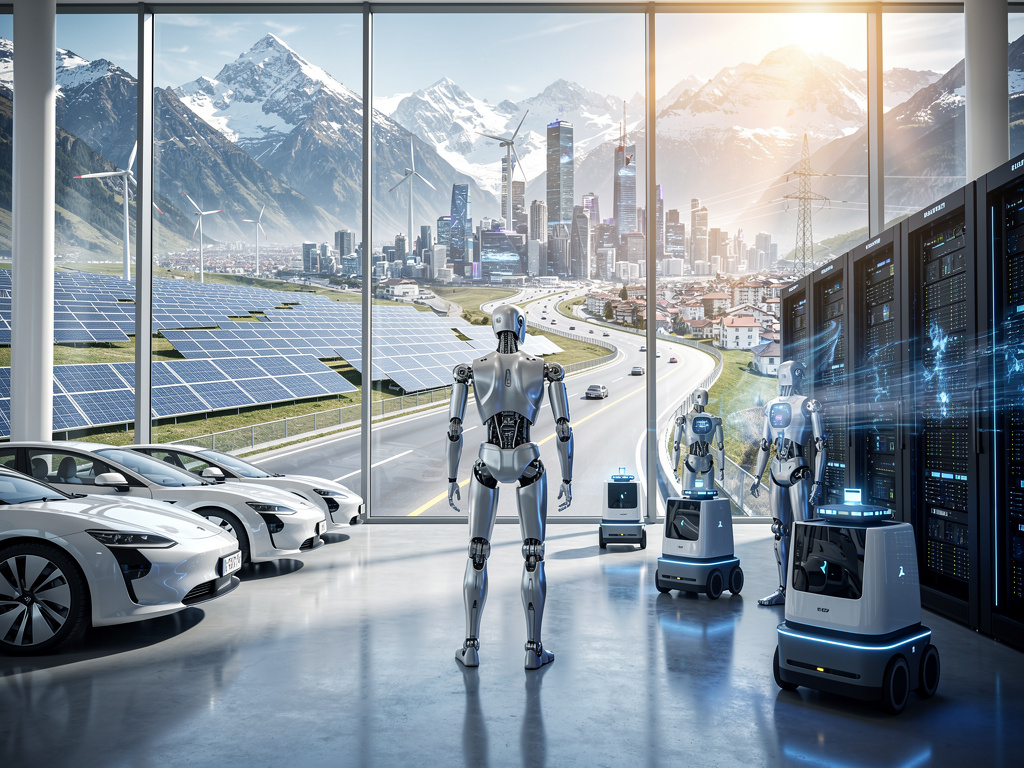
In his conversation, streamed live via the World Economic Forum, Musk forecasted a robot-majority world, with Tesla’s Optimus humanoid robots hitting the market as early as next year. He suggested these machines could transform daily life, from household chores to industrial labor, potentially leading to unprecedented wealth distribution. This optimism contrasts with fears of job displacement, but Musk argued that such abundance would elevate living standards far beyond current levels.
AI’s Ascendance and the Power Predicament
Building on his predictions, Musk delved into the specifics of AI development at Tesla and xAI. He mentioned upcoming chips like AI5, which he claims will revolutionize self-driving vehicles, achieving safety levels vastly superior to humans. This chip, described as roughly equivalent to Nvidia’s Hopper in a single system-on-chip and Blackwell in dual configuration, underscores Tesla’s push for in-house hardware to sidestep supply chain vulnerabilities. Musk has personally invested weekends in its development, signaling its critical importance to the company’s future.
Energy emerged as a recurring theme, with Musk asserting that electricity shortages could hamper AI progress unless addressed urgently. In a report from BusinessToday, he noted that while computing power and software are advancing rapidly, power generation remains the limiting factor. This ties into his vision for solar-powered satellites and expansive renewable energy initiatives, though he critiqued U.S. tariffs on solar imports as a barrier to affordability.
Musk’s comments on autonomous vehicles were equally bold, predicting widespread robotaxi deployment in the U.S. by year’s end. According to CNBC, Tesla’s robotaxis have already launched in Austin, Texas, fulfilling long-standing promises after delays. He flagged imminent European approvals for self-driving tech, potentially opening new markets and accelerating adoption.
Robotics Revolution: From Factories to Everyday Life
Shifting to robotics, Musk envisioned a society where humanoid robots like Optimus become ubiquitous, outnumbering people and handling tasks from manufacturing to personal assistance. This prediction, detailed in coverage by Euronews, suggests sales could begin next year, with applications extending to SpaceX’s Mars ambitions. He joked about dying on Mars, reinforcing his interplanetary goals, but tied it to practical advancements in AI-driven robotics.
In discussions about economic impacts, Musk drew parallels to Iain Banks’ Culture series, positing a future of abundance where AI and robots eliminate scarcity. Posts on X from late 2025 elaborate this, with Musk claiming such technologies could make everyone wealthier than the richest individuals today, providing superhuman medical care and immersive entertainment. This utopian view, however, raises questions about inequality and ethical AI deployment.
Critics at Davos pointed out potential downsides, including workforce disruptions and regulatory challenges. Musk addressed these indirectly by stressing optimism, as reported in The National, where he discussed solar-powered satellites and cast doubt on extraterrestrial life, focusing instead on human-led innovation.
Energy Challenges and Global Trade Tensions
Musk’s critique of U.S. solar tariffs highlighted trade frictions impeding clean energy progress. In his Reuters interview, accessible via Reuters, he argued these policies make solar power less competitive, complicating the energy needs for AI expansion. He proposed aggressive targets for Tesla, including scaling humanoid robot production, which could strain global supply chains.
On a broader scale, Musk warned of AI’s energy demands shifting to space-based computing by AI7 or Dojo3 iterations, as per his X posts. This involves harnessing solar power in orbit to bypass terrestrial limitations, potentially revolutionizing data processing with minimal latency issues, even if light-speed constraints persist.
He elaborated on latency not being a fundamental barrier, citing human civilization’s success despite biological “packet drops.” Coverage in CBS News captured his assertion that robots will outnumber humans, with Tesla leading the charge through Optimus sales starting next year.
Interplanetary Ambitions and AI Ethics
Musk’s Davos remarks extended to space exploration, linking AI and robotics to Mars colonization. He envisioned AI6 optimizing data centers and humanoid robots, paving the way for self-sustaining off-world societies. This aligns with his X commentary on using even a fraction of the sun’s power for AI, yielding exponential returns that render traditional economics obsolete.
Ethical considerations surfaced implicitly, with Musk advocating for AI safety amid rapid progress. His xAI venture aims to understand the universe, but he cautioned against overregulation that could stifle innovation, a point echoed in BusinessToday’s analysis of his speech.
In a lighter vein, Musk joked about a “Trump Peace Board” and Greenland, as noted in Forbes, blending geopolitics with tech futurism. Yet, his core message remained focused on harnessing AI for humanity’s advancement, despite power and infrastructure challenges.
The Road Ahead: Innovation Amid Uncertainty
Looking forward, Musk predicted enhancements to platforms like X, with AI-driven recommendations becoming “incredible” by year’s end, reducing spam and personalizing content. This, from his recent X post, suggests a shift where devices act as edge nodes for AI inference, overcoming bandwidth constraints.
Industry insiders at Davos debated these visions, weighing optimism against practical hurdles. Musk’s emphasis on electricity as AI’s biggest challenge, reiterated in Euronews, prompts calls for policy reforms in energy sectors worldwide.
Ultimately, his predictions challenge conventional thinking, urging leaders to prepare for a robot-infused, AI-dominant era. As detailed in The National, Musk’s blend of critique and hope positions him as a key voice in shaping technology’s trajectory.
Beyond Davos: Implications for Tech Ecosystems
The ripple effects of Musk’s statements are already evident in market reactions, with Tesla shares fluctuating post-Davos. Analysts from CNBC note the robotaxi expansion as a potential revenue driver, while solar tariff comments fuel discussions on trade policy.
On X, sentiment reflects excitement mixed with skepticism, with users echoing Musk’s posts on AI wealth creation. This public discourse underscores the need for balanced approaches to innovation, ensuring benefits are widespread.
Musk’s warnings about U.S. AI leadership, tied to energy generation, highlight geopolitical stakes. As per Reuters, addressing these could secure dominance in emerging tech fields.
Sustaining the Surge: Energy and AI Synergies
Delving deeper, Musk’s solar satellite promises, as covered in The National, aim to provide unlimited clean energy for AI. This could mitigate the electricity crunch he foresees, enabling scalable computing without environmental trade-offs.
For robotics, Optimus’s integration with AI5 chips promises “almost perfect” autonomy, transforming industries from automotive to healthcare. CBS News reports on this as a game-changer, potentially starting sales next year.
Musk’s X insights on space-based AI compute suggest a paradigm shift, where orbital data centers handle massive workloads, free from earthly constraints.
Visions of Abundance in a Tech-Driven World
Envisioning the societal impact, Musk’s references to Iain Banks’ works paint a picture of post-scarcity living, where AI and robots fulfill needs effortlessly. This, from his X posts, implies redefining wealth through access rather than ownership.
Challenges remain, including ethical AI deployment and job transitions. Forbes captures Musk’s humorous takes, but underlying seriousness calls for proactive strategies.
As industries adapt, Musk’s Davos predictions serve as a blueprint, urging investment in energy infrastructure to unlock AI’s full potential.
In reflecting on these insights, it’s clear Musk’s appearance has galvanized discussions, blending bold forecasts with pragmatic warnings to guide the tech world’s next chapter. His emphasis on optimism, amid critiques of policies like solar tariffs in Reuters, encourages a forward-looking stance that could redefine global progress. Whether robots truly outnumber humans or AI achieves superintelligence soon, the conversations sparked at Davos will influence strategies for years to come, pushing boundaries in innovation and sustainability.


 WebProNews is an iEntry Publication