
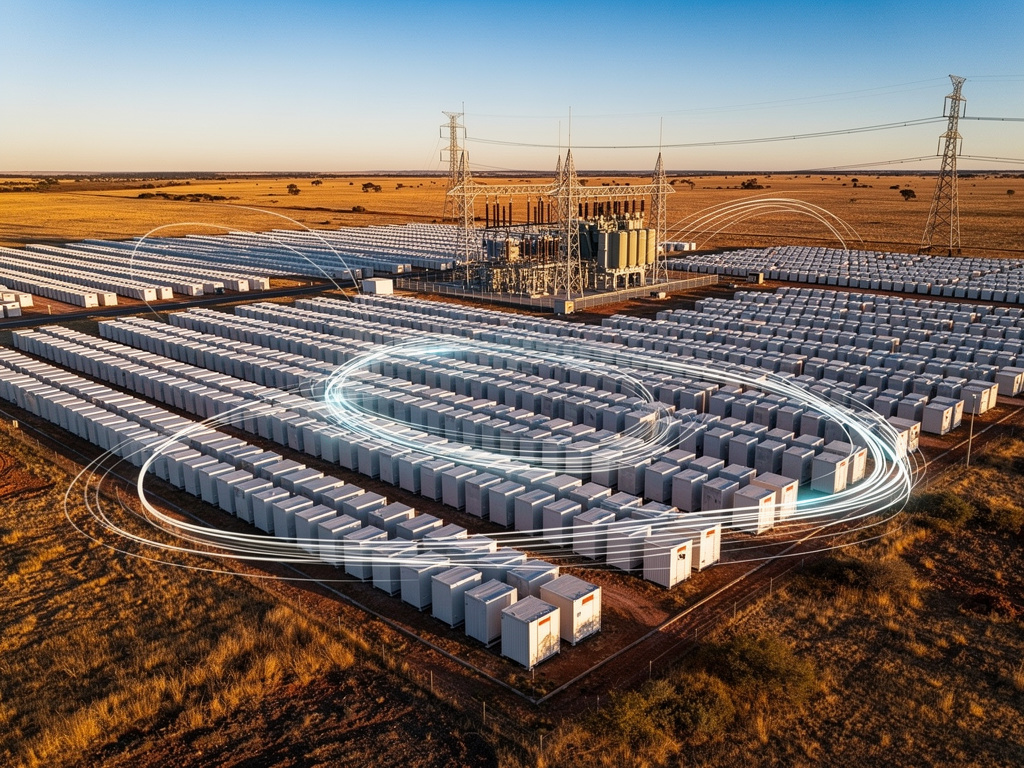
In the dusty plains north of Adelaide, a hulking assemblage of Tesla Megapacks stands as a testament to bold engineering and market savvy. The Hornsdale Power Reserve, often dubbed Tesla’s Big Battery, has evolved from a high-stakes publicity stunt into a cornerstone of Australia’s National Electricity Market (NEM). What began as Elon Musk’s audacious 100-day bet in 2017 now delivers unmatched reliability, outpacing gas peakers in speed and precision while saving consumers over $150 million, according to recent analysis from techAU.
Musk’s wager came amid South Australia’s blackouts from a 2016 storm, prompting the state to seek rapid grid stabilization. Tesla secured the contract on September 29, 2017, promising a 100 MW/129 MWh lithium-ion system for A$90 million. Construction wrapped in 63 days, connecting to the grid by December 1—well ahead of the deadline, avoiding Musk’s ‘free battery’ pledge. The project, owned by French firm Neoen, quickly proved its worth by arbitraging price spikes and providing frequency control.
From Musk’s Gambit to Market Maverick
Early performance shattered skepticism. In its first year, Hornsdale saved A$40 million in grid costs, doubling to A$116 million ($75.78 million) by 2019 through dominance in fast-response services, as reported by Teslarati. Tesla’s Autobidder software emerged as the secret weapon: an AI-driven platform that forecasts prices, load, and generation in real time, executing trades faster than human operators or fossil plants.
Autobidder functions like Autopilot for energy markets, using machine learning to buy low during surpluses and sell high amid peaks. It has consistently out-traded competitors, stabilizing the NEM—Australia’s interconnected grid serving 10 million customers—while minimizing fossil fuel reliance. Posts on X highlight its role, with Tesla noting Autobidder optimizes 16 of the UK’s top 20 grid batteries, a capability proven first at Hornsdale.
Expansion Unlocks New Grid Capabilities
By 2020, Neoen and Tesla boosted capacity 50% to 150 MW/193.5 MWh, but the upgrade introduced Virtual Machine Mode (VMM)—a breakthrough enabling synthetic inertia. Traditional grids depend on spinning turbines for inertia to dampen frequency swings; VMM emulates this with inverters, a world first at scale approved by the Australian Energy Market Operator (AEMO). pv magazine International detailed how Hornsdale began delivering these services in July 2022, addressing inertia shortfalls from retiring coal plants.
Neoen confirmed VMM implementation in 2023, allowing Hornsdale to provide ‘grid-forming’ support during disturbances, as per their announcement cited in Neoen’s press release. This has been pivotal for South Australia’s 70% renewable penetration, preventing cascading failures and enabling more wind and solar integration.
Proven Reliability in a High-Renewables Arena
Hornsdale’s uptime exceeds 99%, making it one of the NEM’s most dependable assets amid volatile weather and demand. AEMO data shows it responds in under 100 milliseconds to frequency events, far quicker than gas turbines’ seconds-long ramp-up. Cumulative savings now top A$1.5 billion when factoring arbitrage and ancillary services, per industry trackers, with techAU’s January 2026 visit underscoring its enduring impact.
The battery’s role expanded during heatwaves and storms, discharging fully to cap prices at A$14,400/MWh caps while recharging off-peak. Elon Musk tweeted in 2019: ‘World’s first very large scale battery has worked out well,’ linking to performance reports—a sentiment echoed in recent X discussions.
Autobidder’s AI Edge Redefines Trading
Autobidder’s prowess lies in its proprietary algorithms, processing terabytes of NEM data daily. It bids into 11 markets—from energy to FCAS (Frequency Control Ancillary Services)—capturing 10-20% of South Australia’s FCAS revenue. Tesla’s Q4 2025 report noted 14.2 GWh in global energy storage deployments, with Hornsdale as the pioneer showcasing Autobidder’s scalability.
In Victoria’s 350 MW Big Battery win in 2021, Autobidder was key, per techAU. This software now powers projects worldwide, turning batteries into profit machines that subsidize consumer bills.
Inertia Innovation Stabilizes Renewables Push
VMM’s grid-forming inverters mimic synchronous machines, injecting or absorbing power to maintain 50 Hz stability. Neoen’s October 2023 update emphasized: ‘A minimum level of inertia… is needed both during normal operation and after major disturbances.’ This countered closures of thermal plants, with Hornsdale providing services at scale unmatched globally until recent emulations.
AEMO’s approvals validated the tech during trials, where Hornsdale emulated a 75 MW steam turbine’s inertia. Clean Energy Finance Corporation hailed it as a ‘pioneering grid game changer,’ funding expansions that now total gigawatts nationwide.
Economic Wins for Consumers and Investors
Savings accrue via lower wholesale prices: Hornsdale clipped 100+ events, preventing A$1 million/hour spikes. A 2023 Yahoo Finance piece noted South Australia’s shift from fossil dependence, with Hornsdale enabling 24/7 renewables viability. Neoen reports returns exceeding 10% IRR, attracting capital to storage.
As Australia targets 82% renewables by 2030, Hornsdale’s model proliferates—Neoen’s December 2025 866 MWh project deploys Tesla’s new architecture, per Energy Storage News. Cumulative NEM batteries hit 10.6 GW under construction.
Global Blueprint from Down Under
Hornsdale’s success has rippled: Tesla’s 16 UK Autobidder sites and U.S. Megapack horns echo its formula. Musk’s 2023 X post affirmed: ‘The entire Earth can be powered by sustainable energy with tech that exists today,’ spotlighting Megapacks and Virtual Power Plants. Recent techAU road trip in January 2026 reaffirmed its status, with over 2,000 km driven to witness the site firsthand.
Legacy of Speed and Stability
Nine years on, Hornsdale anchors a NEM transformed: gas peakers idle as batteries dispatch first. Its evolution from bet to bedrock proves large-scale storage’s viability, blending AI trading, synthetic inertia, and rapid scaling to fortify grids worldwide.


 WebProNews is an iEntry Publication