
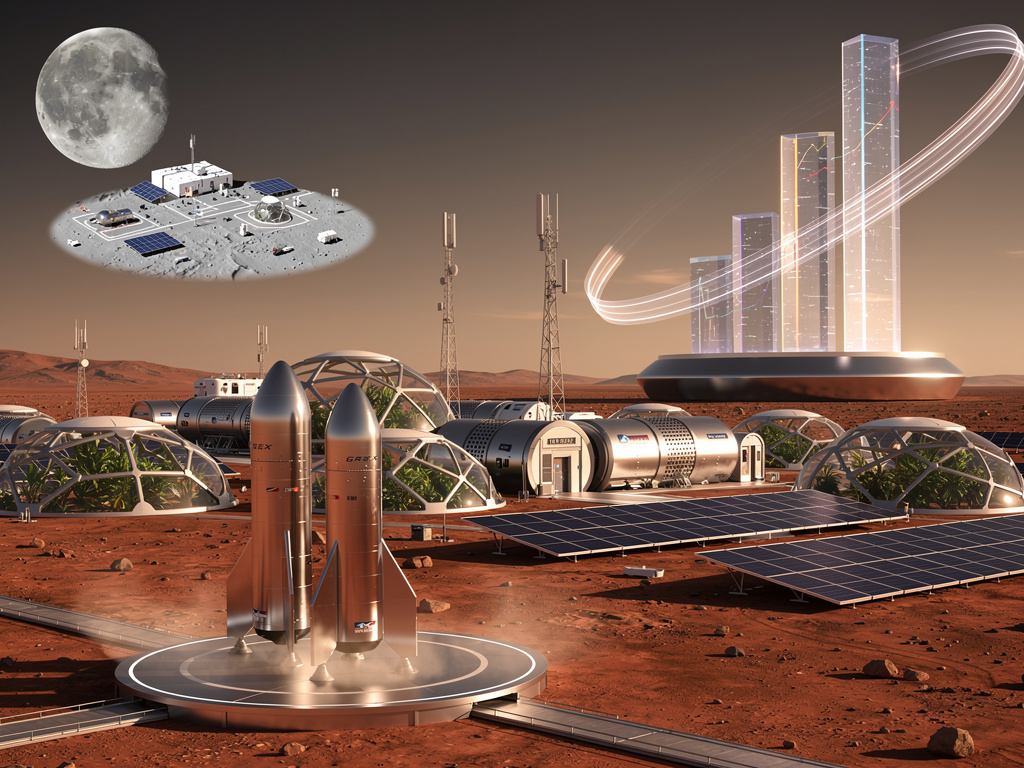
Elon Musk wants humanity to become a space-faring civilization. He has said so for years. Now the goal sits at the center of SpaceX’s path to going public.
The rocket company founded in 2002 disclosed in its IPO prospectus that Musk stands to gain another billion shares only if SpaceX reaches a $7.5 trillion market value and plants one million people on Mars. Fortune first highlighted the scale of this compensation package in May. The numbers dwarf typical corporate incentives. They match the scale of Musk’s stated ambition.
Short sentences capture the stakes. One million settlers. Tens of thousands of Starship flights. A self-sustaining city built from cargo delivered across 140 million miles of empty space. But recent shifts complicate the picture. In February Musk announced SpaceX would prioritize a self-growing lunar city reachable in under 10 years. Mars would follow five to seven years later. Reuters reported the pivot, noting it marked a departure from earlier Mars-first rhetoric.
The Moon as Stepping Stone
Critics called the change a retreat. Supporters saw pragmatism. The Moon offers shorter travel times, potential ice for fuel, and a testing ground for technologies needed farther out. Musk wrote on X that securing civilization’s future demanded speed. The Moon delivered that speed. Yet the Mars timeline has stretched before. Uncrewed Starships once eyed late 2026. Musk later called the odds 50-50. Human landings slipped toward 2029 or 2031. Wikipedia’s compilation of announcements tracks the adjustments.
Starship itself has flown 12 times as of late May 2026. Seven succeeded. Recent tests advance booster catching and orbital refueling, two prerequisites for any serious Mars campaign. SpaceX’s own site still lists the long-term vision in bold terms. “Starship is designed to fly to other worlds and will enable self-growing bases on the Moon, an entire civilization on Mars, and ultimately expansion to the Universe.” The company quotes Musk directly: “You want to wake up in the morning and think the future is going to be great — and that’s what being a spacefaring civilization is all about. It’s about believing in the future and thinking that the future will be better than the past. And I can’t think of anything more exciting than going out there and being among the stars.”
And the motivation runs deeper than exploration. Musk has warned for more than a decade that Earth faces risks from climate change, artificial intelligence, nuclear conflict and asteroid strikes. A single-planet species remains too vulnerable. Spreading to Mars creates redundancy. So the company built Starship to carry 100 tons or more per flight. It designed orbital tankers to refill vehicles in space. It envisions fleets departing during Earth-Mars alignment windows every 26 months.
But talk alone never built a city. SpaceX must master propellant production on Mars using local carbon dioxide and water ice. It must shield settlers from radiation. It must solve food, oxygen and medical needs for thousands during the long voyage. The Motley Fool examined the IPO filing and noted the company’s frank admission of risks tied to this multiplanetary mission. Challenges abound. Technical. Financial. Regulatory.
Pay Tied to Planetary Success
Musk’s latest pay structure makes those challenges personal. The board approved the package in January 2026. It vests only upon hitting both the valuation target and the one-million-person threshold. NBC News described the arrangement as peculiar yet aligned with Musk’s history of performance-based rewards at Tesla. Skeptics question whether any board can enforce such distant milestones. Musk already owns a large stake. The extra shares could push his compensation into the hundreds of billions.
Investors reading the S-1 see more than rockets. Starlink already generates cash flow. The network delivers internet from orbit and funds Starship development. Artificial intelligence efforts appear in the prospectus too. SpaceX describes a vertically integrated machine that builds satellites, launches them, powers data centers with solar energy and aims for off-world cities. The filing ties all these threads to the same overarching purpose.
Recent coverage shows the narrative evolving in real time. The Motley Fool article from June 11 captures Musk’s enduring drive to create that space-faring civilization. It echoes earlier pieces but frames the IPO as the moment Wall Street must price the dream. Starship’s rapid iteration continues at Starbase in Texas. New prototypes stack. Cryogenic tests complete. Flight 13 preparations accelerate even as regulatory reviews linger.
Critics point to delays. Supporters highlight progress no other entity matches. NASA depends on SpaceX for crew and cargo to the International Space Station. The company lands Falcon 9 boosters dozens of times per year. That flight cadence once seemed impossible. Now it funds the next leap.
So the question facing potential public shareholders is simple. Do they buy the vision? One million people on Mars would require millions of tons of cargo. Hundreds or thousands of Starships produced each year. An industrial base on another planet. The numbers strain belief. Yet the same was once said of reusable rockets.
Musk has moved timelines before. He has also delivered results that surprised experts. The compensation structure forces accountability over decades. If SpaceX succeeds, the payoff matches the accomplishment. If not, the shares remain unvested.
Meanwhile the Moon beckons first. A lunar city could test closed-loop life support, in-situ resource utilization and long-duration human operations. Success there would de-risk the Mars journey. Failure would expose gaps early. Either outcome informs the larger effort.
SpaceX’s website still carries the original call to action. Make life multiplanetary. The phrase appears in nearly every major update. It survived shifts in schedule and priority. It survived technical setbacks and external criticism. Now it sits inside a document preparing for stock market scrutiny.
That juxtaposition defines the moment. A private company with government contracts, satellite revenue and grand ambitions stands at the threshold of public ownership. Its founder bets his largest payday on a goal once confined to science fiction. Observers will watch every launch, every earnings call and every update from Starbase.
The road remains long. Technical barriers persist. Capital demands will grow. Yet the vision has not dimmed. Musk still believes waking up to a future among the stars beats any alternative. SpaceX’s filing makes clear the company shares that belief. The rest of us now get to decide whether we do too.


 WebProNews is an iEntry Publication