
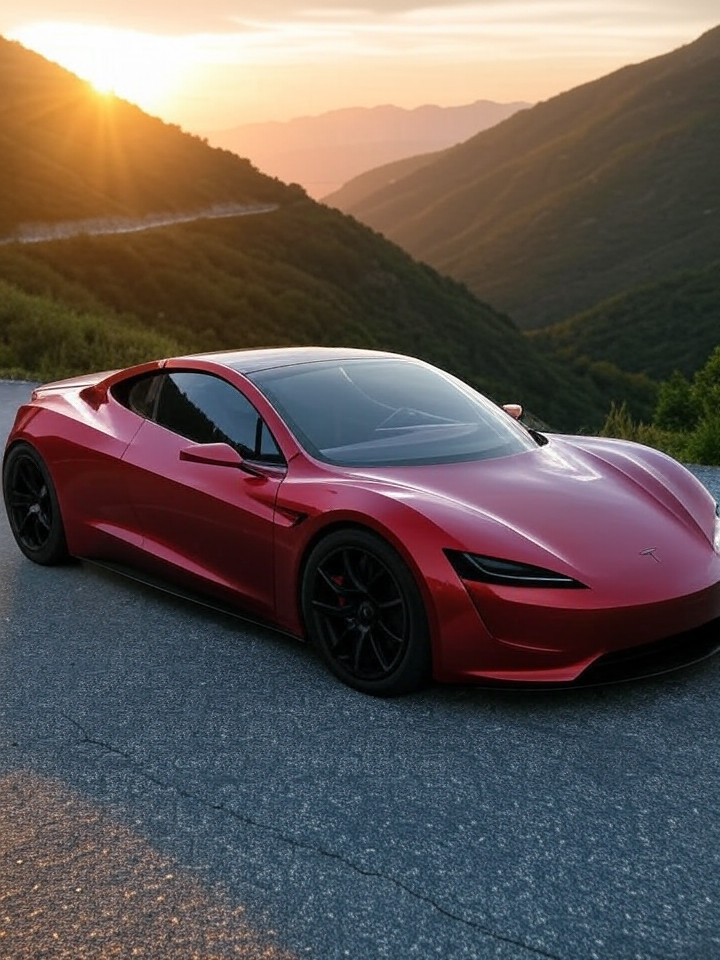
Elon Musk’s High-Octane Bet: Redefining Supercar Priorities in Tesla’s Delayed Roadster
Elon Musk, the enigmatic CEO of Tesla Inc., has once again stirred the automotive world with provocative statements about the company’s long-awaited Roadster. In a recent podcast appearance, Musk declared that safety would not be the primary focus for the next-generation electric supercar, set for unveiling later this year. This admission comes amid a backdrop of repeated delays and escalating expectations, raising eyebrows among regulators, safety advocates, and industry executives. As Tesla pushes the boundaries of performance, Musk’s words highlight a philosophical shift: treating the Roadster not as a everyday vehicle but as the pinnacle—and perhaps the swan song—of human-driven automobiles.
The comments originated from Musk’s interview on the Moonshots podcast with Peter Diamandis, where he emphasized the Roadster’s aim to be “the best of the last human-driven cars.” Drawing parallels to high-performance gas-powered sports cars like Ferraris, Musk suggested that buyers prioritizing safety should look elsewhere. “If safety is your number one goal, do not buy the Roadster,” he stated, according to reports. He tempered this by adding that Tesla would “aspire not to kill anyone in this car,” but the core message was clear: exhilaration trumps caution in this project.
This stance arrives at a pivotal moment for Tesla, which faces mounting pressure to deliver on ambitious promises. The Roadster, first teased in 2017 with claims of 0-60 mph acceleration in under two seconds and a top speed exceeding 250 mph, has seen its launch postponed multiple times—from 2020 to 2023, and now eyeing production in 2027 or later. Industry insiders speculate that these delays stem from supply chain disruptions and Tesla’s diversion of resources to models like the Cybertruck and Cybercab.
Musk’s Vision for the Ultimate Thrill Machine
Delving deeper, Musk’s philosophy positions the Roadster as a halo vehicle, designed to outpace traditional supercars in every metric while signaling the end of an era. In the podcast, he argued that with autonomous vehicles on the horizon, the Roadster represents the final frontier for manually operated performance cars. This perspective aligns with Tesla’s broader strategy, where innovation often courts controversy to generate buzz.
Sources close to the matter, including coverage from Mashable, note that Musk’s remarks were part of a broader discussion on Tesla’s future lineup. The article highlights how he compared the Roadster to luxury sports cars where safety takes a backseat to speed and handling. This isn’t entirely novel; supercar manufacturers like Lamborghini and McLaren have long emphasized performance over crash-test ratings, often forgoing standard safety features to reduce weight and enhance agility.
However, Tesla’s electric pedigree adds a layer of complexity. Unlike internal combustion engines, electric vehicles can achieve instantaneous torque, potentially amplifying risks in unskilled hands. Analysts worry that deprioritizing safety could invite scrutiny from bodies like the National Highway Traffic Safety Administration (NHTSA), which has previously investigated Tesla over autopilot-related incidents.
Regulatory Hurdles and Industry Reactions
The automotive sector’s response has been swift and varied. Safety organizations, such as the Insurance Institute for Highway Safety, have expressed concerns that Musk’s comments could undermine public trust in electric vehicles. In an era where Tesla touts its vehicles as among the safest on the road—thanks to features like reinforced battery packs and advanced driver-assistance systems—the Roadster’s approach seems anomalous.
Drawing from recent news, Autoblog reported that Musk’s focus is on making the Roadster “the best—and final—human-driven car,” prioritizing metrics like acceleration and top speed. This echoes sentiments from earlier X posts by Musk, where he discussed the Roadster’s evolution, noting past challenges like supply chain issues that delayed its release. Posts on X from users and Musk himself reveal a sentiment of excitement mixed with skepticism, with some questioning if the April 1 reveal date is a jest, given it’s April Fool’s Day.
Industry executives point out that while supercars often receive exemptions from certain safety standards due to low production volumes, Tesla’s high-profile status amplifies risks. For instance, the original Tesla Roadster, produced from 2008 to 2012, faced recalls for issues like faulty rear suspension components, as documented in historical NHTSA filings. The new model’s promised features, including optional SpaceX thrusters for enhanced performance, could further complicate certification processes.
Engineering Trade-Offs in Pursuit of Performance
At the heart of Musk’s strategy are the engineering compromises inherent in building a boundary-pushing vehicle. The Roadster is expected to feature a tri-motor setup, potentially delivering over 1,000 horsepower, with a range exceeding 600 miles on a single charge. Such specs demand lightweight materials and aerodynamic designs that might sacrifice structural integrity in crashes.
Insights from autoevolution suggest Musk views the Roadster as a “moonshot” project, where safety is secondary to innovation. The publication details how the reveal is slated for April 1, 2026, a date Musk confirmed in the podcast, despite the ironic timing. This delay has allowed Tesla to integrate cutting-edge battery technology, possibly from its 4680 cells, which promise higher energy density but raise questions about thermal management in high-speed scenarios.
Comparisons to competitors are inevitable. Ferrari’s SF90 Stradale, for example, balances hybrid power with advanced safety systems, achieving top Euro NCAP ratings. Tesla’s deviation could position the Roadster as a niche product for adrenaline seekers, but it risks alienating a broader market increasingly conscious of sustainability and safety.
Market Implications and Consumer Sentiment
Tesla’s stock has fluctuated in response to such announcements, reflecting investor unease. According to Business Insider, 2026 is a “prove-it” year for Tesla, with deadlines looming for the Roadster demo alongside robotaxi production. Musk’s comments could bolster hype among enthusiasts, but they might deter risk-averse buyers in a market where electric vehicle adoption hinges on perceived reliability.
On X, discussions around Musk’s statements reveal polarized views. Some users praise the bold approach, drawing from Musk’s past posts where he defended Tesla’s engineering choices, like the minimal carryover from the Lotus Elise in the original Roadster. Others express concern, citing older posts where Musk addressed safety in other models, such as the Model S Plaid’s performance limits without special devices.
Consumer advocates argue that even supercars should adhere to baseline safety norms. The Roadster’s potential for autonomous features, if included, could mitigate risks, but Musk’s emphasis on human-driven thrills suggests otherwise. This tension underscores a broader debate: as autonomy advances, should manual vehicles prioritize fun over protection?
Tesla’s Broader Strategy Amid Delays
Zooming out, the Roadster fits into Tesla’s ecosystem of ambitious projects. Recent expansions at Giga Texas, as mentioned in Not a Tesla App, include facilities for Optimus robots and Cybercab, potentially diverting resources from the Roadster. Musk has hinted at “hover capability” for the vehicle, blending automotive and aerospace elements via SpaceX collaboration.
Critics, including those in TechRadar, question if these features justify safety trade-offs. The article quotes Musk’s podcast quip about aspiring “not to kill anyone,” framing it as hype for what he calls “the best of the last human-driven cars.” This narrative positions the Roadster as a collector’s item, not a mass-market offering.
Financially, Tesla’s reliance on such projects is under scrutiny. CNN Business notes that while robotaxis remain hypothetical, they drive shareholder value, much like the Roadster’s promises. Yet, with profit margins sputtering, delivering a safe-yet-thrilling Roadster could be key to restoring confidence.
The Road Ahead for Electric Supercars
As the April reveal approaches, speculation mounts about the Roadster’s final specs. Will it include advanced crumple zones or rely solely on its rigid chassis? Industry observers anticipate prototypes showcasing extreme performance, possibly at the expense of passive safety features like airbags in unconventional placements.
Musk’s history of bold claims— from launching a Roadster into space to promising sub-1-second acceleration—sets a high bar. References to his X activity, including defenses of past decisions, suggest he’s unfazed by criticism. For instance, older posts highlight how supply chain woes, not safety lapses, delayed progress.
Ultimately, the Roadster could redefine what enthusiasts expect from electric vehicles, challenging norms in a field dominated by combustion engines. If successful, it might cement Tesla’s reputation as an innovator willing to gamble on the edge.
Balancing Innovation with Responsibility
For industry insiders, the real intrigue lies in how Tesla navigates certification. Low-volume exemptions under U.S. regulations allow flexibility, but global markets like Europe demand stringent crash tests. Musk’s comments, amplified across platforms, could influence policy discussions on high-performance EVs.
Comparisons to Tesla’s other models reveal inconsistencies. The Model 3 boasts five-star safety ratings, yet the Roadster’s ethos diverges. This dichotomy reflects Musk’s segmented approach: safety for the masses, thrills for the elite.
As Tesla forges ahead, the Roadster embodies the tension between progress and prudence. Whether it becomes a triumph or a cautionary tale depends on execution—and perhaps a dash of Musk’s trademark audacity.
Echoes from Tesla’s Past and Future Prospects
Reflecting on the original Roadster, which pioneered Tesla’s electric ambitions despite teething issues, the new iteration carries symbolic weight. Musk’s X posts from years ago underscore lessons learned, like avoiding over-reliance on external chassis designs.
Looking forward, integration with Tesla’s ecosystem—such as over-the-air updates for performance tweaks—could address safety dynamically. Yet, as Teslarati details, Musk’s “crazy” claims fuel anticipation, positioning the Roadster as a bridge to an autonomous future.
In this high-stakes game, Musk’s wager on performance over protection might just pay off, redefining the supercar paradigm for the electric age.


 WebProNews is an iEntry Publication