
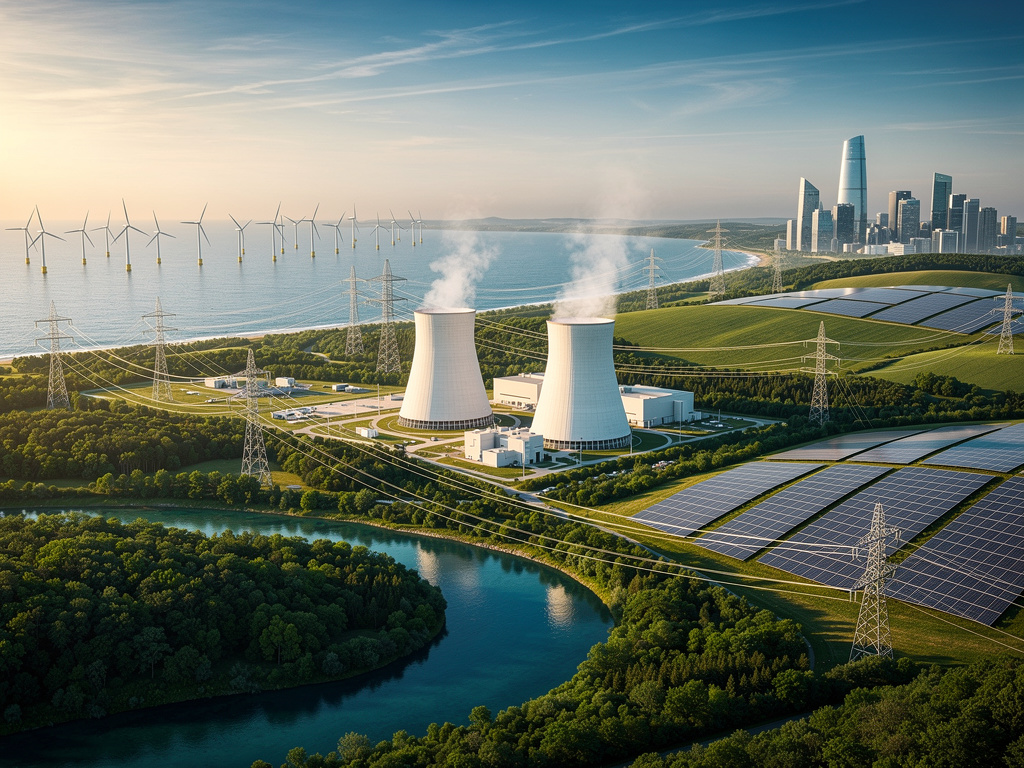
Europe’s Atomic Awakening: Reviving Nuclear Power to Slash Carbon Emissions
In a bold declaration that could reshape the continent’s energy strategy, the European Economic and Social Committee (EESC) has positioned nuclear power as a cornerstone for eliminating fossil fuels. According to a recent opinion adopted by the EESC, nuclear energy forms an indispensable part of a clean energy blend essential for phasing out carbon-intensive sources. The committee urges the European Commission to integrate crucial regulatory and financial mechanisms to facilitate investments, while fostering open discussions with civil society. This stance arrives at a pivotal moment, as Europe grapples with soaring energy demands and geopolitical vulnerabilities.
The EESC’s position emphasizes nuclear’s role in providing stable, low-carbon electricity, which currently accounts for about 40% of the EU’s low-emission power, per data from the World Nuclear Association. With electricity needs projected to surge over the coming decades due to electrification in transport and industry, the committee argues that nuclear offers reliability that intermittent renewables alone cannot match. This view aligns with broader calls for a diversified approach, avoiding over-reliance on variable sources like wind and solar.
Critics, however, point to longstanding concerns over nuclear safety, waste management, and high upfront costs. Yet the EESC counters these by highlighting advancements in technology and the urgent need for energy security, especially after disruptions from events like the Russia-Ukraine conflict. The opinion calls for streamlined permitting processes and funding incentives to unlock nuclear’s potential, potentially accelerating the bloc’s path to net-zero emissions by 2050.
Nuclear’s Evolving Role in EU Policy Shifts
Recent analyses underscore nuclear’s impact on decarbonization trajectories. A study published in ScienceDirect reveals that nuclear plants are the largest carbon-neutral source in the EU’s electricity mix, playing a vital part in maintaining continuous supply. Without expanding nuclear capacity, the research suggests, Europe risks slower emission reductions and heightened vulnerability to energy shortages. This is particularly relevant as aggregated demand is expected to rise significantly, demanding greater grid flexibility.
Advocates like nucleareurope, in a report updated last year, argue that ramping up nuclear to 150 gigawatts by 2050 could enable faster decarbonization and bolster supply security. Their findings, detailed in a nucleareurope press release, demonstrate how nuclear complements renewables, preventing fossil fuel lock-in and curbing CO2 emissions. Yves Desbazeille, the group’s director general, stresses that nuclear addresses Europe’s triple challenge: achieving net zero, ensuring affordable energy, and securing supplies amid global uncertainties.
This perspective gains traction amid shifting EU policies. For instance, the European Parliament’s fact sheet on nuclear energy, updated earlier this year, outlines its contribution to integration efforts, providing over a quarter of the bloc’s electricity. As noted in the European Parliament’s overview, nuclear’s base-load capability supports the transition away from imports, reducing dependency on volatile foreign gas markets.
Geopolitical Pressures and Industrial Imperatives
Europe’s energy woes have intensified scrutiny on nuclear options. A Wavestone analysis from November portrays 2025 as a turning point, with countries like France and Finland advancing reactor projects to reclaim sovereignty. The report highlights fragmentation, where pro-nuclear nations push forward while others, like Germany, phase out plants—a move now questioned amid blackouts and price spikes.
Sentiment on platforms like X reflects this debate, with users noting Europe’s past mistakes in dismantling baseload power, leading to emissions and security issues. Posts emphasize that retaining and expanding nuclear could yield terawatt-hours of cheap, domestic energy by 2030, countering the “zombie policy” of closures inherited from eras of abundant Russian gas. This echoes calls from figures like Sweden’s Ebba Busch, who via X advocates for nuclear to combine net zero with economic growth.
Further, the Clean Air Task Force (CATF) argues in an October piece that nuclear, including small modular reactors (SMRs), is central to competitiveness. EU Commissioner Dan Jørgensen’s remarks at an SMR assembly, as reported in CATF’s blog, affirm that no climate scenario succeeds without nuclear, urging a diverse strategy for self-reliance.
Challenges in Deployment and Public Perception
Despite optimism, hurdles remain substantial. High costs and regulatory delays have stalled projects, with some estimates showing nuclear four times pricier than renewables in initial outlays, as debated in recent X threads. Users point to countries like Germany achieving over 50% renewable electricity at lower fuel costs post-investment, questioning nuclear’s economics. However, proponents counter that total system costs, including grids and backups, favor a mixed approach, per a WindEurope study that ironically underscores renewables’ affordability but overlooks nuclear’s stability.
The EESC’s call for transparent dialogue aims to address these divides, advocating inclusive debates to build consensus. This is crucial as Europe navigates post-2035 shifts, including potential dilutions to combustion engine bans reported by Reuters. Such changes could heighten electricity demands from electric vehicles, making nuclear’s dispatchable power even more vital.
In Bulgaria, media like BTA echo the EESC’s view, stressing financial enablers for nuclear integration. This resonates with Czechia’s ambitious plans, investing billions in reactors to replace coal, targeting 60% nuclear electricity by 2050, as covered in Euronews.
Strategic Alliances and Technological Innovations
The formation of alliances signals momentum. The EU’s Nuclear Alliance, aiming for 150 GW, reflects member states’ commitment to scaling up. X discussions from users like Mark Nelson highlight institutional shifts, such as the Green Deal commissioner’s replacement with a pro-nuclear figure from Slovakia, indicating deeper EU support.
Technological advances, particularly SMRs, promise faster deployment and lower risks. The European Industrial Alliance on SMRs, as per CATF reports, positions these as essential for industrial decarbonization, offering modular solutions for hard-to-abate sectors.
Yet, as The Guardian notes in coverage of watered-down car bans, environmentalists worry this could undermine green goals. Nuclear advocates argue it complements such policies by providing clean power for electrification.
Economic Benefits and Global Comparisons
Economically, nuclear could save billions. WindEurope’s analysis, while promoting renewables, admits a mixed system minimizes costs, estimating €1.6 trillion in savings through balanced grids. Integrating nuclear, as per nucleareurope, ensures cost-efficiency without fossil backups.
Globally, Europe’s approach contrasts with Asia’s rapid builds, but recent commitments, like those in the Czech Republic, signal a catch-up. X posts from 2022 recall how energy crunches revived nuclear’s case, with skyrocketing prices exposing gas dependencies.
The EESC’s opinion, building on these, calls for EU-wide enablers, potentially unlocking investments worth trillions. As RT World News reports on EU policy softenings, nuclear’s firmness provides a counterbalance.
Path Forward: Balancing Innovation and Caution
To realize nuclear’s promise, experts urge harmonized regulations. The European Sting’s recent piece, aligning with EESC, stresses nuclear’s decarbonization key, available at The European Sting. This includes addressing waste and safety through innovation.
Public engagement remains key, with EESC pushing for civil society involvement to mitigate fears rooted in past incidents. X sentiments from users like Isabelle Boemeke note growing realizations that climate goals demand nuclear, especially as renewables face intermittency limits.
Ultimately, Europe’s nuclear revival hinges on political will. With demands rising and fossils fading, the EESC’s blueprint could guide a resilient, low-carbon future, blending atomic power with renewables for sustainable prosperity. As alliances strengthen and technologies evolve, the continent stands at a crossroads, poised to harness nuclear’s might for enduring energy independence.


 WebProNews is an iEntry Publication