
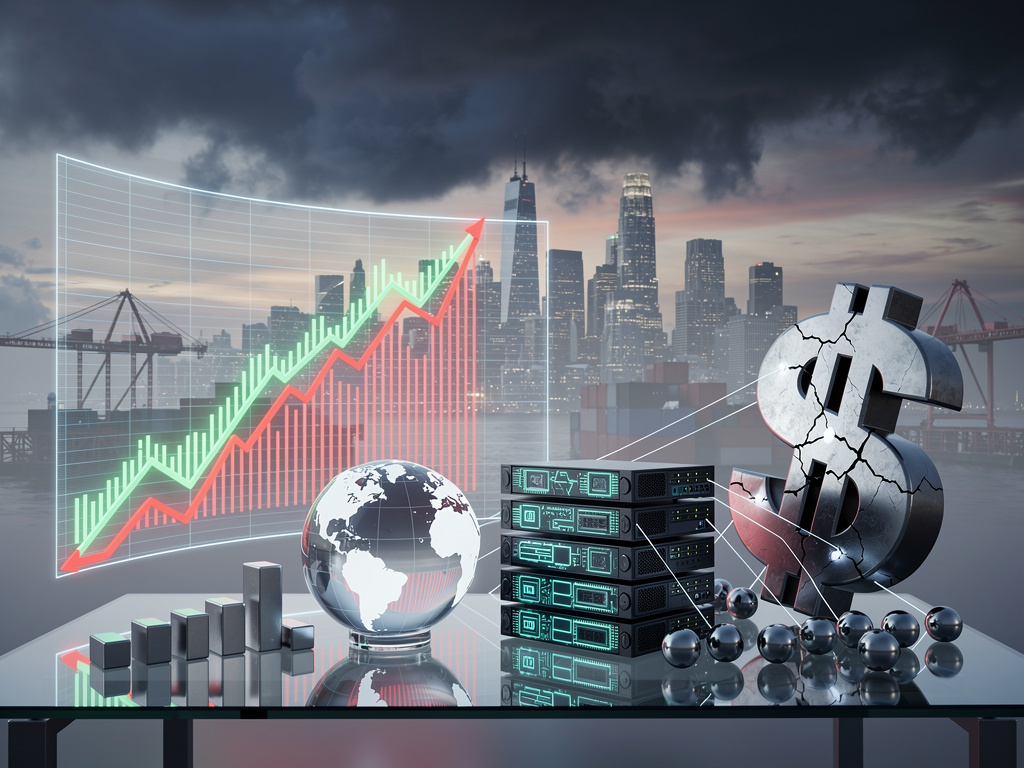
Echoes of Economic Peril: Steve Hanke’s Stark Warning for America’s 2025 Horizon
In the waning days of 2025, as markets shimmer with artificial intelligence-fueled optimism, one veteran economist’s sleepless nights cast a long shadow over the U.S. economic outlook. Steve Hanke, a professor of applied economics at Johns Hopkins University, has emerged as a vocal harbinger of potential turmoil, warning that persistent inflation and an overinflated stock market could precipitate a hard landing. His concerns, rooted in decades of monetary policy analysis, highlight vulnerabilities that many investors and policymakers might prefer to ignore. Drawing from historical precedents and current data, Hanke argues that the Federal Reserve’s missteps have set the stage for economic contraction.
Hanke’s anxiety stems from what he perceives as a dangerous disconnect between monetary realities and market exuberance. He points to the money supply’s sluggish growth as a precursor to recessionary pressures, echoing patterns seen in past downturns. In a recent interview, he emphasized that the U.S. money supply (M2) is expanding at a rate below his “Golden Growth Rate” of about 6% annually, which he believes is necessary to sustain stable 2% inflation without stifling growth. This metric, he contends, has been a reliable predictor of economic health, and its current trajectory suggests trouble ahead.
Beyond monetary metrics, Hanke critiques the Federal Reserve’s handling of interest rates and inflation. He assigns the Fed an “F” grade for its policies over recent years, arguing that delayed rate hikes allowed inflation to embed itself deeply into the economy. Even as inflation has moderated from its peaks, Hanke warns it could rebound, particularly under external pressures like proposed tariffs or geopolitical tensions. His views align with broader concerns about stagflation—a toxic mix of stagnant growth and rising prices—that could undermine consumer confidence and corporate earnings.
Inflation’s Lingering Grip
Recent data underscores Hanke’s inflation worries. Consumer prices, while cooling, remain above the Fed’s target, with core inflation hovering around 3%. Hanke predicts that without aggressive monetary tightening, inflation could dip below 2% temporarily but then surge if fiscal policies loosen further. He draws parallels to the 1970s, when similar dynamics led to prolonged economic malaise. In discussions on platforms like X, users have echoed these sentiments, with posts highlighting public anxiety over persistent price pressures despite official reassurances.
The stock market’s lofty valuations add another layer to Hanke’s insomnia. He describes the current environment as “bubble territory,” with his proprietary bubble meter hitting all-time highs. Metrics like price-to-earnings ratios for tech-heavy indices are reminiscent of the dot-com era, fueled by hype around AI and speculative investments. Hanke warns that a burst in this bubble could trigger widespread sell-offs, eroding household wealth and consumer spending, which drives nearly 70% of U.S. GDP.
Policy decisions under the incoming administration amplify these risks. President-elect Trump’s proposed tariffs, which Hanke likens to the disastrous Smoot-Hawley tariffs of the 1930s, could exacerbate inflationary pressures while slowing global trade. In a post on X dated April 5, 2025, Hanke noted that such measures are already exerting “massive downward pressure on the economy,” potentially mirroring Depression-era contractions. This perspective is supported by analyses from Business Insider, which detailed Hanke’s recession warnings following the election.
Recession Signals Flashing Red
Historical analogies form the backbone of Hanke’s forecasts. He references five instances since 1913 where the U.S. money supply contracted, four of which preceded major recessions, including the Great Depression. The current contraction, ongoing since July 2022, marks only the fifth such event, and Hanke anticipates it will culminate in a downturn by early 2026 if not sooner. This rare signal, he argues, is being overlooked amid the AI investment boom.
Contrasting views from other economists provide a fuller picture. A Deloitte Insights report from December 19, 2025, acknowledges AI’s supportive role in the economy but questions its sustainability, suggesting that momentum could fade without broader productivity gains. Similarly, Deloitte highlights investment in artificial intelligence as a buffer, yet warns of underlying fragilities in consumer sentiment and labor markets.
On X, sentiment reflects a mix of optimism and caution. Posts from users like Christopher Greene describe booming consumer activity, with packed malls and new purchases signaling resilience. However, others, including economist Jonathan A. Parker, note that deficit spending and loose Fed policies have averted a recession thus far, but at the cost of elevated inflation risks. These social media insights reveal a public grappling with economic crosscurrents, where surface-level prosperity masks deeper uncertainties.
Market Bubbles and Black Swans
Hanke’s bubble detector isn’t just alarmist rhetoric; it’s backed by quantitative analysis. In a January 2025 discussion with ITM Trading, he explained that the market is “overpriced, overbought, and overhyped,” with valuations detached from fundamentals. This detachment, he says, invites black swan events—unforeseen shocks that could pop the bubble. Potential triggers include a sudden AI investment pullback or escalating trade wars, as outlined in ITM Trading.
Broader market analyses corroborate these fears. An article in The Economist from November 13, 2025, posits that an AI bubble burst could lead to an “unusual recession,” where financial markets drag down the real economy. This scenario differs from traditional downturns, as it would stem from asset price corrections rather than credit crunches, potentially amplifying global spillovers.
Inflation dynamics further complicate the picture. Hanke predicts inflation will fall below 2% in 2025 due to contracting money supply, but rebound risks loom large. In a December 23, 2024, X post, he reiterated that “inflation is all about the money supply,” forecasting a sub-target dip. Yet, recent news from Business Insider warns of stagflation derailing stock rallies, with Apollo’s chief economist highlighting sluggish growth amid elevated prices as a key 2026 risk.
Policy Pitfalls and Future Pathways
The Federal Reserve’s role remains central to Hanke’s critique. He lambasts the Fed for tolerating inflation 1.5 times its target, allowing deficits to balloon to 6% of GDP. This leniency, combined with AI-driven investment booms, has delayed recessionary forces, but Hanke warns the bill is coming due. Echoing this, a Bloomberg feature from a week ago assesses recession odds at 30% heading into 2026, citing resilient but bending labor markets.
Fiscal policy adds another wildcard. Trump’s agenda, including tax cuts and deregulation, could stimulate short-term growth but fuel inflation if not offset by spending restraints. Hanke, in a March 16, 2025, X post, projected economic slowdown due to subpar money supply growth, aligning with his “Quantity Theory of Money” that he claims “never lies.” This theory underpins his forecasts, emphasizing money’s role in driving prices and output.
Industry insiders must also consider global interconnections. An American Enterprise Institute piece from a week ago draws parallels to the 2008 crisis, warning of complacency amid consensus optimism. It argues that today’s views may prove as misplaced as those pre-2008, with potential for a “difficult year ahead” due to unaddressed imbalances.
Navigating Uncertainty
As 2025 draws to a close, Hanke’s warnings serve as a clarion call for vigilance. While some metrics, like robust GDP growth up to 3.9% annualized, suggest strength, underlying fragilities persist. Posts on X from users like dada_didenko speculate on a 2026 recession, citing moderate growth and sticky inflation as harbingers.
Diversification emerges as a key strategy for investors. Hanke advocates for assets like gold, which he sees as hedges against monetary instability. In his ITM Trading interview, he stressed preparing for danger in overvalued markets, a sentiment echoed in broader discussions.
Ultimately, the interplay of inflation, bubbles, and policy will shape 2026’s economic trajectory. Hanke’s insights, drawn from rigorous analysis, urge a reevaluation of assumptions. By heeding these signals, stakeholders can better position themselves against potential storms, turning foresight into a competitive edge in an unpredictable environment.


 WebProNews is an iEntry Publication