
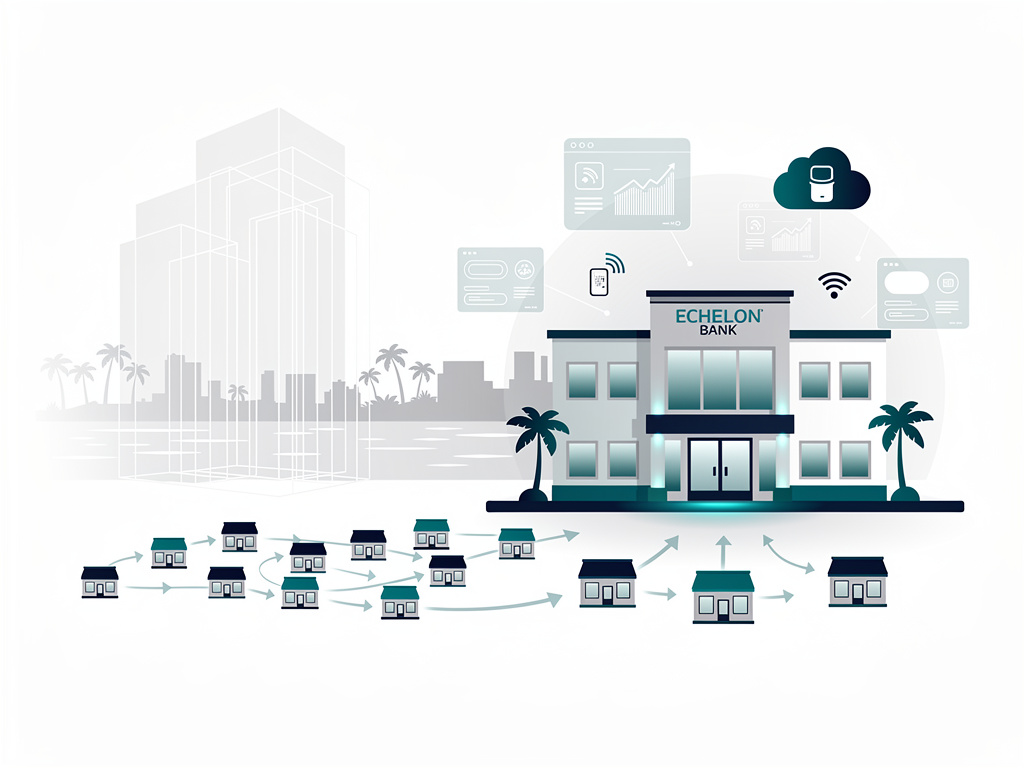
In the midst of relentless banking mergers reshaping Florida’s financial map, a cadre of seasoned Tampa Bay bankers is mounting a counteroffensive with Echelon Bank, the region’s first new charter in five years. Led by Rob Shaw, the 52-year-old president and CEO, this de novo venture aims to launch as early as late April 2026, targeting small and midsize businesses overlooked by expanding giants.
Florida’s bank headquarters have plummeted from 315 in the early 2000s to just 67 today, a 78.73% drop fueled by acquisitions from regional and national players, according to Business Observer. Shaw, a West Point graduate with nearly 30 years in local banking at firms like Regions, USAmeriBank and Signature Bank, invested $1 million of his own capital. He recruited a team of ex-colleagues around Thanksgiving 2024, filing the FDIC charter by late July 2025.
“That consolidation is a huge reason why we’re doing what we’re doing,” Shaw told Business Observer. The startup has raised about 70% of its $23 million to $50 million capital goal since October 2025, accelerating post-holidays with local investors, per the publication.
Veteran Team Targets Merger Gaps
Chris Kneer, Echelon’s chief banking officer and former USAmeriBank executive, initially called the idea “crazy” after retiring, but joined believing “the markets really really want one.” Kneer emphasized community banks’ edge: “People are starved for that relationship and they’ll pay a little bit more for it.” The lineup includes CFO Katya Perez (ex-USAmeriBank chief accounting officer), Chief of Staff Jen Ptack (15 years at Bank of Tampa), CTO David Rhodes (ex-USAmeriBank) and Chief Credit Officer Edmund O’Carroll (veteran of Florida Bank and others).
All nine employees have skin in the game as part-owners, fostering an ownership mindset, Shaw noted. Echelon’s name draws from cycling formations where riders shield each other from crosswinds, symbolizing teamwork: “You’re not just a lone rider out there doing your thing, but you become part of a team,” per Business Observer.
The bank plans branches in Feather Sound, Pinellas County, and Tampa near Bayshore and Bay to Bay Boulevard. It will deploy FIS Horizon core technology for digital banking akin to multibillion-dollar peers, sourced via Ariba advisors.
Strategy Amid National De Novo Drought
Echelon focuses on “vanilla — but vanilla is a great flavor,” pursuing local owner-managed businesses, nonprofits, defense contractors, commercial real estate, construction loans and white-glove executive banking. Shaw highlighted the void: “There’s a whole segment of great customers who get left behind and told to call a 1-800 number.” The business plan, detailed in FDIC filings, commits to 8% Tier 1 capital for three years, serving the Tampa-St. Petersburg-Clearwater MSA.
Nationally, community banks have shrunk by nearly 2,000 since 2010 amid post-recession rules, with only 62 de novos launched, reports Tampa Bay Business Journal. Florida bucks the trend slightly, with recent startups in Sarasota, Naples and Miami, but Tampa Bay’s drought underscores consolidation’s toll.
Shaw’s leap earned him a spot on Tampa Bay Business Journal’s 25 People to Watch in 2026, as peers watch with “curiosity and enthusiasm.” Capital raising casts a wide net for hundreds of local backers valuing community ties.
Tampa Bay’s Merger Surge Creates Openings
2025 saw fierce talent wars as mergers and expansions hit Tampa Bay, per Tampa Bay Business Journal. Banesco USA acquired St. Petersburg loans to enter the market, while PNC plans 46 West Coast Florida branches by 2030, doubling its footprint. BankUnited shifts to a larger downtown Tampa office in Q1 2026 for commercial growth, noted Business Observer.
Regions Bank named Rory Glenn to lead Tampa Bay wealth management, aiming to double advisers in two years, according to Tampa Bay Business Journal. BayFirst National Bank posted a $19 million loss in 2025’s first nine months from SBA exits but eyes 2026 profitability via community focus, per Business Observer.
U.S. bank M&A hit over 150 deals in 2025, surpassing 2024 totals, with momentum into 2026 driven by margins and capital needs, states Reed Smith. Echelon positions as agile alternative, blending tech like its site promises with local service.
Regulatory Path and Growth Outlook
The FDIC approved Echelon’s deposit insurance application alongside a Florida charter pending with the Office of Financial Regulation. Projections deem growth attainable, per filings. Organizers skipped a holding company, emphasizing direct control.
As Echelon nears its capital close by January 2026’s end, it recruits more veterans. Shaw’s prior roles taught him community banking’s appeal: “You’re much more of a consultant, not just an order taker,” he said to Business Observer. In a field of giants, Echelon bets on relationships to carve a niche.


 WebProNews is an iEntry Publication