
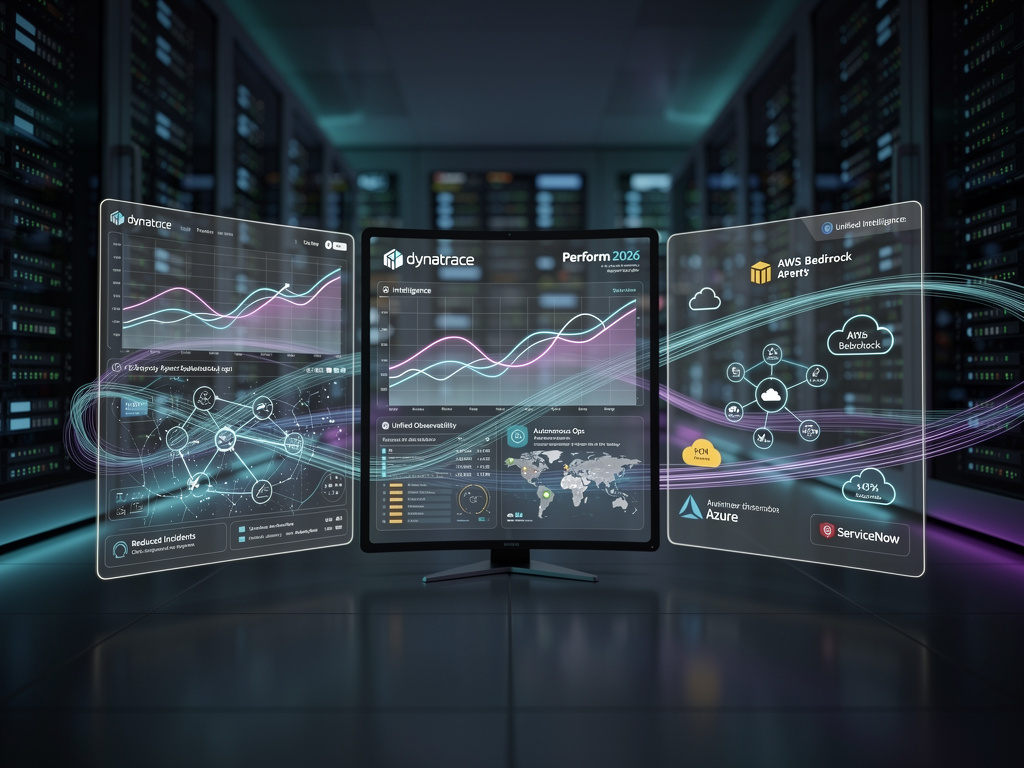
In a bold push at its Perform 2026 conference this week, Dynatrace unveiled Dynatrace Intelligence, an agentic operations system designed to propel enterprises from reactive monitoring to human-supervised autonomy. The platform fuses deterministic AI—grounded in real-time causal context—with agentic AI capable of reasoning, decision-making, and action within strict guardrails. This comes as Gartner predicts that 40% of enterprise apps will integrate task-specific agents by year-end, up from less than 5% today, making reliable observability essential for scaling AI safely.
Chief Product Officer Steve Tack emphasized the shift during the Las Vegas keynote: “You have all this information, but it’s still humans that are gluing together the action, and that’s really what we want to change.” Customers, he noted, complain of “drowning in data, but we’re still starving for action.” TechTarget reported that the new agents draw on a consolidated observability backend, integrating real-user monitoring data into the Grail data lakehouse and Smartscape knowledge graph for unified context.
The overhaul addresses enterprise AI ROI challenges through “context engineering,” evolving from prompt engineering to provide large language models with precise corporate data, relationships, and tools for deterministic decisions. IDC’s Stephen Elliot observed: “Organizations are progressing beyond reactive monitoring toward autonomous operations models that combine deterministic AI with agentic AI systems.” BusinessWire highlighted how Dynatrace Intelligence powers domain-specific agents for SRE, development, and security teams.
Unified Data Backbone Powers Precision
Grail now consolidates metrics, logs, traces, events, user sessions, business, and security data with contextual integrity, while the enhanced Smartscape real-time dependency graph maps every entity and interdependency across clouds and Kubernetes. This “digital twin” enables agents to detect anomalies, assess blast radius, and act preemptively. Omdia analyst Torsten Volk noted it tightens context loops for semi-autonomous operations in more scenarios. Dynatrace integrated RUM data previously siloed, alongside CMDB relationships and feature flags from its DevCycle acquisition.
Developer interfaces have been streamlined, with a single Clouds app view replacing fragmented hyperscaler UIs for AWS, Azure, and Google Cloud. New IDE integrations like VS Code and Windsurf provide direct infrastructure visibility, blurring lines between observability and action platforms. Dynatrace blog detailed its pioneering role as the first AWS partner for Model Context Protocol (MCP) integration with Amazon Bedrock AgentCore, allowing agents secure access to causal, real-time signals for anomaly detection and proactive responses.
Domain agents specialize in issue prevention, business observability, and security ops, supervised by operator agents. Agentic workflows incorporate policy-driven controls and approvals, mobilizing on anomalies or requests to execute via existing tools for communication, tracking, and fixes. Dynatrace blog announced general availability of its AI Observability app, supporting frameworks like LangChain and Bedrock via OpenTelemetry and OpenLLMetry for tracing token usage, latency, errors, and costs.
Cloud Partnerships Accelerate Adoption
Dynatrace expanded integrations with AWS DevOps Agent, Azure Kubernetes Service, Microsoft Foundry, and upcoming ServiceNow ties for “pre-flight checks” assessing change risks. ServiceNow’s Pablo Stern enthused: “What if we had a better integration where we could not only make the change, but understand what the potential risk and potential blast radius were?” These enable automated prevention, reducing outages from changes—a leading cause.
The Dynatrace MCP Server empowers AI assistants in IDEs and ITSM to query live production insights securely. TELUS reported streamlining incident resolution to minutes: “From detection to pull requests,” said Kulvir Gahunia. Benchmarks showed Dynatrace agents delivering up to 12x more fixes. ISG named Dynatrace a leader in cloud-native observability and security for the sixth year, crediting partnerships amid rising AI complexity. BusinessWire.
As vendors like Datadog acquire feature management tools, observability evolves into “platforms of action.” TheCube Research’s Rob Strechay stressed no single control plane; best-of-breed integrations via open protocols like MCP and A2A ensure governance. Dynatrace’s phased adoption path starts with AI insights, advances to supervised automation, then full autonomy with guardrails.
Real-World Impacts and Trust Imperative
Enterprises face AI’s non-deterministic risks: hallucinations, cost spikes, audit gaps. Dynatrace’s approach builds trust via reasoning traces and history, per IDC’s Elliot. Boston Consulting Group data shows embedded agents yield 30-50% faster processes and 40% less low-value work when governed properly. X discussions from Perform echoed this, with users noting observability as AI’s control plane.
Customer spotlights at Perform underscored ROI: Dynatrace fuels safe AI scaling, mitigating data leakage and prompt injection. The platform’s production-first design supports experimentation without redeploys. As global AI spend nears $2 trillion by 2026, Dynatrace positions observability as the intelligence layer for behavior, causality, and risk in agentic ecosystems.
Analysts foresee deeper protocol integrations for end-to-end visibility. Dynatrace’s moves—Intelligence agents, MCP ecosystem, DevCycle controls—set a benchmark, enabling CIOs to cede routine decisions confidently while retaining oversight in dynamic environments.


 WebProNews is an iEntry Publication