
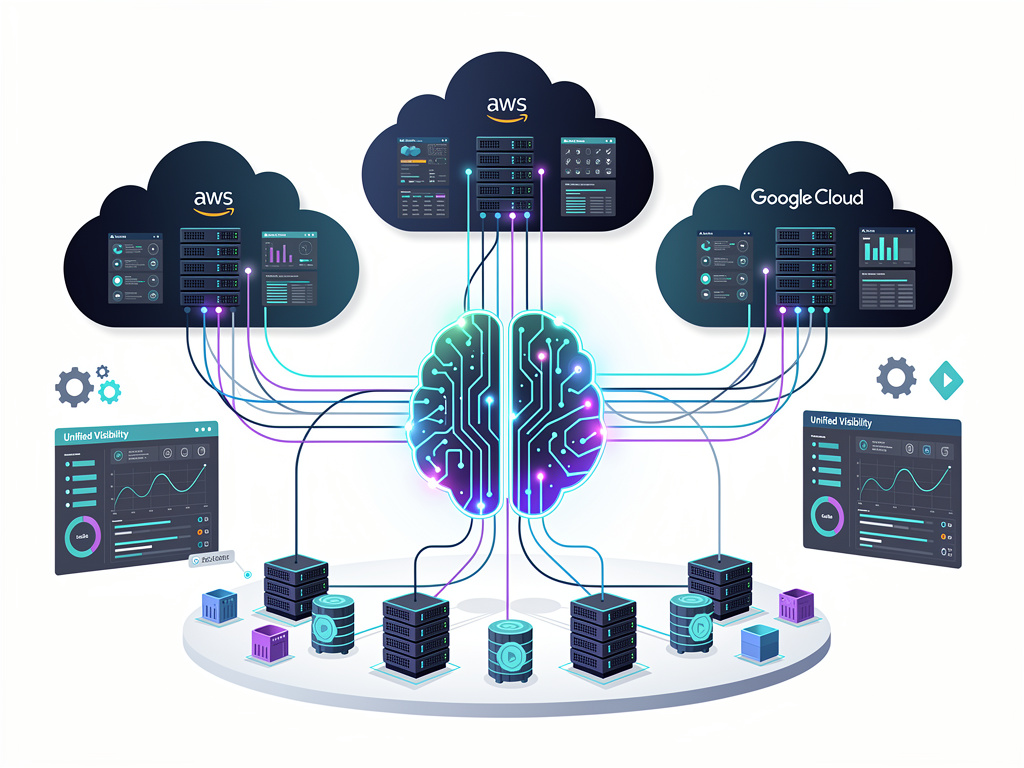
Dynatrace is making a bold wager that autonomous artificial intelligence can solve one of enterprise technology’s most expensive headaches: managing sprawling multi-cloud environments that have become too complex for human teams to optimize effectively. The software intelligence company unveiled a sweeping set of platform enhancements at its Perform 2025 conference that integrate deeper into Amazon Web Services, Microsoft Azure, and Google Cloud Platform while introducing AI capabilities designed to operate with minimal human intervention.
The timing reflects mounting pressure on IT organizations to control cloud spending while maintaining performance across increasingly fragmented infrastructure. According to Channel Insider, the new capabilities aim to address what Dynatrace characterizes as a critical gap in how enterprises monitor, optimize, and secure workloads distributed across multiple cloud providers. The company’s approach centers on what it calls “autonomous intelligence”—AI systems that can identify issues, determine root causes, and in some cases remediate problems without waiting for human administrators to intervene.
The announcements come as enterprises grapple with cloud bills that have ballooned beyond initial projections. Industry analysts estimate that organizations waste between 30 and 35 percent of their cloud spending on unused or underutilized resources, a problem that intensifies as companies adopt multi-cloud strategies to avoid vendor lock-in and leverage best-of-breed services from different providers. Dynatrace’s expanded integrations promise granular visibility into resource consumption patterns across AWS, Azure, and Google Cloud, enabling finance and operations teams to identify optimization opportunities that might otherwise remain hidden in the complexity of distributed systems.
Deep Integration with Hyperscale Cloud Providers
The enhanced AWS integration provides observability into a broader range of services including Amazon Elastic Kubernetes Service, AWS Lambda serverless functions, and Amazon Relational Database Service instances. This expansion addresses a common pain point for DevOps teams: the difficulty of correlating performance data across managed services, custom applications, and underlying infrastructure. By automatically discovering dependencies and mapping relationships between cloud resources, Dynatrace aims to eliminate blind spots that can lead to outages or performance degradation.
For Microsoft Azure customers, the platform now offers deeper insights into Azure Kubernetes Service, Azure Functions, and Azure SQL Database. The integration extends to Azure’s native monitoring tools, allowing organizations to consolidate telemetry data from multiple sources into a unified view. This capability becomes particularly valuable as enterprises run hybrid applications that span on-premises data centers and multiple cloud regions, where maintaining consistent observability has historically required stitching together disparate monitoring tools with custom integrations.
Google Cloud Platform users gain similar benefits through expanded support for Google Kubernetes Engine, Cloud Functions, and Cloud SQL. The integrations leverage APIs provided by each cloud vendor to collect metrics, logs, and traces in real-time, feeding this data into Dynatrace’s analytics engine. What distinguishes these integrations from basic monitoring is the platform’s ability to automatically establish baselines for normal behavior and detect anomalies that might indicate emerging problems, security threats, or opportunities for cost optimization.
Autonomous AI Takes Center Stage in Operations
The autonomous AI capabilities represent Dynatrace’s most ambitious technical advancement, moving beyond traditional alert-based monitoring toward systems that can diagnose and resolve issues independently. The company’s Davis AI engine, which has been in development for several years, now incorporates causal reasoning that can trace problems through complex dependency chains spanning multiple cloud environments. Rather than simply flagging symptoms, the system attempts to identify root causes by analyzing how changes in one component affect downstream services.
This causal AI approach addresses a fundamental challenge in modern IT operations: the overwhelming volume of alerts generated by monitoring tools. Site reliability engineers often face thousands of alerts daily, most of which are either false positives or symptoms of a single underlying issue. By clustering related alerts and identifying probable root causes, Dynatrace’s autonomous AI aims to reduce alert fatigue while accelerating mean time to resolution. The system can also suggest or automatically implement remediation actions, such as scaling resources, restarting failed services, or routing traffic away from degraded components.
The autonomous capabilities extend to security and compliance monitoring, with AI models trained to detect anomalous behavior that might indicate security threats or configuration drift from established policies. For organizations subject to regulatory requirements, the platform can continuously validate that cloud resources comply with security frameworks and automatically flag or remediate violations. This proactive approach to security and compliance represents a shift from periodic audits to continuous validation, reducing the window of exposure when misconfigurations occur.
Economic Pressures Drive Multi-Cloud Management Innovation
The push toward autonomous cloud management reflects broader economic pressures facing technology organizations. As interest rates have risen and capital has become more expensive, investors and boards are demanding greater efficiency from IT spending. Cloud costs, which many organizations treated as variable expenses that could scale with business needs, have instead become significant fixed costs that resist easy optimization. The distributed nature of multi-cloud environments makes it difficult for finance teams to understand what they’re paying for and whether they’re getting value from those expenditures.
Dynatrace’s platform attempts to bridge the gap between technical operations and financial management by providing cost attribution at a granular level. The system can track spending down to individual applications, teams, or business units, enabling chargeback models that create accountability for cloud consumption. More importantly, by correlating cost data with performance metrics, the platform helps organizations make informed trade-offs between performance and spending, identifying scenarios where over-provisioned resources deliver diminishing returns.
The competitive dynamics in the observability market are intensifying as established players like Dynatrace, Datadog, and New Relic vie for position against cloud providers’ native monitoring tools. AWS CloudWatch, Azure Monitor, and Google Cloud Operations Suite offer increasingly sophisticated capabilities at prices that are difficult for third-party vendors to match. Dynatrace’s strategy appears to be differentiating through cross-cloud capabilities and autonomous intelligence that native tools, which are optimized for their respective platforms, cannot easily replicate.
Technical Architecture Enables Real-Time Decision Making
The technical foundation supporting these capabilities relies on distributed data collection agents that run alongside applications and infrastructure components, streaming telemetry data to Dynatrace’s analytics platform. The architecture is designed to minimize performance overhead while capturing detailed information about application behavior, infrastructure health, and user experience. This data feeds into machine learning models that continuously update their understanding of normal behavior patterns and refine their ability to detect anomalies.
The platform’s approach to data retention and analysis differs from traditional monitoring tools that store raw metrics for limited periods. Instead, Dynatrace employs what it calls “smart data capture,” which retains detailed traces for anomalous transactions while aggregating data for normal operations. This selective retention strategy enables longer-term trend analysis without incurring the storage costs associated with keeping every metric at full granularity indefinitely. The trade-off is that historical deep dives into normal operations may be limited, though the system retains sufficient data to establish baseline behaviors.
Integration with CI/CD pipelines represents another key capability, allowing the platform to assess the performance and security implications of code changes before they reach production. By analyzing how new deployments affect key performance indicators and comparing them against historical baselines, the system can flag releases that degrade performance or introduce vulnerabilities. This shift-left approach to observability aims to catch problems earlier in the development cycle when they’re less expensive to fix and less likely to impact end users.
Market Implications for Enterprise IT Strategy
The evolution of platforms like Dynatrace toward autonomous operations raises questions about how enterprise IT organizations will structure their teams and allocate resources. If AI systems can handle routine monitoring, diagnosis, and remediation tasks, the role of site reliability engineers and operations specialists may shift toward higher-level architecture decisions and exception handling. This transition mirrors broader trends in IT toward platform engineering, where small teams build self-service capabilities that enable developers to operate more independently.
For enterprises evaluating their multi-cloud strategies, the availability of sophisticated cross-cloud management tools may influence decisions about cloud provider selection and workload placement. Organizations that previously felt locked into a single cloud due to operational complexity may find that unified observability platforms reduce the friction of multi-cloud adoption. Conversely, the cost of these third-party platforms—which typically charge based on the volume of data ingested or the number of hosts monitored—must be weighed against the value they provide in optimization and productivity gains.
The autonomous AI capabilities also introduce new considerations around trust and control. While automated remediation can accelerate incident response, it also creates risks if the AI makes incorrect decisions or takes actions that have unintended consequences. Dynatrace addresses this through configurable guardrails that allow organizations to define which actions the system can take autonomously versus which require human approval. Finding the right balance between automation and human oversight will be critical as these capabilities mature and organizations gain confidence in their reliability.
Looking Ahead: The Future of Cloud Operations
The trajectory of cloud operations management points toward increasingly autonomous systems that can handle routine tasks while escalating complex decisions to human experts. Dynatrace’s latest platform enhancements represent a significant step in this direction, though the technology remains in relatively early stages of maturity. The effectiveness of autonomous AI in production environments will depend on factors including the quality of training data, the accuracy of causal models, and the system’s ability to adapt to novel situations it hasn’t encountered before.
As cloud providers continue enhancing their native monitoring and management tools, the competitive pressure on third-party observability vendors will intensify. Success will likely depend on delivering capabilities that justify the additional cost and complexity of deploying another platform layer. For Dynatrace, the bet is that autonomous intelligence and unified multi-cloud visibility provide sufficient value to maintain relevance even as hyperscale cloud providers improve their own offerings. The coming quarters will reveal whether enterprises agree with that assessment and whether autonomous AI can deliver on its promise to tame multi-cloud complexity.


 WebProNews is an iEntry Publication