
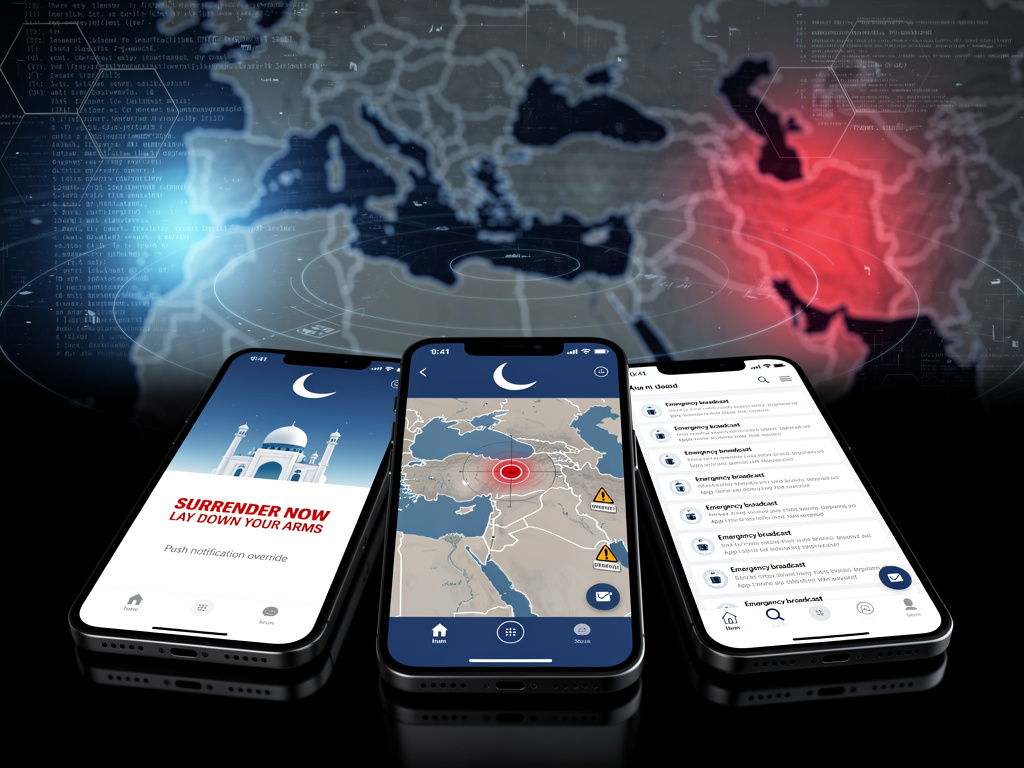
In the early hours of what would become one of the most significant Israeli military operations against Iran in recent memory, millions of Iranian citizens received an unexpected and deeply unsettling notification on their smartphones. The message did not come from their government, their news outlets, or their military. It came from a prayer app — one of the most widely used Islamic devotional applications in the country — and it told them, in no uncertain terms, to surrender.
The incident, which unfolded in June 2025 during a wave of Israeli airstrikes targeting Iranian nuclear and military infrastructure, represents one of the most brazen acts of cyber-enabled psychological warfare ever documented. It also raises profound questions about the vulnerability of civilian digital infrastructure and the expanding boundaries of modern conflict.
A Prayer App Turned Propaganda Vector
According to reporting by Wired, the compromised application was a widely popular Islamic prayer-time app used by millions of Iranians to track daily prayer schedules, Quranic readings, and religious reminders. The app, which had been downloaded tens of millions of times, suddenly began pushing notifications carrying messages in Persian that urged Iranian citizens and military personnel to lay down their arms and not resist the ongoing Israeli military campaign.
The messages were carefully crafted. They were written in fluent Persian, employed a tone that mixed urgency with reassurance, and were timed to coincide precisely with the kinetic phase of Israeli strikes. The psychological impact was immediate: Iranians who had turned to their phones for spiritual comfort in a moment of national crisis instead found themselves reading what amounted to enemy propaganda, delivered through one of the most intimate and trusted channels on their devices.
The Anatomy of the Breach
Cybersecurity researchers and analysts who examined the incident told Wired that the compromise likely targeted the app’s push notification infrastructure rather than the application’s core codebase. Push notification systems, which rely on cloud-based services to deliver messages to users in real time, are often among the least secured components of mobile applications. By gaining access to the notification backend — whether through a compromised API key, a supply chain attack on the notification provider, or direct infiltration of the developer’s administrative panel — the attackers were able to broadcast messages to the app’s entire user base simultaneously.
This method of attack is particularly insidious because it requires no action on the part of the end user. Unlike phishing emails that must be opened, or malware that must be installed, a hijacked push notification arrives unbidden, appearing with the same visual authority as any legitimate alert from the app. For the millions of Iranians who received the messages, there was no immediate way to distinguish the compromised notification from a genuine one.
Israel’s Expanding Cyber-Psychological Toolkit
Israel has neither confirmed nor denied responsibility for the hack, consistent with its longstanding policy of ambiguity regarding offensive cyber operations. However, the operation bears the hallmarks of Israel’s Unit 8200, the signals intelligence division of the Israel Defense Forces that has been linked to some of the most sophisticated cyber operations in history, including the Stuxnet worm that sabotaged Iranian nuclear centrifuges more than a decade ago.
The prayer app hack represents an evolution in Israel’s approach to psychological operations, or PSYOP. Historically, such campaigns in the Middle East have relied on leaflet drops, radio broadcasts, and SMS messages sent to cellphones in conflict zones. Israel employed SMS-based warnings extensively during its operations in Gaza, sending text messages to Palestinian civilians urging them to evacuate specific buildings before airstrikes. But the compromise of a religious application marks a significant escalation — both in technical sophistication and in the willingness to weaponize deeply personal digital spaces.
Iranian Response and Digital Fallout
Iranian authorities moved quickly to contain the fallout. State media initially denied the breach before acknowledging that “foreign cyber aggression” had targeted civilian applications. Iran’s Supreme Cyberspace Council issued directives urging citizens to delete the compromised app and to treat all unsolicited notifications with suspicion — advice that, in a moment of active military crisis, only deepened the atmosphere of confusion and distrust.
The incident also triggered a broader reckoning within Iran’s technology sector. Iranian app developers and cybersecurity professionals, many of whom operate under severe constraints imposed by both international sanctions and domestic censorship policies, found themselves facing uncomfortable questions about the security of their infrastructure. Several Iranian tech commentators noted on social media platforms that the country’s isolation from major Western cloud providers — a consequence of U.S. sanctions — has forced many Iranian developers to rely on less secure or domestically hosted alternatives for critical services like push notifications, potentially making them more vulnerable to exploitation.
The Weaponization of Trust
What makes this incident particularly significant, according to cybersecurity experts, is the deliberate targeting of a religious application. Prayer apps occupy a unique position in the digital lives of observant Muslims. They are opened multiple times daily, their notifications are rarely silenced, and they carry an implicit aura of spiritual authority. By compromising such an app, the attackers exploited not just a technical vulnerability but a relationship of trust between users and a tool they associated with their faith.
“This is about attacking the information environment at its most personal level,” said one Western cybersecurity analyst quoted by Wired. The choice of a prayer app was almost certainly deliberate, designed to maximize psychological disorientation. A compromised weather app or news aggregator would have been technically equivalent but emotionally far less potent. The attackers understood that the medium was as important as the message.
Legal and Ethical Gray Zones
The operation also raises thorny questions under international humanitarian law. The laws of armed conflict generally permit psychological operations aimed at reducing enemy morale and encouraging surrender, provided they do not constitute perfidy — the feigning of protected status to gain a military advantage. Whether the hijacking of a civilian religious application crosses that line is a matter of active debate among legal scholars.
Some experts argue that the operation was a legitimate form of psychological warfare, no different in principle from dropping leaflets over enemy territory. Others contend that the compromise of civilian infrastructure — particularly a religious tool — sets a dangerous precedent. If prayer apps are fair targets, what about hospital scheduling systems, educational platforms, or banking applications? The line between military and civilian digital infrastructure has always been blurry; this incident threatens to erase it entirely.
A New Front in the Shadow War
The Israel-Iran cyber conflict has been escalating for years, with both sides trading increasingly aggressive blows. Iran has been linked to cyberattacks on Israeli water systems, hospitals, and government databases. Israel, for its part, has been attributed with attacks on Iranian port facilities, steel manufacturing plants, and fuel distribution networks. The prayer app hack, however, represents something qualitatively different: the use of cyber capabilities not to destroy infrastructure or steal data, but to directly manipulate the psychological state of an entire civilian population during an active military operation.
This integration of cyber operations with kinetic military strikes — sometimes referred to as “multi-domain operations” — is something military planners around the world have theorized about for years. The June 2025 Israeli operation may represent one of the most complete real-world demonstrations of the concept to date. Airstrikes hit physical targets while cyber operations simultaneously targeted the information space, creating a coordinated campaign designed to overwhelm Iranian defenses on every front.
What Comes Next for Civilian App Security
The implications extend far beyond the Middle East. The incident has prompted renewed calls from cybersecurity professionals worldwide for stronger security standards around push notification systems, which remain a weak point across the global app industry. Major platform providers, including Apple and Google, control the primary push notification channels for iOS and Android respectively, but third-party notification services used by many app developers often lack equivalent security protections.
For the millions of Iranians who opened their prayer app that night expecting a reminder to pray, and instead found a message telling them to surrender, the experience was a visceral demonstration of how thoroughly digital technology has become intertwined with modern warfare. The smartphone in their pocket — the same device they used to call their families, check the news, and practice their faith — had been turned, however briefly, into an instrument of their adversary’s will. In the expanding arena of cyber-enabled conflict, no app, no notification, and no digital space can be assumed to be neutral ground.


 WebProNews is an iEntry Publication