
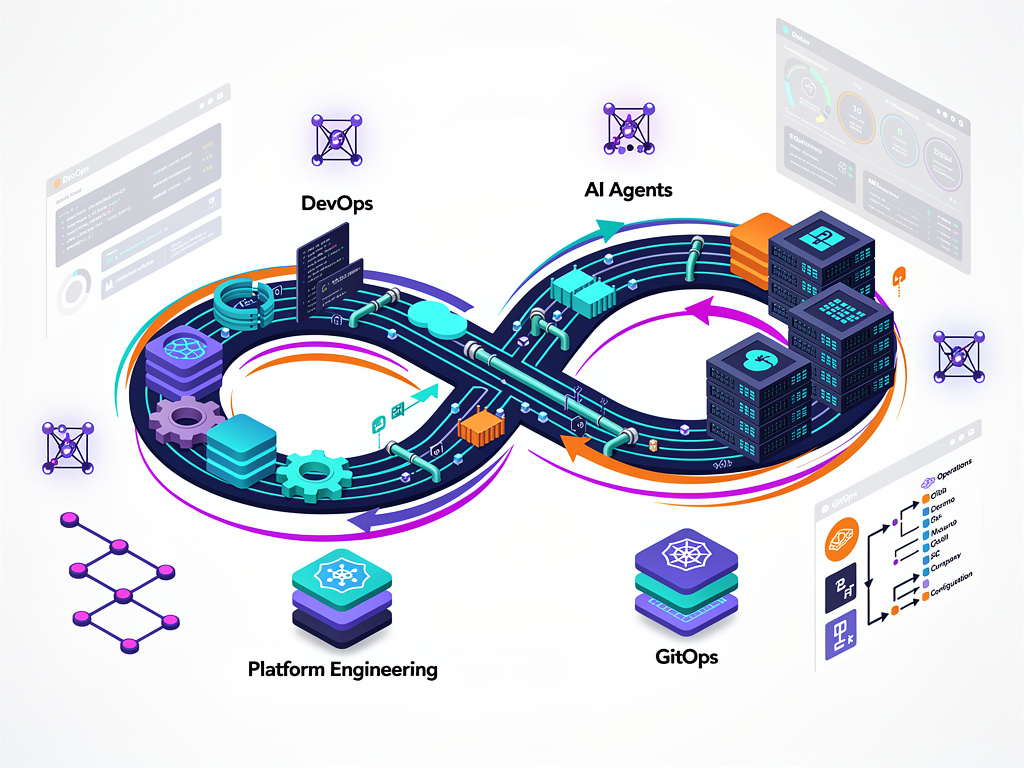
DevOps, the fusion of development and operations teams, has redefined software creation since its inception at cloud pioneers like Netflix and Amazon. No longer confined to silos, it promotes shared responsibility for faster, more reliable releases. As InfoWorld explains, DevOps emerged to bridge developers’ push for rapid features and operators’ demand for stability, enabling continuous integration and delivery over cumbersome big-bang deployments.
Engineers Damon Edwards and John Willis codified its essence in the CALMS framework: Culture of collaboration and agility; Automation to eliminate manual toil; Lean processes for smooth workflows; Measurement for data-driven feedback; and Sharing of knowledge across teams. Gene Kim, author of The DevOps Handbook, captured its appeal: “Who could go back to the old way of trying to figure out how to get your laptop environment looking the same as the production environment? … Once you’ve experienced it, it’s really tough to go back.”
This cultural shift has propelled DevOps into enterprises from banks to retailers, with 83% of developers now participating, per a 2024 survey cited by InfoWorld.
Core Practices Powering Velocity
At its heart, DevOps relies on continuous integration/continuous delivery (CI/CD), infrastructure as code (IaC), and monitoring. Tools like Jenkins for CI/CD pipelines and Terraform for IaC allow declarative management of environments, reducing errors. Observability stacks—Prometheus for metrics, Grafana for visualization, and Loki for logs—provide real-time insights, as highlighted in X posts by experts like @livingdevops.
Security integration, or DevSecOps, embeds scans for vulnerabilities (SAST, DAST, SCA) early in pipelines. Automation extends to testing, deployment, and even anomaly detection, minimizing human intervention.
These practices yield tangible gains: organizations with DevOps cultures invest 33% more time in infrastructure improvements, according to Spacelift.
Persistent Hurdles in Adoption
Despite benefits, challenges persist. Tool sprawl—juggling multiple CI/CD systems—correlates with poorer performance, as noted in surveys. Skills gaps demand proficiency in scripting, cloud architecture, security, and soft skills for cross-team bridging. Cultural resistance from entrenched silos requires leadership buy-in focused on people over tools.
In the U.S., 95% of DevOps practitioners earn over $75,000 annually, underscoring demand but also competition for talent, per InfoWorld.
2026 Trends: AI and Platform Dominance
Entering 2026, DevOps evolves amid AI proliferation. Analyst firms predict 80% of software organizations will adopt internal developer platforms (IDPs) by year-end to tame complexity, shifting from fragmented toolchains to self-service portals, as reported by RealVNC. Platform engineering emerges as DevOps at scale, providing golden paths for CI/CD, IaC, and monitoring.
AI agents upend workflows: self-healing infrastructure uses AIOps to auto-remediate issues like memory leaks, combating alert fatigue affecting 73% of enterprises, per DEV Community. GitOps with ArgoCD and Flux becomes standard, treating Git as the single truth source.
FinOps integrates cost optimization into pipelines, vital as cloud and AI expenses surge nonlinearly, according to DZone.
Security and Resilience Take Center Stage
Supply-chain security via SLSA and Sigstore gains traction amid AI-driven threats. DevSecOps evolves to predictive AI spotting vulnerabilities pre-deployment, as Brady Lamb of Recast Software told WebProNews. Resilience trumps raw speed: feature flags and progressive delivery enable safe rollouts, per LaunchDarkly’s Marcus Holm in Tech Monitor.
X discussions, like @asynctrix’s post on AI pipelines and lightweight Kubernetes for edge, reflect practitioner focus on these shifts. Serverless CI/CD and MLOps for AI models further streamline operations.
Rishi Bhargava of Descope urges mastering MCP for AI-agent apps: “Devops should focus on mastering MCP, which is set to create an entirely new app development pipeline in 2026,” via InfoWorld.
Toolchains for Tomorrow’s Teams
Modern stacks prioritize GitHub Actions over Jenkins for seamless repo integration, Terraform for multi-cloud IaC, and Prometheus-Grafana over legacy monitors, as @livingdevops advises on X. Kubernetes dominates orchestration, with Istio for service mesh and HashiCorp Vault for secrets.
Platform teams standardize these, freeing developers for features. Rohit Ghumare’s (@ghumare64) 2026 roadmap on X—Git, Bash, Docker, K8s, cloud—echoes this progression.
As Matthew Makai of DigitalOcean notes in InfoWorld, embrace AI as “a new nondeterministic paradigm” for deployment and operations.
Enterprise Imperatives and Workforce Shifts
Enterprises treat DevOps trends as an investment portfolio: balancing speed, security, and cost. IDPs enforce compliance via policy-as-code, per DZone. The DevOps market eyes $70 billion by 2032, driven by on-premise and cloud segments, says Programs.com.
Roles evolve: fewer generalists, more platform engineers and SREs with observability and SLO expertise. Continuous learning—via Medium, Reddit, X—remains key, as @devops__cmty emphasizes platform engineering’s quiet rise.
DevOps in 2026 dissolves into infrastructure like electricity, enabling high-velocity delivery amid AI and cloud-native demands.


 WebProNews is an iEntry Publication