
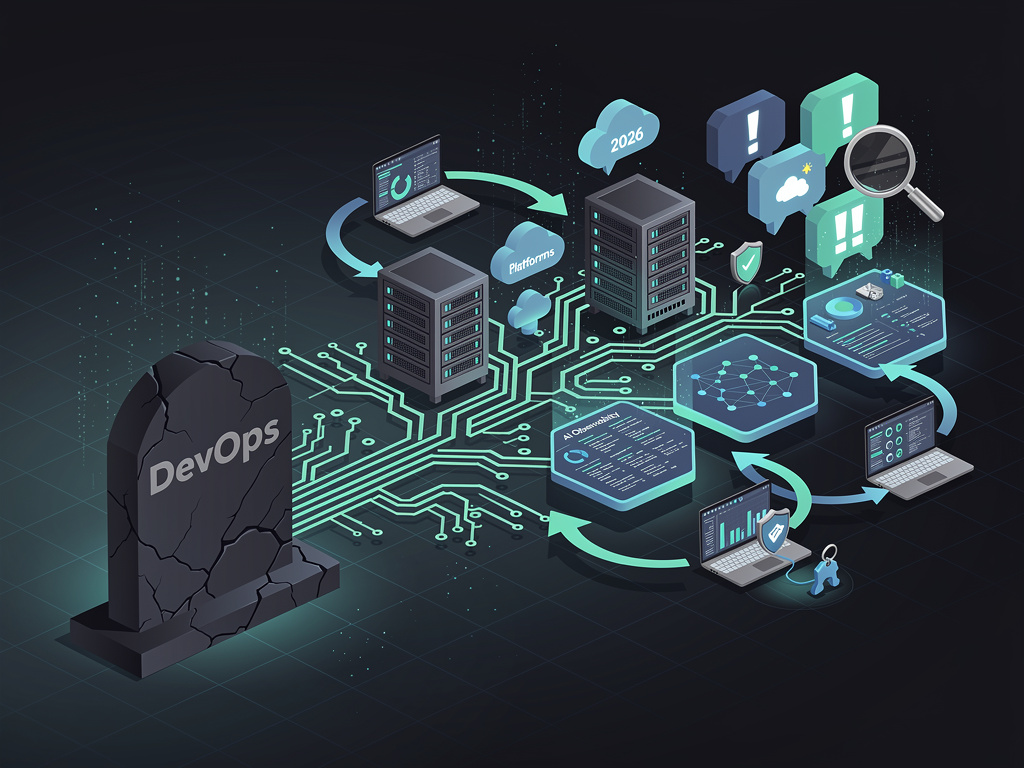
In the relentless churn of technology trends, few movements have faced as many premature obituaries as DevOps. "Every few years, sometimes every few months, someone declares DevOps dead," writes Alan Shimel in DevOps.com. Yet here it stands in 2026, not as a relic but as a foundational force, adapting to AI agents, platform engineering and observability breakthroughs while staying rooted in human collaboration.
The latest salvo came from Charity Majors, co-founder of Honeycomb, in her January 2026 blog post You Had One Job: Why Twenty Years of DevOps Has Failed to Do It. Majors argues the movement boiled down to one mission: forging a feedback loop so developers own their code in production. "I think the entire DevOps movement was a mighty, twenty year battle to achieve one thing: a single feedback loop connecting devs with prod. On those grounds, it failed," she states. Her critique resonates from hard-won experience, highlighting persistent silos and uneven accountability.
Shimel counters in a follow-up on DevOps.com, agreeing on imperfections but rejecting outright failure. DevOps succeeded in speeding deployments, boosting failure visibility and shifting responsibility to teams—even before modern tools. Its lack of a rigid manifesto allowed it to absorb cloud-native tech, SRE, GitOps and now AI, he notes. "DevOps isn’t dead. It isn’t finished. And it certainly isn’t done evolving," Shimel asserts.
Feedback Loops Finally Close
At DevOps’ core lies the feedback loop, long hampered by crude tools. Majors laments developers rarely interacting with production daily. Early monitoring collected logs and metrics but offered little insight. Enter AI-powered observability: platforms now analyze patterns, predict failures and deliver actionable alerts, as detailed in DZone’s 2026 trends report. OpenTelemetry dominates, providing standardized telemetry that AI tools leverage for real-time system understanding.
Shimel emphasizes, "AI has changed the equation, not just a little, but fundamentally. It has turned observability from a passive recording system into an active partner." Tools like Middleware.io and Cast AI optimize Kubernetes clusters while reducing alert fatigue by 70-90%, per DEV Community insights. This evolution fulfills DevOps’ promise, making production behavior visible and learnable.
Industry voices echo this shift. In InfoWorld, experts warn AI workloads expose DevOps gaps in data pipelines and monitoring, urging "paved roads"—comprehensive internal platforms replicating production for testing.
Platforms Rise as DevOps Scales
Platform engineering emerges as DevOps’ maturity marker. Gartner predicts 80% of engineering organizations will have platform teams by 2026, per DEV Community analysis. Internal Developer Platforms (IDPs) like Backstage or Humanitec provide self-service portals with golden paths: standardized CI/CD, Terraform modules and security guardrails.
"Platform engineering is DevOps at scale," notes a DEV Community post. Developers focus on features while platforms handle toil. This addresses Majors’ ownership critique by embedding best practices, reducing drift and cognitive load. FinOps integrates too, with tools like Kubecost showing costs in workflows to prevent budget overruns.
Platform Engineering.org forecasts AI convergence: platforms with built-in DevEx, security-by-design and observability. Salaries reflect demand—platform engineers earn 27% more than traditional DevOps roles.
AI Agents Reshape the Human Role
Predict 2026, hosted by Futurum analysts, warns AI will force DevOps reinvention, per DevOps.com. Agentic AI writes code, runs tests, remediates incidents and makes decisions, collapsing cycles from weeks to minutes. Dion Hinchcliffe highlights AI stressing cloud models, demanding new operational strategies for platform teams.
Tools proliferate: GitHub Copilot for configs, Amazon Q Developer for reviews, Sysdig Sage for threats, as listed in Spacelift’s 2026 roundup. "AI in DevOps transforms automation into intelligence," states NewVision Software, citing McKinsey data on reliability gains.
Yet humans remain central. X discussions emphasize "human-in-the-loop" for ethics and context. Shimel invokes Andrew Clay Shafer: "We may finally be getting the DevOps we deserve—not the promised or marketed version."
Resilience Over Raw Speed
2025’s AI experiments led to tool sprawl and breaks; 2026 prioritizes reliability, per Tech Monitor. "Resilience is the new velocity," with DevSecOps tightening governance. Edge computing and multi-cloud add complexity, but GitOps ensures declarative, auditable infra.
In Pulumi Blog, DevOps engineers are urged to build model-agnostic infra for AI backends. Local AI rises via AWS AI Factories, enabling zero-latency CI/CD with data sovereignty.
X posts from @devops__cmty affirm: Platform engineering matures DevOps, with fewer generalist roles and more specialized SREs automating via AI.
Culture Trumps Tools
DevOps endures because it’s human-centered: collaboration, blameless postmortems, learning from failure. Tools enable but don’t replace this. As All Things Open predicts, "Vibe coding" extends AI supervision across pipelines, but principles persist.
Shimel concludes DevOps responds to complex systems in flux, like email or Agile. Declarations of death stem from frustration or pitches. In 2026, with AI and platforms, it absorbs reinventions, proving resilient through people.
Executives watching DORA metrics see elite performers—those blending DevOps culture with tech—deploy 208 times more frequently with 60% fewer failures. The story continues, human-driven.


 WebProNews is an iEntry Publication