
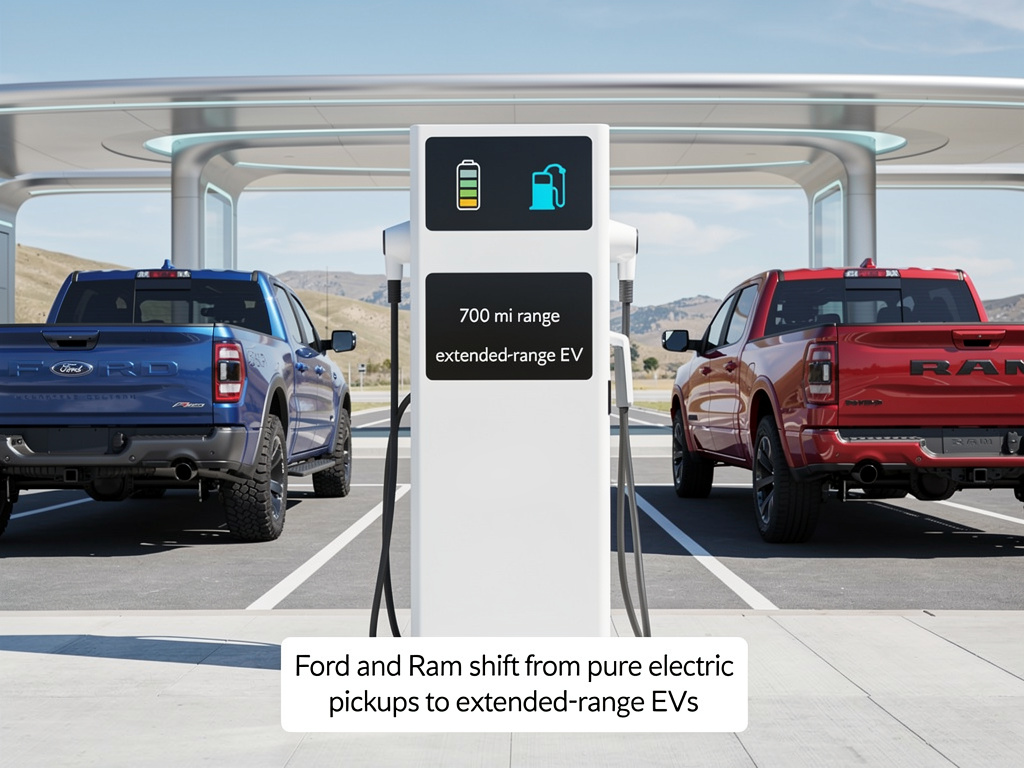
The American automotive industry’s electric vehicle ambitions have collided with market realities, forcing two of Detroit’s most storied manufacturers to recalibrate their strategies in the lucrative pickup truck segment. Ford Motor Company and Stellantis’s Ram brand have both pivoted away from pure battery-electric pickup trucks, instead embracing extended-range electric vehicles (EREVs) that combine electric motors with gasoline generators—a technological compromise that promises to deliver what neither pure EVs nor traditional hybrids could: approximately 700 miles of total range without the anxiety of finding charging stations across America’s vast rural expanses.
According to CNBC, this shift represents more than just a product strategy adjustment—it signals a fundamental reassessment of what American truck buyers actually want versus what environmental regulations and corporate sustainability pledges have demanded. The EREV architecture allows these vehicles to operate primarily on electric power for daily driving, typically offering 100-150 miles of battery-only range, while a small gasoline engine serves as an onboard generator to recharge the battery and extend total range to distances that rival or exceed conventional internal combustion trucks. This approach sidesteps the two most significant barriers to EV adoption in the truck market: range anxiety and charging infrastructure inadequacy, particularly in the rural and commercial contexts where pickups dominate.
The strategic retreat from pure EVs comes despite both manufacturers having invested billions in battery-electric technology and having already brought fully electric pickups to market. Ford’s F-150 Lightning, launched with considerable fanfare in 2022, has seen sales plateau well below initial projections, while Ram’s delayed electric pickup plans have been repeatedly restructured. Industry analysts suggest that while urban and suburban early adopters embraced these vehicles, the core truck-buying demographic—contractors, farmers, recreational users, and those in regions with limited charging infrastructure—remained skeptical about range limitations and charging times that could interfere with work schedules and lifestyle needs.
The Engineering Calculus Behind Extended-Range Architecture
The EREV configuration represents a sophisticated engineering compromise that leverages the best attributes of both electric and combustion powertrains while mitigating their respective weaknesses. Unlike traditional plug-in hybrids, where the gasoline engine can directly power the wheels, EREVs function as pure electric vehicles with the gasoline engine serving solely as a generator. This architecture allows engineers to optimize the combustion engine to run at its most efficient RPM range, dramatically improving fuel economy compared to conventional trucks while maintaining the instant torque and smooth power delivery that characterizes electric motors.
The approximately 700-mile total range figure cited by both manufacturers assumes a full battery charge plus a full tank of gasoline, with the battery providing roughly 100-150 miles of pure electric range and the gasoline generator extending capability for another 550-600 miles. This configuration addresses what market research has consistently identified as the critical threshold for truck buyers: the ability to complete a full day’s work or a weekend’s recreation without refueling or recharging. For commercial users, this translates to predictable operating costs and minimal downtime, while recreational users can venture into remote areas without the anxiety of finding charging stations in regions where even gasoline stations can be sparse.
Market Realities Versus Environmental Aspirations
The pivot to EREVs reflects a sobering assessment of the American automotive market’s actual trajectory versus the ambitious timelines that dominated industry discourse just two years ago. When Ford and General Motors announced plans to transition their pickup lineups to electric power, the assumptions included rapidly expanding charging infrastructure, declining battery costs, and consumer enthusiasm driven by environmental concerns and lower operating costs. Instead, the reality has been more complex: charging infrastructure buildout has lagged projections, battery costs have remained stubbornly high due to raw material constraints, and truck buyers have proven more conservative than anticipated, prioritizing capability and convenience over environmental considerations.
The commercial truck market, which represents a substantial portion of pickup sales, has been particularly resistant to pure EVs. Fleet managers and business owners calculate total cost of ownership with ruthless precision, and the potential for a truck to be unavailable due to charging requirements—or worse, to run out of charge during a critical job—represents an unacceptable risk. The EREV configuration eliminates this concern while still delivering many of the benefits that make EVs attractive for commercial use: lower maintenance costs due to fewer moving parts, reduced brake wear from regenerative braking, and the ability to charge overnight at depots where electricity is cheaper than gasoline, thereby reducing fuel costs for routine local operations.
Competitive Implications and Industry Ripple Effects
Ford and Ram’s embrace of EREV technology places them in a complex competitive position relative to other manufacturers pursuing different electrification strategies. General Motors has committed to pure battery-electric versions of its Chevrolet Silverado and GMC Sierra, while Toyota has long advocated for a multi-pathway approach that includes hybrids, plug-in hybrids, and hydrogen fuel cells alongside battery electrics. The EREV strategy could position Ford and Ram advantageously if consumer preferences continue favoring flexibility over pure electrification, or it could represent a costly detour if charging infrastructure rapidly improves and battery costs decline more quickly than current projections suggest.
The technology also carries significant implications for the broader supply chain and manufacturing ecosystem. EREV production requires capabilities in both electric drivetrain manufacturing and traditional engine production, potentially complicating the industry’s transition away from internal combustion expertise. Battery requirements for EREVs are substantially lower than for pure EVs—typically 30-50 kWh compared to 100-200 kWh for comparable pure electric trucks—which could ease pressure on battery supply chains while still requiring significant battery production capacity. This middle path may prove easier for traditional automotive suppliers to navigate, preserving more of the existing industrial base while gradually shifting toward electrification.
The Regulatory Tightrope and Policy Uncertainties
The shift to EREVs occurs against a backdrop of regulatory uncertainty that has complicated long-term planning for automotive manufacturers. Federal fuel economy standards and emissions regulations have provided the primary impetus for electrification, but the specific treatment of EREVs within these frameworks remains subject to interpretation and potential revision. Unlike pure EVs, which generate zero tailpipe emissions, EREVs produce emissions when the gasoline generator operates, though typically at levels far below conventional trucks due to the optimized operating conditions of the generator engine.
State-level policies add further complexity, particularly in California, which has historically led national automotive policy through its unique regulatory authority under the Clean Air Act. California’s Advanced Clean Cars II regulations, which effectively mandate increasing percentages of zero-emission vehicle sales, create uncertainty about how EREVs will be classified and credited. If EREVs receive favorable treatment as transitional technologies, they could serve as a bridge strategy for manufacturers; if they’re treated more like conventional vehicles, the business case weakens considerably. This regulatory ambiguity has forced manufacturers to hedge their bets, maintaining development programs across multiple powertrain technologies while trying to read policy signals from both state and federal regulators.
Consumer Psychology and the Compromise Solution
Perhaps the most compelling argument for the EREV approach lies in consumer psychology rather than pure engineering or economic calculus. American truck buyers have demonstrated a particular attachment to capability and versatility, even when actual usage patterns suggest that pure electric range would suffice for the vast majority of daily driving. The phenomenon of “range anxiety” extends beyond rational assessment of actual needs; it represents a psychological comfort factor that pure EVs have struggled to overcome despite increasingly impressive range figures. The knowledge that a gasoline generator stands ready to extend range indefinitely provides psychological reassurance that may prove more valuable than the actual frequency of needing that extended range.
Market research consistently shows that truck buyers overestimate their range needs and underestimate their willingness to adapt behaviors around charging. However, this gap between perception and reality doesn’t diminish its commercial significance—manufacturers must design for the vehicles consumers want to buy, not the vehicles that rational analysis suggests they should buy. The EREV configuration effectively neutralizes range anxiety as a purchase barrier while still delivering the electric driving experience for the majority of miles driven. For manufacturers, this represents a pragmatic acknowledgment that changing consumer behavior is far more difficult than adapting technology to accommodate existing preferences and concerns.
Economic Implications and Total Cost of Ownership
The financial proposition of EREVs occupies a middle ground between conventional trucks and pure EVs, with complexity that varies depending on usage patterns. For buyers who primarily drive within the electric range and charge regularly, the operating costs approach those of pure EVs—electricity is substantially cheaper per mile than gasoline, and maintenance requirements are reduced due to less wear on the combustion engine. However, for buyers who frequently exceed electric range and rely heavily on the gasoline generator, the economic benefits diminish, though efficiency remains superior to conventional trucks due to the optimized operating conditions of the generator engine.
Purchase price represents another critical consideration in the total cost equation. EREVs require both a battery pack and a gasoline powertrain, potentially making them more expensive than either pure EVs or conventional trucks. However, the smaller battery pack required compared to pure EVs partially offsets this cost, and the complexity of the EREV system may be less than that of sophisticated plug-in hybrids that must seamlessly blend power from both electric motors and mechanical engine connections. Federal tax credits and incentives add further complexity to the calculation, with eligibility depending on battery capacity, domestic content requirements, and the evolving interpretation of regulations by the Treasury Department and IRS.
The Path Forward and Industry Evolution
The embrace of EREV technology by Ford and Ram suggests that the automotive industry’s transition to electrification will be more gradual and technologically diverse than the binary ICE-to-EV narrative that dominated discussion in recent years. Rather than a wholesale replacement of one technology with another, the industry appears to be evolving toward a portfolio approach where different powertrain technologies serve different use cases and consumer preferences. This pragmatic evolution may ultimately prove more sustainable than attempts to force rapid wholesale transitions that outpace infrastructure development and consumer acceptance.
The success or failure of the EREV strategy will depend on factors largely beyond the manufacturers’ control: the pace of charging infrastructure development, battery technology advances and cost reductions, fuel prices, and regulatory treatment. If charging infrastructure remains inadequate in rural areas and battery costs stay high, EREVs could represent the optimal solution for the truck market for the next decade or more. Conversely, if infrastructure rapidly improves and battery costs plummet, EREVs might be remembered as an expensive transitional technology that delayed the inevitable shift to pure electrification. For now, Ford and Ram are betting that the middle path offers the best balance of capability, consumer acceptance, and regulatory compliance—a calculated compromise in an industry where the destination is clear but the optimal route remains hotly debated.


 WebProNews is an iEntry Publication