
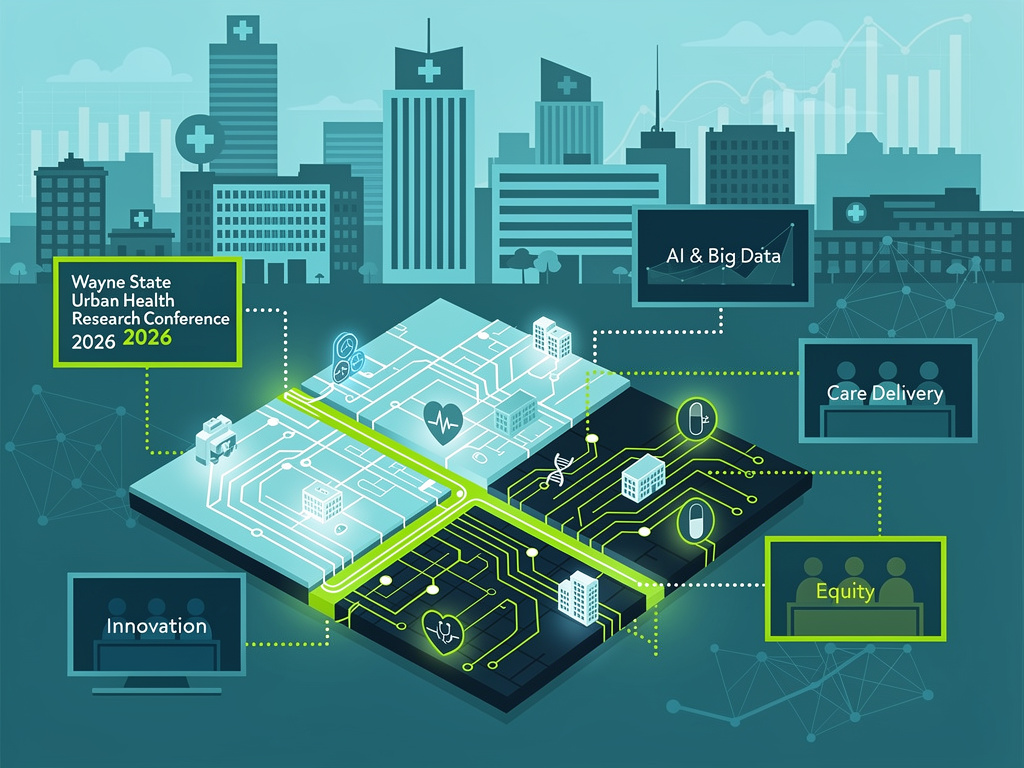
In the heart of Detroit, where health disparities cut deep into urban communities, Wayne State University’s College of Nursing is positioning artificial intelligence and big data as transformative forces for equitable care. The 2026 Urban Health Research Conference, scheduled for April 22 at the university’s Student Center, spotlights this shift under the theme “Transforming Health Care Through AI, Big Data and Innovation.” Running from 8 a.m. to 4 p.m., the event draws nurse scientists, clinicians, health leaders, and policymakers to dissect how these technologies reshape delivery in city settings. Attendance is priced at $125, with registration open via today.wayne.edu).
The conference builds on Wayne State’s longstanding commitment to urban health research, defined as “the study of the determinants and distribution of health and disease in populations living within an urban context,” per the College of Nursing’s research page (nursing.wayne.edu). Past iterations, like the 2025 event on health equity and 2024’s focus on building trust among diverse groups, have evolved toward tech integration, reflecting broader industry momentum where AI promises to bridge care gaps amid staffing shortages and rising chronic disease burdens.
Keynote Vision from a Nursing Informatics Pioneer
Leading the charge is keynote speaker Connie White Delaney, Ph.D., R.N., FAAN, FACMI, FNAP, professor and dean of the University of Minnesota School of Nursing, honored as an American Academy of Nursing 2025 Living Legend. Her address, “AI and Big Data Empowering Transformation of Care Delivery,” will probe how these tools enable “equitable, human-centered health transformation.” Delaney emphasizes nurses and interprofessional teams co-creating “ethical, people-first AI applications that strengthen patient care, advance health equity and preserve the essential humanity of the profession,” according to the official conference site (urbanhealthconf.wayne.edu).
A nationally recognized leader in nursing informatics, Delaney’s insights on leveraging data ecosystems for high-value care align with Wayne State’s interdisciplinary push, where faculty translate findings into clinical practice for urban patients and communities.
Panel Powerhouses Tackle AI’s Front Lines
An expert panel assembles health system executives and researchers to probe AI’s impact on care quality, operations, and outcomes. Panelists include Eric Kaplan, vice president and chief information officer at NorthStar Care Community, presenting “Beyond the Algorithm: Enhancing Care & Connection”; Steven J. Korzeniewski, Ph.D., associate professor of emergency medicine at Wayne State and principal investigator of the PHOENIX project; Jodyn Platt, Ph.D., M.P.H., associate professor at the University of Michigan; Jill Sheipline, B.S.N., R.N., vice president and chief nursing informatics officer at Corewell Health; and Eric Wallis, D.N.P., M.S.A., R.N., NE-BC, FACHE, senior vice president and chief nursing executive at Henry Ford Health. They will forecast AI’s trajectory and strategies for responsible deployment.
Korzeniewski’s PHOENIX—Population Health OutcomEs aNd Information EXchange—exemplifies real-world application, integrating clinical and social determinants data via a Google Cloud virtual warehouse to monitor and manage population health, funded by NIH, CDC, and others (phoenix.wayne.edu). His work targets early-onset hypertension in vulnerable groups, powering initiatives like mobile health units in high-burden Detroit “hotspots,” as noted in Journal of Clinical Hypertension studies.
Breakouts Spotlight Cutting-Edge Applications
Three breakout sessions deliver granular dives. First, “Where Virtual Meets Vulnerability: AI-Enhanced Augmented Reality Therapy for PTSD and Anxiety Across Diverse Populations,” led by Arash Javanbakht, M.D., associate professor of psychiatry at Wayne State School of Medicine, and Dalia Khalil, Ph.D., R.N., associate professor at the College of Nursing.
Second, “Faculty Intelligence Meets Artificial Intelligence: AI-Driven Excellence in Programmatic Assessment for Interprofessional Education Across Health Professions,” features Aline Saad, PharmD, director of faculty development at Wayne State’s Eugene Applebaum College of Pharmacy and Health Sciences; Randon Jenkins, R.N., B.S.N., D.N.P., AGPCNP-BC; Caitlin Rukat, M.S.; and Brian J. Barnes, PharmD.
Third, “Leveraging Artificial Intelligence Across the Care Continuum: Pediatric Sepsis Detection to Patient-Centered Care in Aging Populations,” by Cynthera McNeill, D.N.P., A.P.R.N., AGPCNP-C, FAANP, associate professor, and Stacey Sears, D.N.P., CPNP-AC, assistant professor at the College of Nursing. These sessions underscore AI’s versatility from mental health to pediatrics and geriatrics.
Sponsors and Credits Fuel the Mission
NorthStar Care Community serves as presenting sponsor, with Henry Ford Health at gold level, supporting 4.25 pending contact hours via Ohio Nurses Association approval. The event caps with posters, networking, and a wine-and-cheese reception, fostering collaborations amid Detroit’s pressing needs—like cardiometabolic risks in vulnerable tracts tracked by PHOENIX.
Wayne State’s conference arrives as AI surges in health care, with 2026 trends forecasting governance maturity and GenAI workflow integration, per Wolters Kluwer experts. Yet challenges persist: data privacy, bias mitigation, and equitable access in cities. By convening local titans like Corewell and Henry Ford, the gathering positions Detroit as a proving ground for ethical AI scaling.
PHOENIX Rises in Detroit’s Data Wars
PHOENIX, Korzeniewski’s brainchild, has spotlighted COVID-19 mortality spikes in socioeconomically vulnerable areas and birthed mobile units for hypertension screening, per PLOS One and eClinicalMedicine. “Our Mission is to Connect Communities with Information that Drives Positive Social Changes in Pursuit of Lifespan Equality,” states the project site, blending EHRs with social data for actionable insights.
This platform’s role in the conference panel highlights Wayne State’s edge: fusing academia, health systems, and tech for urban impact, contrasting broader national debates on AI ethics.
From Past Equity Fights to Tech Frontiers
Prior conferences laid groundwork—2025’s community-engaged equity push with Urmeka Jefferson on breastfeeding interventions; 2024’s trust-building via Yale and Duke keynotes. The 2026 pivot to AI signals acceleration, mirroring Wayne State’s WSU AI, Big Data & Analytics Group efforts and events like NeuroCollaborate on brain health data science.
As WebProNews notes, the event grapples with “robust governance frameworks that ensure transparency, accountability, and patient consent,” vital for public trust in data-hungry models (webpronews.com).
Urban Stakes Demand Actionable Innovation
Detroit’s metrics—high chronic disease in socially vulnerable zones—make this imperative. Sessions on AR for PTSD, AI assessments, and sepsis detection promise tools for frontline clinicians, while Delaney’s human-centered ethos guards against dehumanization. With sponsors like NorthStar (diamond-level past supporter) investing, the conference transcends talk, seeding partnerships for AI pilots in Motor City wards.


 WebProNews is an iEntry Publication