
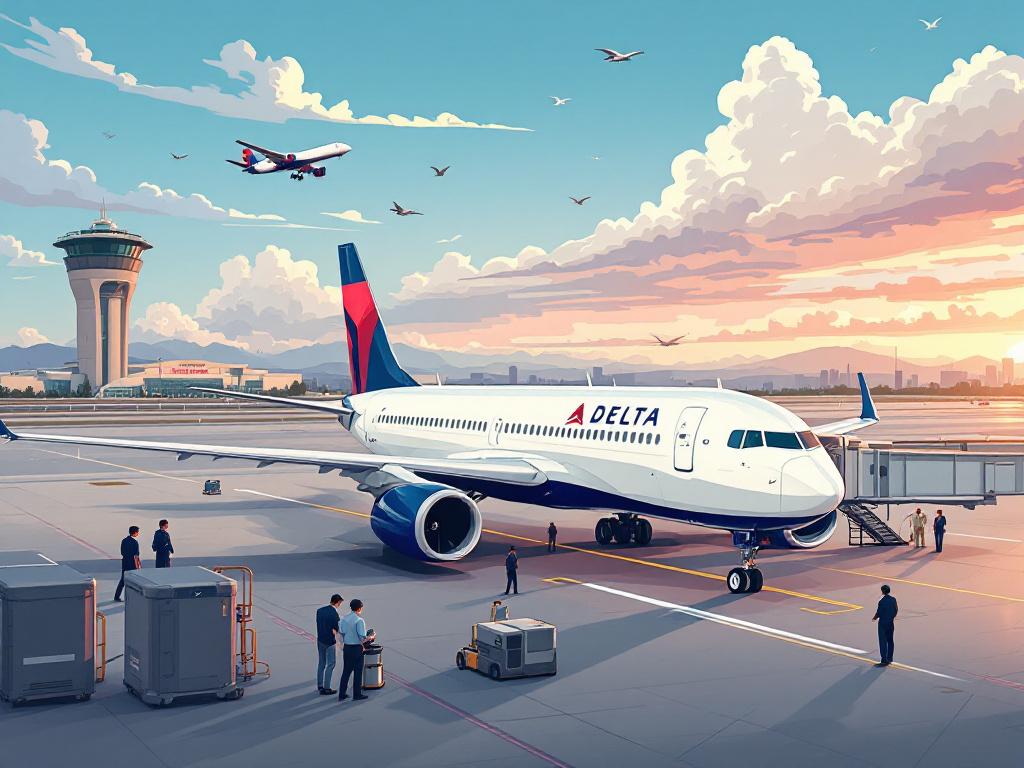
In the waning days of 2025, Delta Air Lines Inc. has emerged as a stark emblem of the broader economic ripples from the recent U.S. government shutdown, projecting a staggering $200 million dent in its fourth-quarter pretax profit. The Atlanta-based carrier, one of the nation’s largest, attributes this financial blow to widespread flight disruptions triggered by federal staffing shortages during the six-week impasse. As air travel demand rebounds, Delta’s leaders are navigating a tricky path, balancing immediate losses with optimistic forecasts for 2026, even as the episode underscores vulnerabilities in the aviation sector tied to political gridlock.
The shutdown, which stretched from October into November, forced mandatory flight reductions at dozens of major airports, crippling operations for airlines and stranding millions of passengers. According to reports from BBC News, the cuts began on the first day of November, affecting 40 key U.S. airports and leading to thousands of cancellations. Delta, with its extensive network, bore a disproportionate brunt, slashing routes and facing cascading delays that eroded revenue during a peak travel period. Company executives detailed in a recent SEC filing that the chaos not only reduced passenger loads but also deterred bookings amid uncertainty, amplifying the profit hit.
Beyond the immediate numbers, this event highlights how intertwined the airline industry is with federal oversight, particularly through agencies like the Federal Aviation Administration (FAA) and Transportation Security Administration (TSA). Staffing shortfalls during the shutdown—fueled by furloughs and unpaid workers—led to reduced air traffic control capacity, prompting airlines to preemptively cancel flights to avoid safety risks. Delta’s update, as covered in Reuters, emphasizes that while the shutdown ended last month, its aftershocks linger in the form of adjusted profit guidance, now trimmed to reflect the $200 million impact.
Unpacking the Financial Toll on Delta’s Operations
Analysts poring over Delta’s disclosures note that the $200 million figure equates to roughly $0.25 per share, a bite that’s material but not catastrophic for a company of its scale. Still, it’s a reminder of how external shocks can swiftly erode margins in an industry where fixed costs like fuel and aircraft leases loom large. In a statement echoed across financial platforms, Delta reported via Investing.com that the hit stems from both direct revenue losses and indirect effects, such as compensatory measures for affected passengers, including refunds and rebookings.
The Atlanta Business Chronicle, focusing on Delta’s hometown impact, detailed how the airline’s hub at Hartsfield-Jackson Atlanta International Airport saw significant cutbacks, contributing to the profitability squeeze as fourth-quarter earnings approach. “Government shutdown-related flight cuts will significantly reduce profitability,” the publication noted in its coverage at Atlanta Business Chronicle. This local angle reveals broader economic strains, with small businesses tied to airport operations—from vendors to ground services—facing their own downturns.
Delta’s response has been multifaceted, involving aggressive marketing to restore traveler confidence and operational tweaks to ramp up capacity post-shutdown. Yet, the episode has sparked internal reviews, with insiders suggesting investments in contingency planning, such as enhanced automation for air traffic management, to mitigate future risks. As one aviation consultant remarked in industry discussions, the shutdown exposed “systemic fragilities” that could prompt regulatory pushes for more resilient infrastructure.
Ripples Across the Broader Aviation Sector
While Delta’s $200 million loss grabs headlines, it’s part of a larger pattern affecting competitors like United Airlines and American Airlines, which have reported similar, albeit smaller, impacts. The collective toll on the industry could exceed $1 billion, based on preliminary estimates from trade groups. Posts on X (formerly Twitter) capture public sentiment, with users highlighting millions of delayed passengers and economic fallout, including one account noting over 5 million airline disruptions during the shutdown’s peak.
This isn’t Delta’s first brush with external disruptions—recall the 2018 shutdown or the pandemic-era slumps—but the 2025 event stands out for its duration and timing, overlapping with holiday travel surges. Bloomberg’s analysis at Bloomberg points out that Delta was compelled to “slash flights due to the recent record government shutdown,” underscoring how federal borrowing spikes and data delays compounded the chaos. The carrier’s filing also warns of “permanently damaged” federal statistical systems, which could hinder accurate economic forecasting for quarters to come.
Looking ahead, Delta’s executives are bullish on recovery, citing a rebound in bookings to pre-shutdown levels. In a CNBC report accessible at CNBC, the airline forecasts “strong travel demand into 2026,” driven by corporate travel resurgence and international expansions. This optimism is tempered by caveats: lingering effects on consumer confidence, especially among business travelers wary of policy volatility.
Policy Implications and Industry Advocacy Efforts
The shutdown’s aviation fallout has ignited calls for legislative reforms to insulate critical sectors from political brinkmanship. Airline lobbying groups, including Airlines for America, are pushing for measures like automatic funding extensions for FAA operations during budget disputes. Delta’s CEO, in recent remarks, echoed this, arguing that such disruptions undermine U.S. competitiveness in global aviation.
From a macroeconomic view, the Congressional Budget Office (CBO) has projected that the shutdown shaved 1-2 percentage points off fourth-quarter GDP growth, with aviation and tourism hit hardest. X posts from economic analysts, such as those tracking federal debt surges to $619 billion during the period, illustrate the interconnectedness: shutdowns inflate borrowing while paralyzing revenue-generating industries like travel.
Delta’s strategic pivots include bolstering partnerships with tech firms for predictive analytics, aiming to forecast and mitigate similar events. Industry insiders speculate this could lead to innovations like AI-driven routing optimizations, reducing dependency on federal staffing.
Passenger Experiences and Long-Term Trust Challenges
On the ground, passengers bore the human cost, with tales of missed connections and holiday plans upended flooding social media. One X user described the shutdown as “nightmare fuel” for travelers, amplifying frustrations over government travel systems like DTS. Delta responded with enhanced customer service protocols, but rebuilding trust will take time, especially as competitors vie for loyalty.
Financially, the $200 million hit aligns with Delta’s updated outlook in its SEC Form 8-K, detailed at StockTitan, which highlights “healthy travel demand and strong early 2026 trends” despite the setback. This duality—short-term pain amid long-term promise—defines Delta’s narrative.
Comparatively, past shutdowns inflicted less damage due to shorter durations, but 2025’s record length amplified effects. Analysts from Goldman Sachs, referenced in broader economic discussions on X, warn of potential GDP drags from declining tourism, with non-citizen arrivals down 10% in March alone.
Strategic Responses and Future-Proofing Aviation
Delta’s playbook for recovery involves fleet optimizations and route expansions, particularly in high-growth markets like Asia and Europe. The carrier’s premium offerings, such as Delta One suites, are positioned to capture rebounding demand, with executives projecting unit revenue growth in the low single digits for 2026.
Yet, challenges persist: fuel price volatility and labor negotiations could compound the shutdown’s legacy. Union representatives for air traffic controllers have decried the unpaid furloughs, potentially leading to talent attrition that prolongs recovery.
In investor circles, Delta’s stock has shown resilience, dipping modestly post-announcement but buoyed by the positive demand outlook. As covered in StockTwits at StockTwits, bookings have “bounced back to earlier expectations after a brief slowdown in November.”
Economic Echoes and Sector-Wide Lessons
The broader economic narrative ties the shutdown to fiscal policy debates, with X accounts like The Kobeissi Letter quantifying the damage: 43 days of delayed economic data and billions in new debt. For Delta, this translates to advocacy for stable funding mechanisms, potentially influencing upcoming congressional budgets.
Smaller carriers, lacking Delta’s scale, face steeper hurdles, with some regional operators reporting double-digit revenue drops. This disparity underscores the need for industry-wide resilience strategies, from diversified revenue streams to public-private partnerships.
Ultimately, Delta’s experience serves as a case study in adaptability, blending financial prudence with forward-looking investments. As the airline charts its course into 2026, the $200 million lesson from 2025 may well catalyze reforms that fortify aviation against future political tempests.
Voices from the Industry and Path Ahead
Industry veterans argue that while Delta’s hit is eye-catching, it’s the systemic issues—like data blackouts on jobs and inflation—that pose longer threats. Referencing the Business Insider piece at Business Insider, the “travel chaos that canceled thousands of flights” encapsulates the human and economic scale.
Passenger advocacy groups are now pressing for compensation frameworks, potentially leading to new regulations. Delta, proactive in its outreach, has launched campaigns emphasizing reliability, aiming to convert setback into brand strength.
As 2025 closes, the shutdown’s shadow lingers, but Delta’s projections signal a sector poised for rebound, provided policy stability holds. This episode, rich in lessons, may redefine how airlines and governments collaborate to safeguard the skies.


 WebProNews is an iEntry Publication