
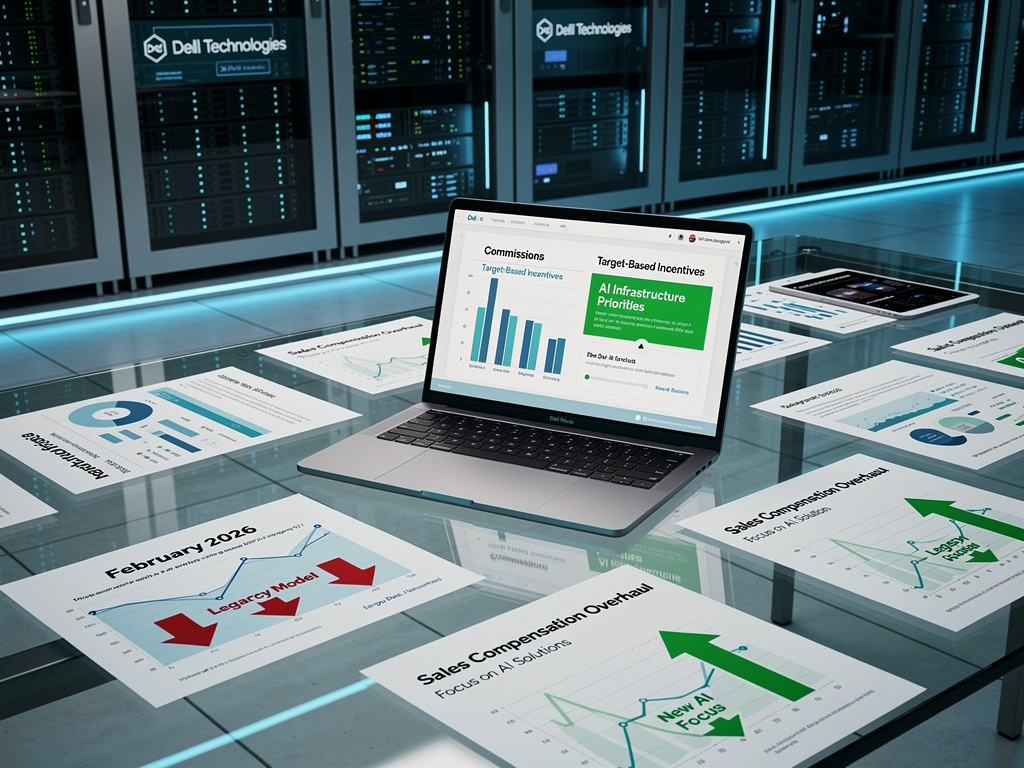
Dell Technologies is preparing to fundamentally reshape how it pays its vast sales force, a sweeping compensation overhaul that signals just how aggressively the Round Rock, Texas-based technology giant is betting its future on artificial intelligence infrastructure. The changes, set to take effect at the start of Dell’s fiscal year 2026 in February, represent one of the most significant internal restructurings at the company in recent memory — and they’re generating considerable anxiety among the rank and file.
According to internal documents and employee accounts reported by Business Insider, Dell is moving away from its traditional commission-based sales compensation model toward a system built around “target incentive” payments. Under the new structure, salespeople will no longer earn commissions tied directly to individual deal revenue. Instead, they will receive incentive payouts based on whether they hit predetermined performance targets — a shift that Dell’s leadership frames as a modernization effort but that many veteran sales staff view with deep skepticism.
The Mechanics of a Compensation Revolution
The new compensation framework is not merely a tweak at the margins. Dell is restructuring its sales organization into what it calls “solution” areas, with AI-related products and services occupying a central position. Sales representatives will be assigned to specific solution categories, and their target incentives will be calibrated to the strategic priorities Dell has identified — chief among them, the sale of AI-optimized servers, networking equipment, and associated infrastructure.
Under the outgoing model, Dell’s sales staff earned commissions that scaled with the size and volume of deals they closed. Top performers could earn substantial payouts by landing large enterprise contracts, particularly in Dell’s traditional strongholds of PCs, storage, and conventional server hardware. The new system replaces that direct linkage with a more managed approach: salespeople will have defined targets, and their incentive compensation will be determined by their attainment against those goals. Dell has told employees that the changes are designed to better align the sales force with the company’s strategic direction, according to Business Insider.
Why AI Is Driving the Overhaul
The timing of Dell’s compensation restructuring is no coincidence. The company has been riding a remarkable wave of demand for AI infrastructure, particularly its PowerEdge servers equipped with Nvidia’s graphics processing units. Dell reported that its AI server orders reached $3.6 billion in a single quarter in 2024, and the company’s Infrastructure Solutions Group has become the primary growth engine for the entire enterprise. CEO Michael Dell and his leadership team have made clear that they view AI infrastructure as the defining opportunity of the next decade, and the compensation changes are designed to ensure the sales organization is rowing in that direction.
But the shift also reflects a harder truth about Dell’s legacy businesses. PC sales, once the bedrock of the company Michael Dell founded in his University of Texas dorm room, have become a lower-margin, slower-growth segment. Traditional server and storage sales, while still substantial, face intense competition from Hewlett Packard Enterprise, Lenovo, and an expanding roster of cloud providers who build their own hardware. By reorienting sales incentives around AI solutions, Dell is effectively telling its sales force that the old playbook — moving boxes at volume — is no longer sufficient.
Internal Resistance and Morale Concerns
Not everyone inside Dell is embracing the changes with enthusiasm. Multiple current and former employees have expressed concern that the new system could significantly reduce total compensation for experienced salespeople who thrived under the commission model. The fear, articulated in internal discussions and on professional forums, is that target-based incentives give the company far more control over payouts and could effectively cap earnings for top performers who previously had virtually unlimited upside on large deals.
Some sales staff have told colleagues that the changes feel like a cost-cutting measure dressed up as strategic alignment. Dell has undergone multiple rounds of layoffs in recent years — the company cut approximately 6,650 jobs in early 2024, representing about 5% of its global workforce, as reported by multiple outlets at the time. The combination of headcount reductions and compensation restructuring has created a climate of uncertainty within the sales organization. Veterans who built their careers and their client relationships under one set of rules are now being asked to adapt to an entirely different incentive structure, with limited clarity on what their actual earnings will look like.
A Broader Industry Trend
Dell is not operating in isolation. Across the enterprise technology sector, companies are rethinking how they compensate sales teams as the nature of technology purchasing evolves. The rise of subscription-based software, consumption-based cloud services, and complex multi-vendor AI deployments has made the traditional model of paying commissions on one-time hardware sales increasingly anachronistic. Salesforce, Microsoft, and other major technology vendors have all made adjustments to their compensation structures in recent years to incentivize recurring revenue, customer retention, and solution selling over transactional deal-making.
What makes Dell’s move particularly noteworthy is its scale and speed. The company employs tens of thousands of sales professionals worldwide, and implementing a compensation overhaul of this magnitude across a global organization in a single fiscal year transition is an enormously complex undertaking. It requires not just new compensation plans but new sales methodologies, new training programs, new CRM configurations, and new management practices. The risk of execution failure — or of losing top talent to competitors who still offer traditional commission structures — is substantial.
The AI Infrastructure Arms Race Intensifies
Dell’s urgency is understandable when viewed against the competitive dynamics of the AI infrastructure market. Hewlett Packard Enterprise has been aggressively pursuing AI server contracts, and Super Micro Computer — despite its recent accounting controversies — remains a formidable competitor in the GPU server space. Meanwhile, hyperscale cloud providers like Amazon Web Services, Microsoft Azure, and Google Cloud are not just customers for AI hardware but increasingly competitors, as they design custom chips and build proprietary infrastructure at massive scale.
In this environment, Dell’s ability to sell integrated AI solutions — combining servers, storage, networking, and services into cohesive packages — could be a significant differentiator. But executing that strategy requires a sales force that understands AI workloads, can engage with data science and engineering teams inside customer organizations, and can articulate value propositions that go beyond price-per-unit. The compensation changes are, in part, an attempt to cultivate that kind of consultative selling capability by rewarding outcomes rather than transactions.
What’s at Stake for Dell’s Future
The stakes for Dell could hardly be higher. The company’s stock has performed well in recent quarters, buoyed by investor enthusiasm for its AI-related revenue growth. But that performance has created expectations that Dell must continue to deliver. If the compensation restructuring disrupts sales momentum — either by demoralizing the existing sales force or by triggering an exodus of experienced talent — the consequences could ripple through Dell’s financial results at precisely the moment when execution matters most.
There is also the question of whether Dell’s target-based incentive model will actually produce the behavioral changes the company is seeking. Compensation consultants and organizational psychologists have long debated the relative merits of commission-based versus target-based pay structures. Commissions create strong individual motivation but can encourage short-term thinking and internal competition. Target-based systems promote teamwork and strategic alignment but can reduce the entrepreneurial energy that drives breakthrough sales performance. Dell is betting that in the AI era, strategic alignment matters more than individual heroics.
The View From the Corner Office
For Michael Dell, who has guided his company through multiple reinventions — from direct-to-consumer PC sales to enterprise computing to the massive EMC acquisition and subsequent return to public markets — this latest transformation is consistent with a career-long pattern of willingness to make bold structural changes when the market demands it. The question is whether the sales organization, which is ultimately the engine that converts Dell’s technology investments into revenue, will follow where leadership is pointing.
As Dell’s fiscal year 2026 begins in February, thousands of sales professionals will log into new compensation dashboards, study new target structures, and begin the difficult work of adapting to a new reality. Some will thrive under the new system. Others will leave for competitors or adjacent industries. The net effect on Dell’s AI ambitions — and its bottom line — will become apparent in the quarters that follow. What is already clear is that Dell is not content to let its sales organization operate on autopilot while the technology world undergoes its most significant transformation in a generation. Whether this gamble pays off will depend not just on the design of the new compensation plans but on the thousands of individual decisions made by the salespeople who must execute them every day.


 WebProNews is an iEntry Publication