
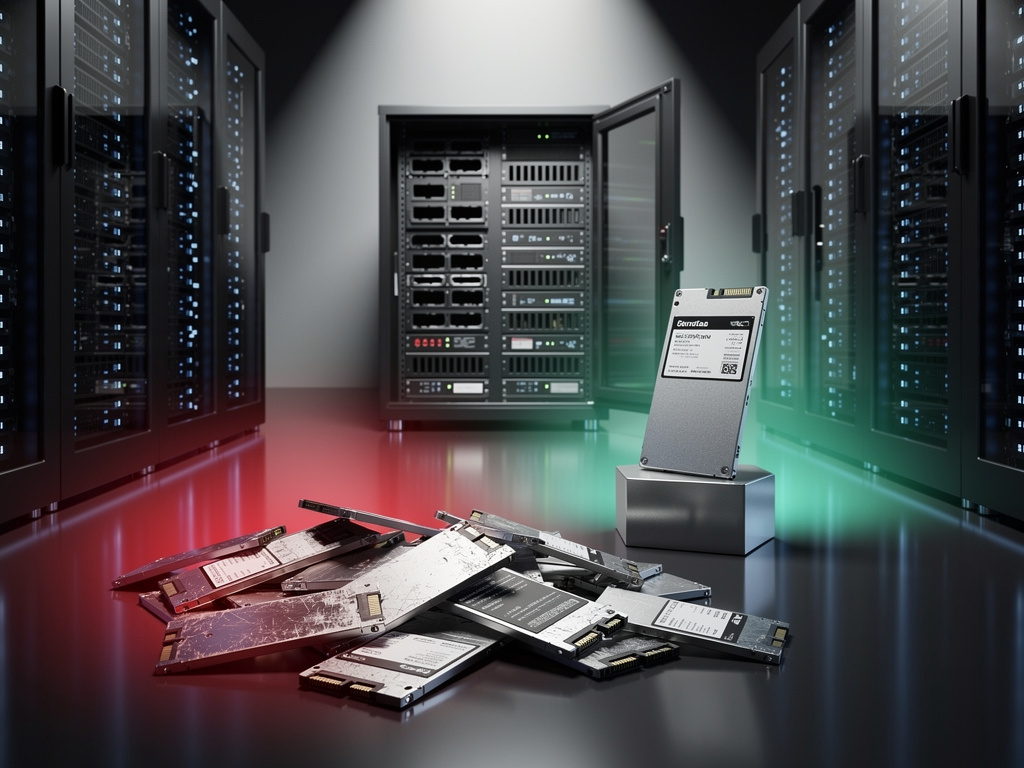
The Perils of Penny-Pinching: Why Recycling Enterprise SSDs Could Spell Disaster for Data Centers
In the high-stakes world of enterprise storage, where every byte counts and downtime can cost millions, a recent caution from a Dell executive has sent ripples through the industry. Darrel Ward, senior vice president of storage platforms at Dell Technologies, has issued a stark warning against the practice of recycling solid-state drives (SSDs) in mission-critical environments. This advice comes amid a global shortage of flash memory, driven by surging demand from artificial intelligence applications and data-intensive workloads. Ward’s comments, highlighted in a report from TechRadar, underscore the risks of repurposing drives that may have already endured heavy use, potentially leading to catastrophic data loss.
The shortage of NAND flash, the core component of SSDs, has been exacerbated by the explosion in AI training and inference tasks, which require vast amounts of high-speed storage. Enterprises are scrambling to secure supplies, with prices skyrocketing and lead times extending into months. In this environment, some organizations are turning to reclaimed or refurbished SSDs to cut costs and meet immediate needs. However, Ward argues that such measures are ill-advised for workloads where reliability is paramount, such as financial transactions, healthcare databases, and real-time analytics.
Drawing from industry insights, the warning aligns with broader trends in storage management. A piece from Blocks & Files details how Dell is advising against reclaiming installed SSDs for reuse, emphasizing that data integrity could be compromised. This isn’t just theoretical; real-world failures have demonstrated the fragility of overused flash media, where wear-leveling algorithms can only mitigate so much before endurance limits are reached.
The Flash Crunch: Supply Chain Strains and Enterprise Dilemmas
The roots of the current flash shortage trace back to production constraints and geopolitical tensions affecting semiconductor manufacturing. Major suppliers like Samsung, Micron, and Kioxia have faced disruptions, while demand from hyperscalers building out AI infrastructure has outpaced capacity expansions. Enterprises, caught in the middle, are exploring alternatives like quad-level cell (QLC) drives for higher density, but these come with their own trade-offs in performance and longevity.
Ward’s perspective is particularly pointed: recycling SSDs might seem like a savvy cost-saving move, but it flies in the face of the reliability demands of modern applications. “It’s exactly the opposite of what AI and mission-critical workloads require,” he stated, as reported in the TechRadar article. The potential for sudden failures increases exponentially with reused drives, especially in arrays handling petabytes of data where a single point of failure can cascade into widespread outages.
Industry observers on platforms like X have echoed these concerns. Posts from technology enthusiasts and IT professionals highlight anecdotal evidence of SSD failures in recycled setups, with one user noting how refurbished drives led to unexpected data corruption in a mid-sized data center. These sentiments reflect a growing wariness, as businesses weigh short-term savings against long-term risks.
Experts point to the technical underpinnings of SSD wear. Each flash cell has a finite number of program/erase cycles—typically 3,000 to 5,000 for enterprise-grade TLC NAND—after which error rates climb dramatically. Reusing drives without thorough vetting can introduce hidden defects, as prior usage patterns aren’t always transparent. Dell’s own updates to its PowerStore platform, including new 30TB QLC drives, aim to address capacity needs without resorting to reclamation, according to a report from Data Center Dynamics.
Security vulnerabilities add another layer of complexity. Recent flaws in Dell’s Storage Manager software, patched in late 2025, exposed systems to authentication bypass and unauthorized access, as detailed in a SecPod Blog post. While not directly tied to SSD recycling, these incidents highlight the broader ecosystem risks when hardware and software aren’t meticulously managed.
For mission-critical workloads, the stakes are even higher. In sectors like aviation or energy grids, where data loss could endanger lives, regulatory bodies mandate stringent reliability standards. Recycling SSDs might violate these, inviting audits and penalties. Ward’s warning serves as a reminder that in the pursuit of efficiency, cutting corners on storage can backfire spectacularly.
Beyond the Warning: Strategies for Sustainable Storage
To navigate these challenges, enterprises are adopting multifaceted approaches. One key strategy involves investing in advanced monitoring tools that predict drive failures before they occur. Dell’s PowerProtect suite, enhanced for cyber resilience, offers features like immutable backups and rapid recovery, as outlined in a Dell blog. These tools help mitigate risks associated with any storage medium, including potentially recycled ones.
Diversification of suppliers is another tactic gaining traction. By sourcing from multiple vendors, companies reduce dependency on any single flash producer. Additionally, hybrid storage architectures—combining SSDs with HDDs for less critical data—can alleviate pressure on flash resources. Insights from SSDBuddy‘s 2026 guide emphasize evaluating factors like endurance ratings and thermal performance when selecting industrial SSDs for IoT and enterprise use.
Case studies illustrate the perils vividly. In one instance, a financial firm repurposed SSDs from a decommissioned server farm, only to suffer a multi-hour outage when multiple drives failed simultaneously during peak trading hours. The incident, discussed in various X threads, underscores the domino effect in RAID configurations where correlated failures amplify damage.
Training and best practices play a crucial role too. IT teams are increasingly focusing on data sanitization and certification processes for reused hardware. Organizations like Dell provide guidelines through resources such as the Dell EMC Server Administrator Storage Management User’s Guide, which details health status monitoring for virtual disks.
Yet, not all recycling is doomed. In non-critical applications, such as archival storage or development environments, refurbished SSDs can be viable with proper testing. The key differentiator is workload classification—ensuring that high-stakes operations use fresh, warrantied hardware.
Looking ahead, innovations in storage technology promise relief. Emerging standards like PCIe 5.0 and CXL (Compute Express Link) enable more efficient data handling, potentially extending drive lifespans. Dell’s refreshes to its storage lines, incorporating higher-capacity SSDs and beefed-up security, as covered in another Blocks & Files article from September 2025, signal a proactive stance against shortages.
Industry Ripples: Economic and Operational Impacts
The economic ramifications of SSD recycling risks are profound. Data loss incidents can lead to direct financial hits, from recovery costs to lost revenue. A single major outage might cost upwards of $100,000 per minute for large enterprises, according to industry estimates. Ward’s caution, therefore, isn’t just technical advice but a business imperative.
On X, discussions reveal a mix of skepticism and agreement. Some users argue that with rigorous testing, recycling is feasible, citing successful deployments in budget-constrained settings. Others share horror stories, like arrays failing due to overlooked wear, amplifying the debate on sustainable practices.
Regulatory pressures are mounting as well. In the U.S., frameworks from bodies like NIST emphasize data integrity in critical infrastructure, indirectly discouraging risky cost-cutting. Globally, similar standards in the EU’s GDPR framework penalize negligence in data handling.
To build resilience, companies are turning to AI-driven predictive analytics. Tools that monitor SSD health in real-time, forecasting failures based on usage patterns, are becoming standard. Dell’s Data Protection Suite, promoted for its centralized management of backups, helps ensure compliance and quick restores, as noted in their product page.
Collaboration across the supply chain is essential. Manufacturers are ramping up production, with announcements of new fabs aimed at doubling output by 2027. Meanwhile, enterprises are negotiating long-term contracts to secure allocations, buffering against volatility.
Ultimately, Ward’s warning highlights a pivotal choice: prioritize short-term savings or invest in robust, future-proof storage. As AI workloads continue to evolve, demanding ever-greater speed and capacity, the industry must adapt without compromising on reliability.
Voices from the Field: Real-World Lessons and Future Directions
Frontline IT professionals offer valuable perspectives. In interviews and online forums, many recount experiences where recycled SSDs performed adequately initially but degraded faster than expected under heavy loads. One X post described a scenario where an entire virtual disk array became degraded due to rebuilding failures, mirroring issues in Dell’s documentation.
Educational initiatives are bridging knowledge gaps. Webinars and whitepapers from vendors like Dell emphasize the importance of endurance specifications and proper decommissioning protocols. For instance, the Dell Security Update KB addresses vulnerabilities that could exacerbate hardware risks.
As the shortage persists into 2026, alternative technologies like storage-class memory (SCM) are gaining interest. These promise higher endurance but at a premium cost, potentially reshaping enterprise strategies.
In reflecting on these developments, it’s clear that while recycling offers temptation, the path to data security lies in innovation and caution. Enterprises that heed warnings like Ward’s may avoid the pitfalls that have ensnared others, ensuring their operations remain uninterrupted in an increasingly data-driven world.
The conversation on X continues to evolve, with recent posts praising Dell’s updates to PowerStore for enhancing cybersecurity and file system capabilities. These enhancements, detailed in Data Center Dynamics, position companies to tackle both shortages and threats head-on.
Finally, as the industry moves forward, the emphasis on holistic storage management—encompassing hardware, software, and human factors—will define success. By learning from past missteps and embracing cutting-edge solutions, businesses can safeguard their most valuable asset: data.


 WebProNews is an iEntry Publication