
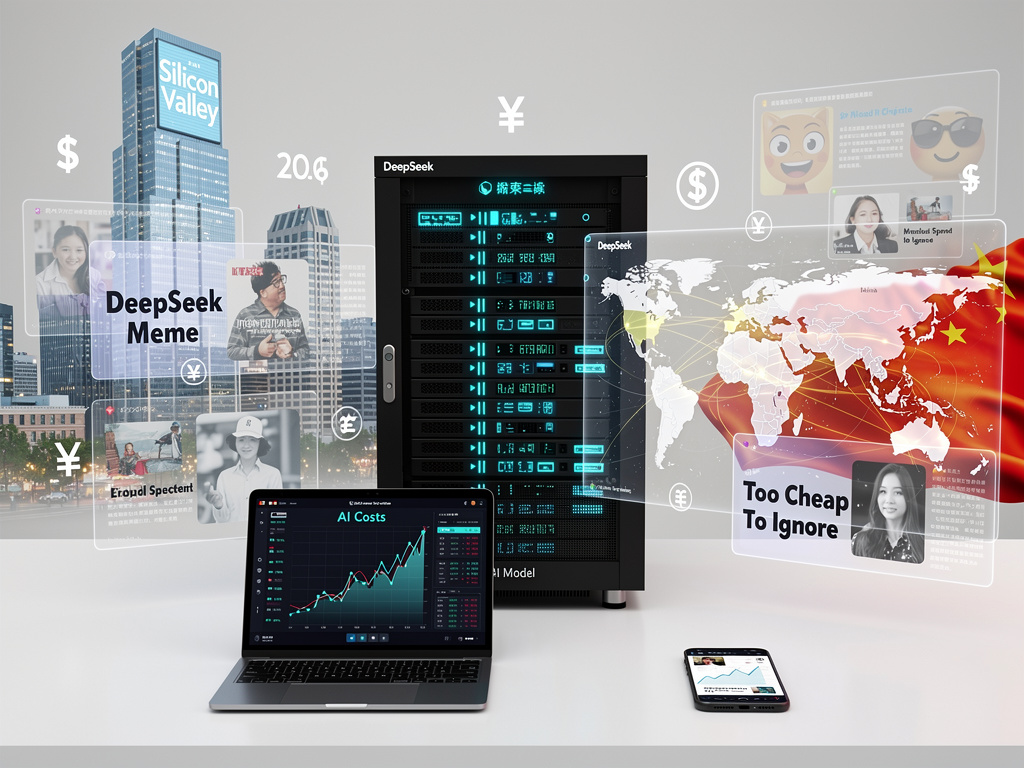
When a relatively obscure Chinese artificial intelligence company manages to simultaneously rattle the stock market, challenge the dominance of American tech giants, and spawn an avalanche of internet memes, something extraordinary is happening. DeepSeek, the Hangzhou-based AI lab, has accomplished all three in a matter of weeks — a feat that speaks to both the genuine technical achievement behind its models and the cultural moment in which it arrived.
The company’s open-source AI models, particularly DeepSeek-R1 and its successor variants, have forced a reckoning across the technology industry. But while boardrooms in San Francisco and Washington scramble to assess the competitive implications, ordinary internet users have responded in the most human way possible: by making jokes about it.
The Technical Shock That Rattled Wall Street
DeepSeek first captured serious attention in late January 2025 when it released its R1 reasoning model, which demonstrated performance comparable to OpenAI’s most advanced offerings — at a fraction of the reported cost. The company claimed it had trained the model for roughly $5.6 million, a figure that, if accurate, would represent a dramatic departure from the hundreds of millions of dollars American companies have been spending on comparable systems. The announcement triggered a massive sell-off in technology stocks, with Nvidia alone losing nearly $600 billion in market capitalization in a single day, the largest single-day loss for any company in U.S. stock market history.
The implications were immediate and far-reaching. If frontier AI models could be built without the most advanced chips and without the enormous capital expenditure that had become the industry’s baseline assumption, then the investment thesis underpinning much of the AI boom would need serious revision. As MSN reported, DeepSeek was “conquering the AI world” — and doing so with a speed that left many industry observers stunned.
A Meme Machine as Much as a Model Machine
But for millions of internet users, the DeepSeek story was less about transformer architectures and inference costs than it was about comedy. As the MSN article documented, the internet responded to DeepSeek’s sudden prominence with a torrent of memes — at least 30 notable examples circulated widely across social media platforms including X, Reddit, and Instagram. The humor ranged from poking fun at Silicon Valley’s panic to imagining the reactions of OpenAI CEO Sam Altman upon learning that a Chinese competitor had matched his company’s output at a tiny fraction of the price.
One widely shared meme depicted American tech executives sweating nervously as DeepSeek’s download numbers climbed. Another showed a comedic comparison between the lavish spending of U.S. AI labs and DeepSeek’s apparently lean operation. The jokes captured a genuine undercurrent of public sentiment: after years of hearing that AI development required tens of billions of dollars in infrastructure, here was a company that seemed to have found a shortcut. Whether or not the full picture was that simple, the narrative was irresistible.
The Open-Source Strategy That Changed the Conversation
Part of what made DeepSeek’s rise so disruptive was its decision to release its models as open-source software. Unlike OpenAI, which has moved increasingly toward a closed, commercial model, or Google, which guards its most powerful systems behind API access, DeepSeek made its weights freely available. This allowed developers, researchers, and hobbyists around the world to download, modify, and deploy the models on their own hardware.
The open-source approach generated enormous goodwill in the developer community and accelerated adoption far beyond what a proprietary release could have achieved. Within days of its release, DeepSeek’s app topped the Apple App Store download charts in the United States, overtaking ChatGPT — a symbolic milestone that generated its own wave of headlines and, naturally, more memes. The app’s popularity was not merely a curiosity; it represented a genuine shift in user behavior, as millions of people chose to try a Chinese-made AI assistant for the first time.
Washington’s Response: Between Admiration and Alarm
The political reaction in the United States was swift and predictable. Lawmakers who had already been concerned about China’s AI ambitions seized on DeepSeek as evidence that U.S. export controls on advanced semiconductors were either insufficient or, paradoxically, had spurred Chinese engineers to innovate around the restrictions. The Biden administration had imposed sweeping chip export controls in October 2022, updated them in 2023, and the Trump administration continued to tighten them into 2025. DeepSeek’s achievements raised uncomfortable questions about whether these measures were working as intended.
Some analysts argued that the restrictions had, in effect, forced Chinese AI researchers to become more efficient — to do more with less. DeepSeek’s engineers reportedly used Nvidia’s H800 chips, a less powerful variant specifically designed to comply with export restrictions, rather than the cutting-edge H100s available to American firms. If the company’s benchmarks were to be believed, the efficiency gains were remarkable. Others cautioned that DeepSeek’s cost claims might not tell the full story, noting that the company is backed by the Chinese quantitative hedge fund High-Flyer, which had previously amassed a significant stockpile of advanced chips before the export controls took effect.
Silicon Valley’s Internal Reckoning
Inside the major American AI companies, the response to DeepSeek was a mixture of respect, skepticism, and urgency. OpenAI reportedly accelerated certain product timelines in response. Meta’s Mark Zuckerberg, who had already committed to an open-source AI strategy with the Llama model family, pointed to DeepSeek as validation that open-source development was a viable path — while also acknowledging the competitive pressure it created. Nvidia CEO Jensen Huang attempted to calm investors by arguing that DeepSeek’s success actually demonstrated growing demand for AI compute, since more efficient models would lead to broader adoption, which would in turn require more chips.
Not everyone was convinced by Huang’s argument. The market’s initial reaction suggested that investors, at least temporarily, feared that the era of limitless AI infrastructure spending might be drawing to a close. If models could be trained cheaply and run efficiently on less powerful hardware, the case for spending $100 billion or more on data centers — as Microsoft, Google, and Amazon had each signaled they intended to do — became harder to justify. The debate over AI capital expenditure, which had been simmering for months, was suddenly front and center.
The Memes Tell a Deeper Story
The viral humor surrounding DeepSeek was more than just internet noise. Memes have become a primary way that complex technological and economic stories are processed and disseminated by the general public. The jokes about DeepSeek — comparing it to a scrappy underdog defeating a bloated incumbent, or imagining panicked boardroom meetings at OpenAI — reflected a broader skepticism about the American tech industry’s spending habits and a certain delight in seeing established players caught off guard.
As MSN’s coverage of the meme phenomenon illustrated, the internet’s comedic response also served as a form of democratized commentary. When a meme shows Sam Altman looking nervously at a DeepSeek logo, it distills months of industry analysis into a single image. When another meme jokes about American AI companies burning through billions while DeepSeek operates on what appears to be a shoestring budget, it captures a real tension in the market that formal reporting sometimes struggles to convey with the same immediacy.
Censorship Concerns and Geopolitical Baggage
For all the enthusiasm, DeepSeek has not been without controversy. Researchers quickly discovered that the model’s responses were filtered on topics sensitive to the Chinese government, including questions about Tiananmen Square, Taiwan’s political status, and the treatment of Uyghur Muslims in Xinjiang. When asked about these subjects, DeepSeek’s model would either deflect, provide answers aligned with Chinese Communist Party positions, or refuse to respond altogether.
These censorship issues raised significant concerns about the model’s suitability for use in contexts where unfiltered information is expected. Several governments, including Italy and Australia, moved to restrict or investigate DeepSeek’s use on government devices. The U.S. Navy issued guidance prohibiting personnel from using the app. Privacy advocates also flagged concerns about user data being stored on servers in China, subject to Chinese data laws that could compel disclosure to government authorities.
What Comes Next for the Industry and the Internet
DeepSeek’s emergence has accelerated a set of questions that the AI industry was already grappling with: How much does it really cost to build a world-class AI model? Is the massive capital expenditure race sustainable? And can open-source development keep pace with — or even outrun — proprietary efforts backed by the world’s richest companies?
The memes will continue, of course. They always do when a story is this rich with irony and drama. But beneath the humor lies a serious inflection point for the global technology industry. DeepSeek has demonstrated that the barriers to building competitive AI systems may be lower than previously assumed, and that innovation can emerge from unexpected places and under unexpected constraints. Whether the company can sustain its momentum, overcome the geopolitical headwinds it faces, and continue to deliver models that match or exceed those of its American rivals remains an open question. What is no longer in question is that DeepSeek has already changed the terms of the debate — and given the internet some of its best material in years.


 WebProNews is an iEntry Publication