
DeepSeek built its name on doing more with less. The Chinese startup’s models delivered performance that matched or beat top American systems. They did so at a fraction of the cost. Markets trembled. Nvidia lost hundreds of billions in a single session after the debut of DeepSeek’s R1 reasoning model in early 2025.
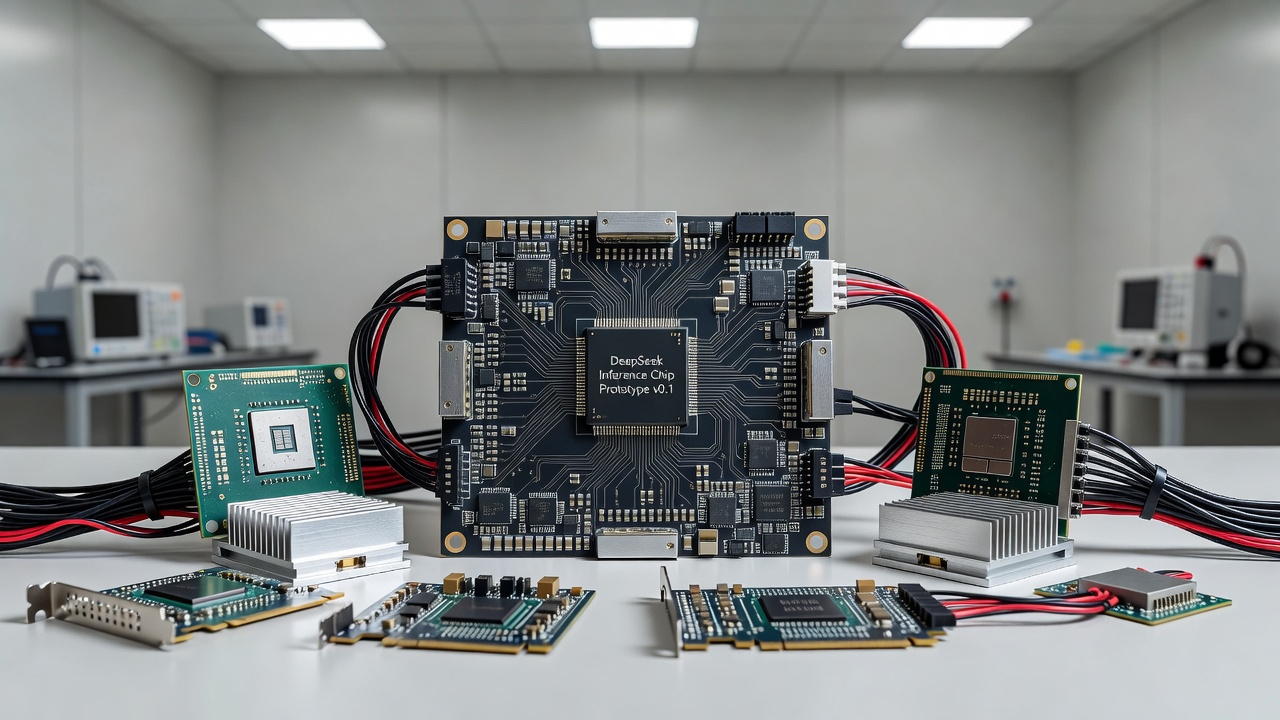
Now the company wants control over the silicon itself. On Tuesday, Reuters reported that DeepSeek has begun developing its own AI chip. Three people familiar with the matter described an effort focused on inference. That is the process where trained models generate answers for users. The project started about a year ago. It remains early stage.
The Hangzhou-based firm has quietly ramped up hiring of chip-design engineers. No public postings appeared on hiring sites. DeepSeek also reached out to partners in chip design, foundries and memory. All three sources spoke on condition of anonymity because the information is not public. DeepSeek did not respond to requests for comment.
From Model Efficiency to Hardware Ambition
This marks a sharp turn. DeepSeek long focused on software breakthroughs over commercialization. Its V3 model trained on 2,048 Nvidia H800 chips, according to the company’s paper. Later versions leaned on Huawei hardware. In April 2026, DeepSeek released V4 optimized for Huawei’s Ascend chips. Huawei said its Ascend SuperPoD products supported the V4 series. Orders for Huawei’s Ascend 950 processors jumped among Chinese tech giants like ByteDance, Tencent and Alibaba.
Yet reliance on others carries risks. U.S. export controls bar China’s access to Nvidia’s most advanced processors. Huawei dominates roughly half of China’s $50 billion domestic AI chip market thanks to those restrictions. But even Huawei lags Nvidia’s best by a wide margin. Alibaba and Baidu now develop their own chips and erode Huawei’s position.
DeepSeek’s move follows a clear logic. Inference represents the fastest-growing slice of AI compute demand. As applications proliferate, the work shifts from expensive training runs to running models at scale. Specialized inference chips can prove cheaper and less power-hungry than general-purpose GPUs. An in-house option would give DeepSeek greater control over performance, cost and supply.
The company already showed what efficiency looks like. Its models used clever architectural choices. Mixture-of-Experts designs helped. So did hardware-aware optimizations and low-precision formats. One South China Morning Post article from August 2025 noted DeepSeek’s V3.1 hint about “home-grown chips to be released soon.” The firm tied the model to a UE8M0 FP8 scale. That format cuts memory needs by up to 75 percent in some cases. No vendor details emerged then. But the message was clear. China aims for a self-sufficient stack.
DeepSeek’s founder, Liang Wenfeng, spoke openly in a 2024 Chinese media interview. Chip export controls posed a real challenge. SemiAnalysis previously estimated DeepSeek’s parent High-Flyer holds around 50,000 Hopper-generation GPUs. That mix includes H100s, H800s, H20s and older A100s. Training costs stayed remarkably low. One claim put R1 development at just millions of dollars. Debates continue over exact figures and whether experiments or fine-tuning added hidden expenses. The CSIS analysis from April 2025 stressed that DeepSeek’s reported $5.576 million for V3 covered only the final pretraining run on H800s.
But the results spoke volumes. DeepSeek’s open-weight releases let anyone run the models. Costs ran far below OpenAI or Anthropic equivalents. A New York Times report from May 2026 called the Huawei optimization a milestone in Beijing’s push for independence. It weakens U.S. leverage. Washington can restrict Nvidia exports. Chinese labs adapt anyway.
And the trend spreads. OpenAI unveiled its Jalapeno custom inference chip last month, built with Broadcom. Anthropic weighs its own designs. Google, Amazon and Meta already run custom silicon. Every major AI player seeks to loosen Nvidia’s grip. Nvidia’s valuation sits near $4.75 trillion. That assumes the company stays indispensable.
DeepSeek’s chip effort faces steep hurdles. Designing competitive AI silicon demands years and heavy capital. U.S. rules block access to leading-edge overseas foundries. High-bandwidth memory remains constrained. Those components matter especially for inference. Success is no sure thing. Analyst Richard Windsor of Radio Free Mobile told Reuters that Nvidia stays at zero in China regardless. DeepSeek’s chips would likely stay domestic too without advanced manufacturing access.
Still, the timing carries weight. DeepSeek reversed its long-standing aversion to outside funding. It now seeks to raise $7 billion at a $52 billion to $59 billion valuation, per earlier Reuters reporting. The money would fuel hardware ambitions. The firm that once rejected external capital now needs it for silicon.
Recent market moves reflect the pressure. Nvidia shares slipped about 1.6 percent in premarket trading after the news broke. Broader semiconductor names felt the heat too. Yet demand for AI compute shows no signs of fading. Cloud providers report strong growth. Data center buildouts continue at pace.
China’s domestic chipmakers gain ground. The “four dragons” — Moore Threads, MetaX, Biren and Enflame — pushed forward with listings or filings. Huawei’s Ascend line improved through direct collaboration with labs like DeepSeek. One Asia Financial report from April 2026 detailed how V4 runs on both Nvidia and Huawei silicon. That flexibility matters under sanctions.
DeepSeek’s bet goes beyond one company. It signals a broader fragmentation in AI hardware. Models once trained exclusively on restricted U.S. chips now run on domestic alternatives. Inference chips could accelerate that shift. They target the part of the workload that touches end users most directly. Lower costs there could reshape pricing across AI services.
Questions remain. How quickly can DeepSeek deliver a competitive chip? Will it match the efficiency gains seen in its software? Partnerships with foundries will prove decisive. Memory constraints could limit performance. And U.S. policy may tighten further in response.
One thing looks certain. The assumption that export controls would hand the United States permanent dominance no longer holds. DeepSeek proved models could match frontier performance under constraints. Now it tests whether the same efficiency mindset can extend to hardware. The AI race just gained another dimension. Software alone no longer suffices. Control of the full stack matters more than ever.
Industry watchers will track every quiet hire and partnership. DeepSeek stays low profile. Its impact does not. From viral models that rattled Wall Street to silicon designs that could reshape supply chains, the startup keeps forcing recalibrations in Silicon Valley and Washington alike.


 WebProNews is an iEntry Publication