
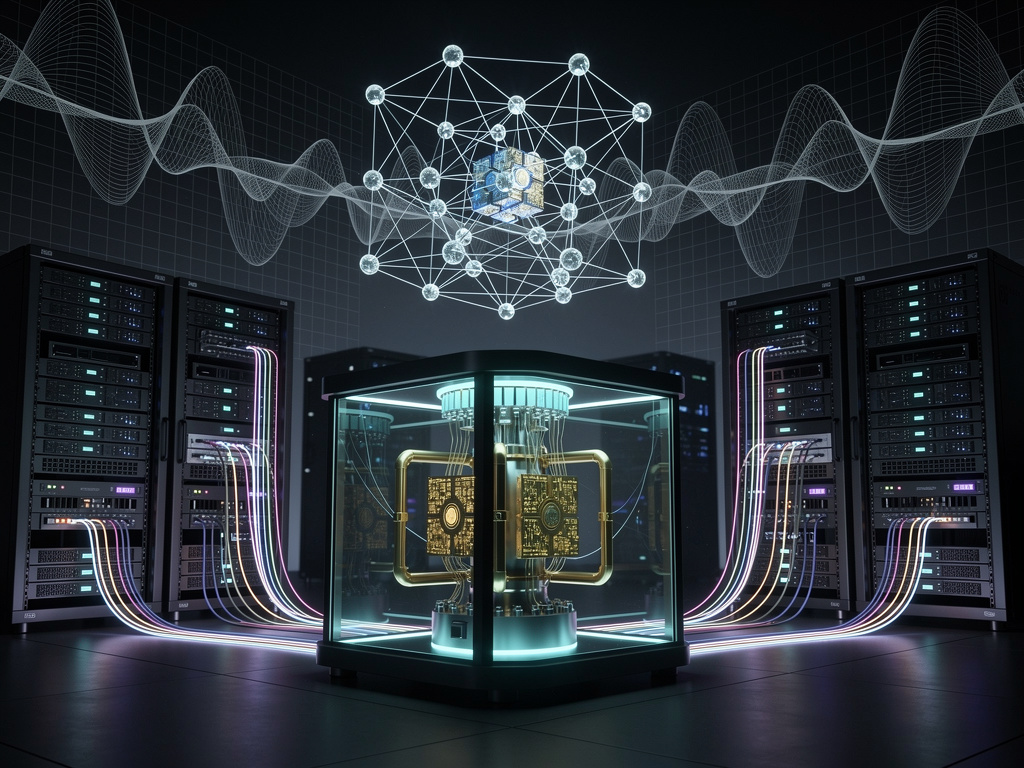
In the high-stakes sector of quantum computing, the battle has shifted from merely increasing the number of qubits to ensuring those qubits actually work. For years, the industry has been plagued by "noise"—the tendency for quantum bits to lose their state due to microscopic interference. This week, researchers at Google DeepMind published findings in Nature that suggest artificial intelligence may be the missing component required to stabilize quantum processors. Their new system, AlphaQubit, applies the same transformer architecture found in large language models to the physics of quantum error correction, reportedly outperforming current industry standards in identifying and neutralizing computational faults.
The significance of this development cannot be overstated for investors and insiders tracking the trajectory of fault-tolerant quantum computing. While competitors like IBM and Quantinuum have focused heavily on hardware fidelity and logical qubit construction, DeepMind’s approach suggests that software—specifically advanced machine learning—can compensate for hardware imperfections. This hybrid approach could accelerate the timeline for commercial viability, moving the goalposts for pharmaceutical simulations and materials science breakthroughs that rely on sustained, error-free quantum calculations.
The Persistent Bottleneck of Quantum Decoherence
To understand the value of AlphaQubit, one must examine the fundamental fragility of the hardware. Quantum computers rely on qubits that exist in a state of superposition, but these states are notoriously volatile. A minor fluctuation in temperature or electromagnetic radiation causes decoherence, destroying the calculation. The industry standard solution is the "surface code," a method where many physical qubits act together to form a single, reliable "logical" qubit. However, this requires a decoder—a system that monitors the physical qubits and interprets their errors in real-time.
Standard decoders rely on statistical matching algorithms. They are fast but often struggle with complex, correlated errors where a fault in one qubit triggers faults in neighbors. According to the Google DeepMind report, AlphaQubit departs from these statistical methods. Instead, it treats the error data coming from the quantum processor as a language. Just as ChatGPT predicts the next word in a sentence, AlphaQubit predicts the most likely error based on the "syntax" of the quantum noise. In tests on Google’s Sycamore processor, the AI system reduced the error rate significantly compared to the leading tensor-network decoders.
Transformers Applied to Quantum Physics
The technical architecture of AlphaQubit utilizes a two-stage transformer model. The first stage takes the raw syndrome data—the measurements indicating something went wrong—and processes it to understand the temporal and spatial relationships of the errors. The second stage predicts the specific correction needed. This ability to learn the "fingerprint" of a specific machine is critical. Every quantum processor has unique defects; AlphaQubit adapts to the specific quirks of the Sycamore chip it runs on, effectively learning to navigate the hardware’s specific flaws better than a generic algorithm could.
This adaptability presents a distinct advantage for scaling. As manufacturers build larger chips, the complexity of crosstalk—interference between qubits—grows exponentially. A static algorithm struggles to account for these shifting variables. A learning model, conversely, can be retrained as the hardware evolves. TechCrunch notes that this capability effectively allows Google to squeeze higher performance out of existing hardware, potentially saving millions in fabrication costs by mitigating the need for theoretically perfect manufacturing.
Implications for the Commercial Quantum Timeline
For the financial sector and industrial conglomerates waiting to deploy quantum algorithms for portfolio optimization or nitrogen fixation, AlphaQubit represents a shift in the roadmap. The prevailing assumption was that fault tolerance would require millions of physical qubits, a hardware challenge that pushes commercial timelines into the 2030s. If AI decoding can lower the threshold for error correction, useful logical qubits might be achieved with smaller, noisier processors. This aligns with recent movements by Microsoft and Quantinuum, who recently demonstrated highly reliable logical qubits using a different hardware approach.
However, the integration of AI decoders introduces a new latency challenge. Neural networks are computationally heavy. A quantum computer operates in microseconds; if the AI decoder takes milliseconds to process the error, the calculation will have already collapsed before the correction is applied. DeepMind acknowledges this speed limit. While AlphaQubit is accurate, it is currently too slow for real-time correction in a live loop. The current research proves the accuracy of the method, but the engineering challenge now shifts to accelerating the inference speed of the model, perhaps through specialized ASIC hardware similar to Google’s TPU infrastructure.
The Competitive Sector and Hardware Agnosticism
The broader market implications extend beyond Google. If transformer-based decoding becomes the standard, it places a premium on proprietary training data. Companies with the largest, most active quantum processors will generate the most error data, allowing them to train superior decoders. This creates a flywheel effect that could disadvantage smaller startups that lack the hardware volume to train competitive models. Furthermore, while AlphaQubit was tested on superconducting qubits (Google’s chosen modality), the underlying principle of treating errors as a sequence prediction problem is theoretically applicable to trapped-ion systems (IonQ) or neutral atom computers (Pasqal).
Investors should monitor how quickly this software layer matures. The separation between hardware and software in quantum computing is blurring. Just as NVIDIA’s CUDA platform became as valuable as its GPUs, the software stack that manages quantum errors may eventually command as much value as the quantum processors themselves. The publication in Nature serves as a validation of the methodology, but the true test will be the integration of this system into the commercial cloud offerings of Google Cloud Quantum in the coming years.


 WebProNews is an iEntry Publication