
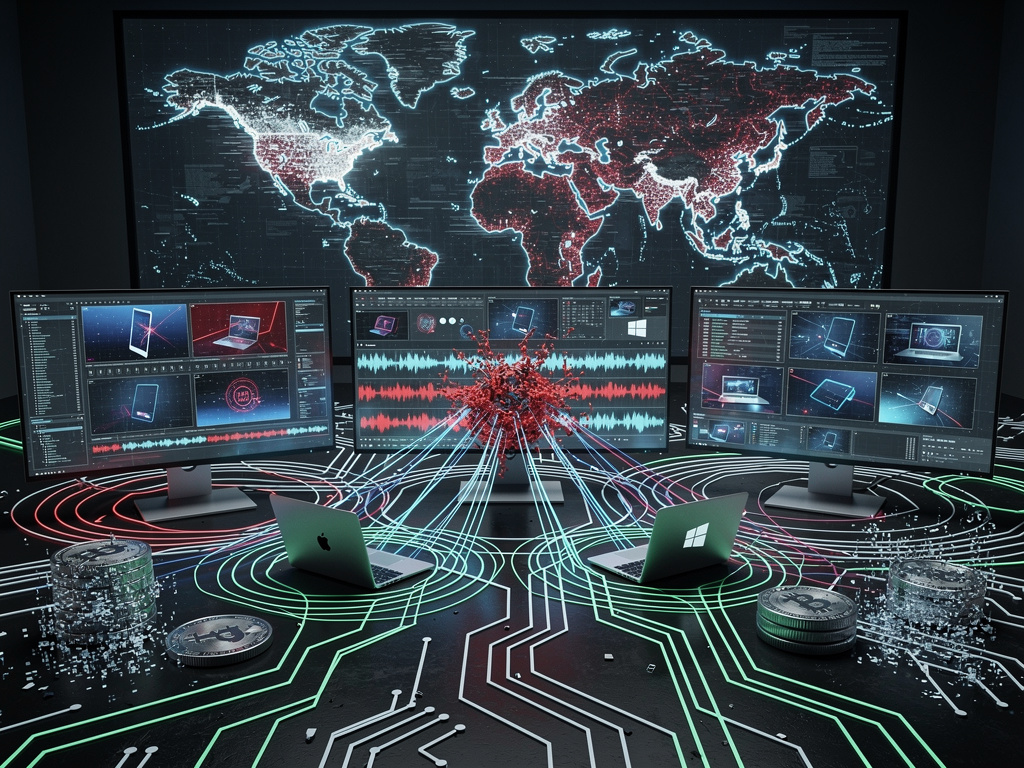
In what cybersecurity researchers are calling one of the most creative social engineering campaigns to date, North Korean state-linked hackers have begun deploying artificial intelligence-generated video content as a lure to distribute malware targeting both macOS and Windows systems. The campaign, attributed to a threat group with ties to Pyongyang, represents a troubling evolution in how nation-state actors are leveraging generative AI tools not just for disinformation, but as a direct vector for cyberattacks against individuals and organizations worldwide.
The scheme, first detailed by cybersecurity researchers, uses convincing AI-generated video presentations — often mimicking legitimate corporate communications or investment briefings — to trick targets into downloading malicious payloads. The approach marks a significant departure from traditional phishing methods that rely primarily on text-based emails and fraudulent documents, signaling that adversaries are rapidly incorporating the latest AI capabilities into their offensive toolkits.
A Campaign Built on Synthetic Trust
According to reporting by TechRadar, the campaign has been linked to North Korean threat actors who have a well-documented history of conducting financially motivated cyber operations to fund the regime’s weapons programs and circumvent international sanctions. What sets this latest operation apart is its use of AI-generated video content — synthetic media that appears to show real people delivering presentations or pitches — as the primary mechanism for building trust with potential victims.
The attackers reportedly craft scenarios designed to appeal to specific targets, including cryptocurrency investors, software developers, and professionals in the financial technology sector. Victims are approached through social media platforms, professional networking sites, or messaging applications and directed to view what appears to be a legitimate video briefing. The video content, generated using increasingly accessible AI tools, is polished enough to pass casual scrutiny, lending an air of authenticity that a simple phishing email could never achieve.
Cross-Platform Malware Delivery: No Operating System Is Safe
One of the most alarming aspects of the campaign is its cross-platform nature. The threat actors have developed malware payloads capable of infecting both macOS and Windows machines, ensuring that virtually no target is out of reach regardless of their operating system preference. This dual-platform approach reflects a broader trend among sophisticated threat groups that recognize the growing market share of Apple devices in corporate and developer environments.
For Windows targets, the malware typically arrives disguised as a software installer or a document viewer required to access the purported video content. On macOS, the attackers have employed similarly deceptive techniques, packaging their payloads in ways that circumvent Apple’s Gatekeeper security features or exploit user willingness to override security warnings. Once installed, the malware can steal credentials, cryptocurrency wallet keys, browser session data, and other sensitive information — all of which can be monetized or leveraged for further intrusion operations.
The Lazarus Group’s Expanding Playbook
North Korea’s cyber operations have long been associated with the Lazarus Group and its various sub-clusters, which have been responsible for some of the most high-profile cyberattacks of the past decade, including the 2014 Sony Pictures hack, the 2017 WannaCry ransomware outbreak, and the theft of hundreds of millions of dollars in cryptocurrency from decentralized finance platforms. The use of AI-generated video content represents the latest chapter in an ever-expanding playbook that has consistently demonstrated a willingness to adopt new technologies and techniques.
Security researchers have noted that North Korean hackers have been early adopters of social engineering tactics targeting the cryptocurrency and Web3 sectors. Previous campaigns have involved elaborate fake job offers, counterfeit venture capital firms, and even compromised open-source software packages distributed through legitimate developer repositories. The addition of AI-generated video to this arsenal suggests that the regime’s cyber units are investing in generative AI capabilities and studying how to deploy them for maximum effect.
Why AI-Generated Video Is Particularly Dangerous
The use of synthetic video as a social engineering tool is particularly insidious because it exploits a fundamental human tendency to trust visual and auditory information more than text alone. A well-crafted AI-generated video of a seemingly real person delivering a business pitch or technical presentation can create a powerful sense of legitimacy that overrides the skepticism many users have learned to apply to suspicious emails or messages.
As generative AI tools have become more accessible and capable over the past two years, the barrier to creating convincing synthetic media has dropped dramatically. Tools that once required significant technical expertise and computational resources are now available as consumer-grade applications, meaning that even modestly resourced threat actors can produce video content that would have been virtually impossible to create just a few years ago. For a state-sponsored group with dedicated resources, the quality of output can be exceptionally high.
The Broader Threat of AI-Powered Social Engineering
This campaign does not exist in isolation. Across the cybersecurity industry, researchers and analysts have been warning about the growing use of AI in offensive operations. From AI-generated phishing emails that are grammatically flawless and contextually appropriate to deepfake audio used in business email compromise schemes, the integration of artificial intelligence into the attacker’s toolkit is accelerating at a pace that defensive technologies are struggling to match.
Earlier this year, multiple reports documented instances of North Korean operatives using AI-generated identities — complete with fabricated LinkedIn profiles, AI-generated headshots, and synthetic resumes — to secure remote employment at Western technology companies. These infiltration campaigns, which have been the subject of FBI warnings and Department of Justice indictments, serve the dual purpose of generating revenue for the regime and providing insider access to corporate networks. The use of AI-generated video in malware delivery campaigns is a natural extension of these tactics.
Defending Against Synthetic Media Attacks
For organizations and individuals, defending against this type of threat requires a multi-layered approach that combines technical controls with heightened awareness. Security experts recommend treating unsolicited video content with the same suspicion typically reserved for unexpected email attachments or links. Verifying the identity of anyone requesting a software download or presenting investment opportunities through independent channels — rather than relying solely on the content of the video itself — is essential.
On the technical side, organizations should ensure that endpoint detection and response (EDR) solutions are deployed across all platforms, including macOS, which has historically received less security attention than Windows in many enterprise environments. Keeping operating systems and security tools updated, enforcing application allowlisting, and implementing robust multi-factor authentication can all help mitigate the risk of credential theft even if a user is initially deceived by a social engineering attack.
A Warning Shot for the Technology Industry
The campaign also raises urgent questions for the technology industry and policymakers about the dual-use nature of generative AI tools. While these technologies offer enormous benefits for legitimate applications — from content creation to accessibility — their potential for abuse in cyberattacks, disinformation, and fraud is becoming increasingly apparent. The cybersecurity community has called for greater investment in deepfake detection technologies, improved platform-level safeguards against synthetic media abuse, and international cooperation to hold state-sponsored threat actors accountable.
As TechRadar reported, this latest campaign underscores the reality that nation-state cyber threats are not static — they evolve in lockstep with technological advancement. North Korea’s willingness to weaponize AI-generated video for malware delivery is a stark reminder that the most dangerous cyber threats are often the ones that exploit not software vulnerabilities, but human psychology. As generative AI continues to mature, the line between authentic and synthetic content will only become harder to discern, making vigilance and skepticism more important than ever for anyone operating in the digital domain.
For now, cybersecurity firms are urging heightened caution for anyone in the cryptocurrency, fintech, and software development sectors — the primary targets of this campaign. The message is clear: if a video seems too polished, an opportunity too good to be true, or a request to download software too convenient, it may well be the product of a North Korean AI lab rather than a legitimate business contact.


 WebProNews is an iEntry Publication