
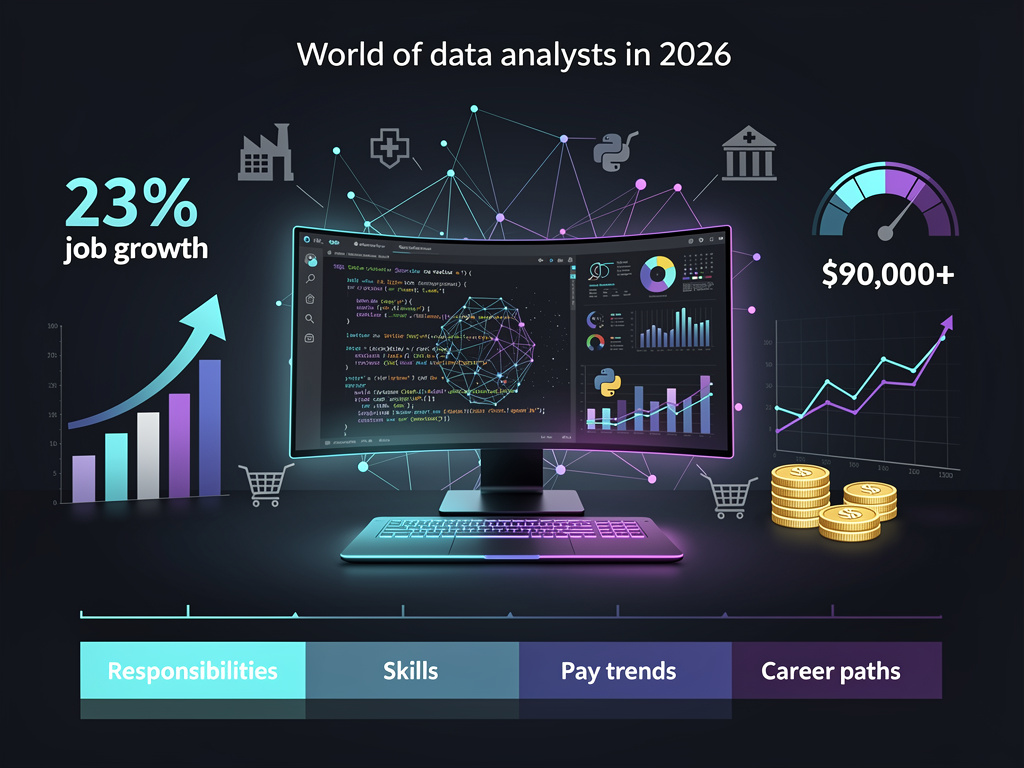
In an era where every corporate decision hinges on data precision, data analysts stand as indispensable architects of strategy. These professionals collect raw information from databases, spreadsheets, and web sources, then cleanse it of errors and inconsistencies to forge reliable foundations for analysis. Their work spans finance, healthcare, and technology sectors, where demand surges far beyond average occupational growth rates.
Day-to-day duties form an iterative cycle: extracting datasets via SQL queries, applying statistical methods to uncover trends and correlations, and crafting visualizations that distill complex findings for executives. As Coursera outlines, analysts translate business challenges into data-driven queries, collaborating across teams to deliver recommendations that directly influence outcomes.
Problem-solving defines the role’s core. Analysts don’t merely report numbers; they probe for underlying causes, validating insights through rigorous statistical checks to ensure accuracy.
Core Technical Arsenal
Proficiency in SQL reigns supreme, enabling efficient data extraction from relational databases—a skill topping 31% of employer demands, per X posts from industry observers like Python Developer. Python and R follow closely at 14% and 10%, respectively, for advanced manipulation and modeling.
Excel and Google Sheets remain foundational for quick pivots and formulas, while BI platforms like Tableau, Power BI, and Looker dominate visualization needs, accounting for 15% of sought-after expertise. Recent X discussions emphasize these tools’ evolution with AI integrations for automated insights.
Statistical acumen underpins it all: understanding distributions, hypothesis testing, and regression to interpret results credibly. As BLS data on related data scientists notes, such knowledge equips analysts to handle growing dataset complexities.
Soft Skills That Seal Deals
Beyond code, analytical thinking drives success—spotting patterns others miss and framing data implications logically. Communication proves equally vital; analysts must convey intricate findings via dashboards and reports to non-technical audiences.
Attention to detail guards against subtle errors, while business savvy aligns analyses with organizational goals. Recruiters prioritize these, as highlighted in X threads by Annie, listing them alongside technical chops for top hires.
Domain knowledge in sectors like finance amplifies impact, turning generic reports into strategic weapons.
Salary Surge and Market Heat
U.S. data analysts command median base pay around $74,000, but 2026 projections paint a hotter picture. Glassdoor pegs typical ranges at $71,715 to $121,094, with Robert Half forecasting starting salaries exceeding $131,000 for seasoned tech specialists boasting certifications.
Entry-level roles hit $90,000 on average, per 365 Data Science analysis of 1,000 postings, up $20,000 from prior years amid 23% BLS-projected growth for data occupations through 2032. Tech and finance lead premiums, with contract gigs offering hourly boosts via flexibility.
Global analytics markets balloon to $133 billion by 2026, per Noble Desktop, fueling 20,800 annual U.S. openings.
AI’s Dual-Edged Evolution
AI automates routine cleaning and basic reporting, shifting analysts toward strategic interpretation and storytelling. Tools like Power BI now embed generative AI for natural language queries, as Splunk forecasts for 2026.
X insights from AnalytixLabs warn routine tasks fade, elevating critical thinking and cross-team collaboration. Yet, Dataryx affirms the role’s viability: “AI isn’t just a future threat it’s altering how analysts work now,” demanding orchestration of AI, data, and business logic.
Upskilling in AutoML and prompt engineering becomes table stakes, boosting pay 10-20% via BI certifications, Robert Half reports.
Climbing the Ladder
Entry as junior analyst evolves to senior roles with 2-4 years, then analytics management. Paths fork to data scientist, BI analyst, or architect, per Pluralsight’s 2026 guide.
Power BI Theme Builder maps progression: advanced DAX/Python at mid-level, team leadership by year seven. Coursera notes data science advances may require master’s degrees, but experience often suffices.
High demand yields stability; Jessup University cites talent shortages ensuring lucrative trajectories.
Entry Strategies for 2026
Build portfolios with 3-5 projects showcasing problem-to-recommendation flows: SQL segmentation, Power BI revenue dashboards. X’s Annie stresses weekly posts, LinkedIn optimization with quantifiable impacts like “Improved reporting speed by 40%”.
Certifications—Google Data Analytics, Tableau Specialist—validate skills. Internships bridge gaps, applying classroom theory to real stakes.
Target 50 weekly applications via LinkedIn, Indeed; practice SQL interviews, dashboard explanations. Remote roles abound, as Minister of Jobs posts demand SQL/Tableau fluency globally.


 WebProNews is an iEntry Publication