
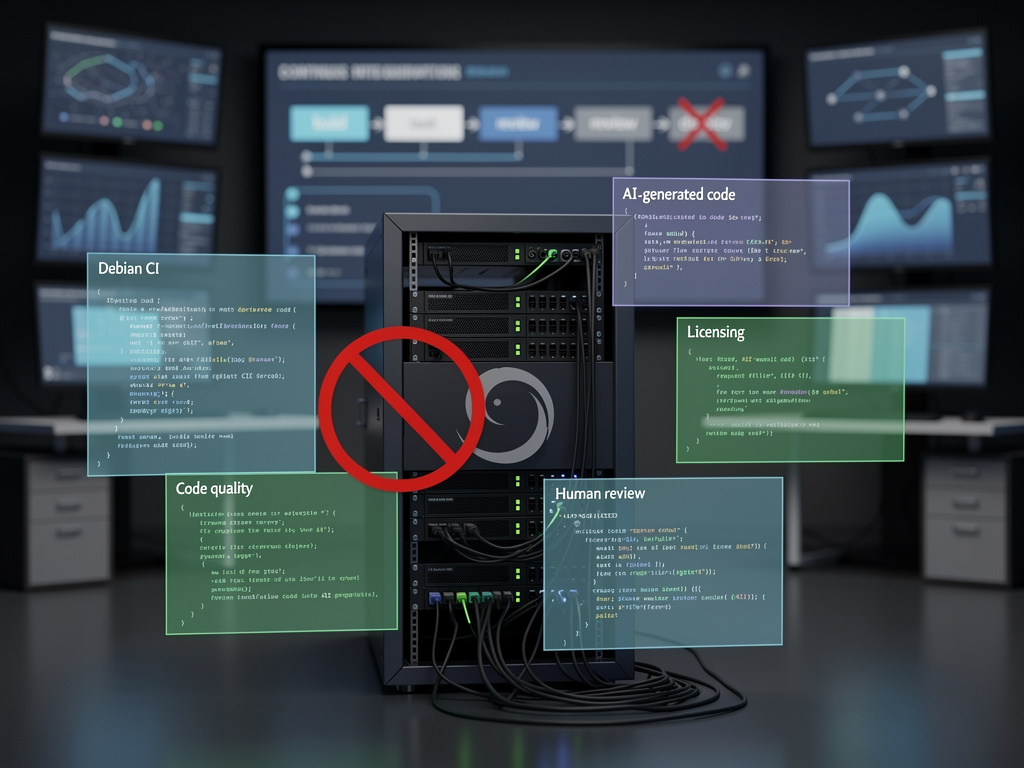
The Debian project, one of the world’s most influential Linux distributions and a cornerstone of open-source software development, has implemented sweeping restrictions on the use of large language models in its continuous integration infrastructure. The decision, which prohibits AI-assisted code generation and testing within Debian’s official CI pipelines, marks a significant departure from the industry’s growing embrace of artificial intelligence tools and raises fundamental questions about code quality, maintainability, and the future direction of community-driven software development.
According to Phoronix, the Debian CI team has formally restricted the use of LLM-generated content in its testing and integration workflows, citing concerns about code reliability, licensing ambiguity, and the potential for introducing subtle bugs that could compromise system stability. The policy represents one of the most conservative stances taken by a major open-source project toward AI assistance, standing in stark contrast to organizations like Microsoft, Google, and Meta that have aggressively integrated AI coding tools into their development processes.
The restrictions specifically target automated code generation, test case creation, and documentation produced by systems like GitHub Copilot, ChatGPT, and other transformer-based models. Debian maintainers expressed particular concern about the opacity of AI-generated code, noting that such contributions often lack the clear provenance and human oversight that have traditionally characterized open-source development. The policy does not completely ban developers from using AI tools in their personal workflows, but it explicitly prohibits submitting AI-generated code to official repositories without substantial human review and modification.
Technical Debt and the Maintainability Crisis
The Debian community’s decision stems from hard-earned lessons about technical debt and long-term maintainability. Unlike commercial software that can be deprecated or rewritten when problems emerge, Debian packages must remain stable and functional for years, often running on critical infrastructure systems worldwide. The distribution’s commitment to backward compatibility and reliability means that any code merged into the project becomes a long-term maintenance obligation for volunteer developers who must understand, debug, and improve it over potentially decades of use.
Debian developers have pointed to specific instances where AI-generated code introduced subtle logic errors that passed initial testing but failed under edge cases or specific hardware configurations. These failures, while not immediately catastrophic, created debugging nightmares for maintainers who struggled to understand the intent behind algorithmically-generated solutions that lacked clear documentation or logical structure. The problem becomes particularly acute in systems programming, where Debian’s core packages operate at low levels of the software stack where errors can cascade into system-wide failures.
Licensing Limbo and Legal Uncertainty
Beyond technical concerns, Debian’s restrictions reflect deeper anxieties about the legal status of AI-generated code. The project has built its reputation on scrupulous attention to software licensing, maintaining detailed records of code provenance and ensuring that every line of code in the distribution complies with the Debian Free Software Guidelines. Large language models, trained on vast repositories of code with varying licenses, introduce fundamental uncertainty about whether their outputs constitute derivative works of copyrighted material.
Recent legal developments have amplified these concerns. Multiple lawsuits against AI companies allege that training models on copyrighted code without explicit permission violates intellectual property rights. While courts have not yet definitively ruled on these questions, Debian maintainers have adopted a precautionary approach, recognizing that the project’s global reach and reliance on volunteer contributions make it particularly vulnerable to licensing disputes. The distribution cannot afford the legal risks associated with potentially contaminated code, especially when the AI companies themselves have provided little clarity about the training data sources or licensing implications of their models’ outputs.
The Software Freedom Conservancy and Free Software Foundation have both issued guidance suggesting caution around AI-generated code in open-source projects, though neither organization has gone as far as Debian in implementing formal restrictions. Their concerns center on the fundamental tension between the transparency principles of free software and the black-box nature of large language models, which cannot explain the origins or reasoning behind their generated code.
Industry Pushback and the Productivity Paradox
Debian’s stance has generated significant controversy within the broader software development community, where AI coding assistants have become increasingly popular. Proponents of these tools argue that they dramatically improve developer productivity, reduce routine coding errors, and allow programmers to focus on higher-level architectural decisions rather than syntax and boilerplate code. Companies like GitHub report that developers using Copilot complete tasks up to 55% faster than those working without AI assistance, suggesting that organizations eschewing these tools may find themselves at a competitive disadvantage.
Critics of Debian’s policy contend that the project risks becoming technologically obsolete by rejecting tools that represent the future of software development. They argue that younger developers, trained with AI assistants from the beginning of their careers, may be less inclined to contribute to projects that prohibit the use of familiar tools. This generational divide threatens to exacerbate existing challenges in recruiting new maintainers for Debian packages, many of which already suffer from understaffing and irregular updates.
The Human Element in Code Review
However, Debian’s defenders emphasize that the restrictions do not represent a blanket rejection of AI technology, but rather an insistence on human accountability in the development process. The policy permits developers to use AI tools for inspiration, initial drafts, or learning purposes, provided that human developers thoroughly review, understand, and take responsibility for any code ultimately submitted to the project. This approach treats AI as a potential aid to human developers rather than a replacement for human judgment and expertise.
The distinction proves crucial in Debian’s volunteer-driven development model. Unlike corporate environments where companies can assign dedicated teams to maintain AI-generated code, Debian relies on individual maintainers who must be able to understand and modify packages independently. Code that reads as idiomatic and comprehensible to human developers becomes essential for knowledge transfer and long-term sustainability. AI-generated code, which often optimizes for functional correctness rather than readability, can create barriers to this collaborative process.
Debian’s emphasis on human-centric development also reflects philosophical commitments that extend beyond mere pragmatism. The project has historically viewed software development as a form of craft and community building, where the process of creating code matters as much as the final product. This perspective values the learning, discussion, and relationship-building that occur during code review and collaborative development—elements potentially diminished when AI systems generate substantial portions of the codebase.
Implications for the Open Source Ecosystem
The Debian decision carries implications far beyond a single Linux distribution. As a foundational project that underpins hundreds of derivative distributions, including Ubuntu, Linux Mint, and countless specialized systems, Debian’s policies influence development practices throughout the open-source world. Packages and practices developed within Debian often propagate to downstream projects, meaning that the CI restrictions could effectively limit AI-generated code across a substantial portion of the Linux ecosystem.
The policy also sets a precedent that other open-source projects may follow, particularly those with similar concerns about long-term maintainability and licensing clarity. Projects like FreeBSD, OpenBSD, and various GNU components face comparable challenges in balancing innovation with stability, and may look to Debian’s approach as a model for managing AI tools in community-driven development. Conversely, projects that embrace AI assistance more enthusiastically may find themselves diverging from Debian’s development culture, potentially creating fragmentation in the open-source community.
The restrictions arrive at a pivotal moment for open-source development, as projects grapple with declining volunteer contributions and increasing complexity in software systems. Some observers worry that overly conservative policies could accelerate the migration of talented developers toward commercial projects that offer more flexible tooling and better compensation. Others counter that maintaining high standards for code quality and transparency remains essential for preserving the trust and reliability that make open-source software valuable in the first place.
The Path Forward for AI-Assisted Development
Looking ahead, Debian’s CI restrictions may prove temporary rather than permanent, contingent on improvements in AI technology and greater clarity around licensing issues. The project has historically adapted its policies as circumstances change, and future developments in AI explainability, provenance tracking, or legal frameworks could address current concerns. Some developers have proposed hybrid approaches, such as requiring AI-generated code to be marked with special annotations or subjected to enhanced review processes, which might satisfy both efficiency and transparency requirements.
The debate also highlights the need for better tools and standards around AI-assisted development. If large language models could provide clear documentation of their reasoning, cite specific training examples that influenced their outputs, or guarantee licensing compliance, many of Debian’s objections might be addressed. AI companies have begun exploring these possibilities, with some developing models trained exclusively on permissively-licensed code or implementing features to track the provenance of generated suggestions.
Ultimately, Debian’s restrictions on LLM use in CI infrastructure represent more than a technical policy decision—they embody a broader philosophical stance about the nature of software development and the values that should guide open-source communities. As AI tools become increasingly sophisticated and ubiquitous, the tension between efficiency and transparency, between automation and human judgment, will likely intensify. How the open-source community resolves these tensions will shape not only the future of projects like Debian, but the fundamental character of collaborative software development in an age of artificial intelligence. The coming years will reveal whether Debian’s conservative approach proves prescient or whether the project must adapt to a world where human and machine contributions become increasingly intertwined.


 WebProNews is an iEntry Publication